Unlock instant, AI-driven research and patent intelligence for your innovation.

Method for detecting content of total organic bromine through catalytic reduction debromination

An organic bromine and organic technology, applied in the field of catalytic reduction debromination determination of total organic bromine content in samples, can solve the problems of inability to distinguish between organic and inorganic bromine special combustion devices, inability to measure, low organic bromine content, etc., and achieves a low detection limit. , low cost, accurate results

Inactive Publication Date: 2019-07-23
HUAZHONG UNIV OF SCI & TECH
View PDF7 Cites 2 Cited by
  • Summary
  • Abstract
  • Description
  • Claims
  • Application Information

AI Technical Summary

Problems solved by technology

[0004] The present invention solves the problem that the organic bromine content in the halogenated flame retardant in the prior art cannot be measured for the lower organic bromine content, and the method of high-temperature pyrolysis cannot distinguish between organic and inorganic bromine and requires a special combustion device and severe high temperature and high pressure conditions technical issues

Method used

the structure of the environmentally friendly knitted fabric provided by the present invention; figure 2 Flow chart of the yarn wrapping machine for environmentally friendly knitted fabrics and storage devices; image 3 Is the parameter map of the yarn covering machine
View more

Image

Smart Image Click on the blue labels to locate them in the text.
Viewing Examples
Smart Image
  • Method for detecting content of total organic bromine through catalytic reduction debromination
  • Method for detecting content of total organic bromine through catalytic reduction debromination
  • Method for detecting content of total organic bromine through catalytic reduction debromination

Examples

Experimental program
Comparison scheme
Effect test

Embodiment 1

[0038] Embodiment 1: A kind of method based on the total organic bromine content in the determination sample of catalytic reduction debromination

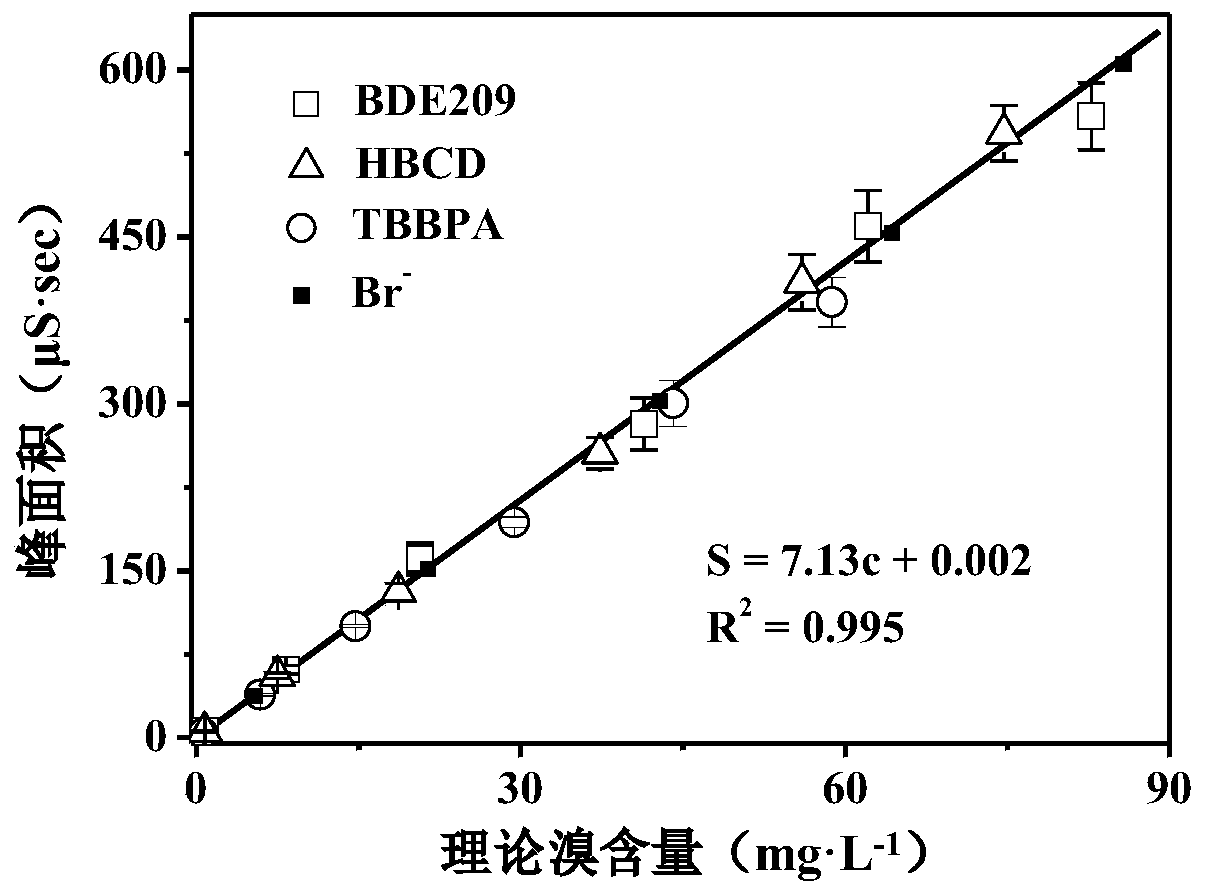
[0039] Step 1: Weigh 10mg Cu / TiO 2 Catalysts were placed in 18 beakers, and 50 mL of methanol solutions of TBBPA, HBCD and BDE209 with mass concentrations of 1, 10, 25, 50, 75 and 100 mg / L were added to them, and dispersed uniformly by ultrasonic. In this way, the reaction solutions at various concentrations were obtained, collected and filtered quickly to obtain the filtrate. Step 2: Under stirring, quickly add hydrazine hydrate to the above 18 parts of the dispersion, and after reacting for 5 minutes, add the same amount of hydrazine hydrate to the dispersion as when adding it for the first time, continue to react for 5 minutes, and then add the same amount as when adding it for the first time The same amount of hydrazine hydrate was added 5 times in total, and the final concentration of hydrazine hydrate added was 1mol L -1 Af...

Embodiment 2

[0040] Embodiment 2: A kind of method based on the total organic bromine content in the determination sample of catalytic reduction debromination

[0041] Step 1: Weigh 10mg TiO respectively 2 Supported nano-Cu catalyst (Cu / TiO 2 , wherein the mass fraction of Cu is 5%) and 45mL of methanol in 5 beakers, and 5mL of 3-bromodiphenyl ether (hereinafter referred to as BDE3), tetrabromobisphenol A (hereinafter referred to as TBBPA), 2,2 ',4,4'-Tetrabromodiphenyl ether (hereinafter referred to as BDE47), hexabromocyclododecane (hereinafter referred to as HBCD) and decabromodiphenyl ether (hereinafter referred to as BDE209) stock solution (1000mg L -1 , for the respective methanol solutions) and ultrasonically disperse evenly, so that the concentration of the catalyst in the dispersion is 0.2g L -1 , the initial concentrations of BDE3, TBBPA, BDE47, HBCD and BDE209 were all 100mg·L -1 .

[0042] Step 2: Under stirring, quickly add hydrazine hydrate to the above 5 parts of the dis...

Embodiment 3

[0043] Embodiment 3: a kind of method based on catalytic reduction debromination determination total organic bromine content in the sample

[0044] Different from Example 2: (1) TiO in step 1 2 Supported nano-Cu catalyst (Cu / TiO 2 , wherein the mass fraction of Cu is 5%) into commercial copper powder; (2) the catalyst mass is increased from 10mg to 100mg, so that the concentration of the catalyst in the dispersion is 2g L -1 (3) get certain reaction solution after adding hydrazine hydrate 5min at every turn in step 2, obtain the reaction solution of 5 stages thus, get filtrate after rapid filtration, then adopt the test method of embodiment 2 to measure its bromide ion concentration respectively, Thereby calculating the debromination rate, the obtained results are as follows image 3 As shown, the histogram represents BDE3, TBBPA, BDE47, HBCD and BDE209 respectively from left to right. image 3 It was shown that BDE3, TBBPA, BDE47, HBCD and BDE209 can be almost completely d...

the structure of the environmentally friendly knitted fabric provided by the present invention; figure 2 Flow chart of the yarn wrapping machine for environmentally friendly knitted fabrics and storage devices; image 3 Is the parameter map of the yarn covering machine
Login to View More

PUM

No PUM Login to View More

Abstract

The invention discloses a method for detecting the content of total organic bromine through catalytic reduction debromination and belongs to the technical field of detection of halogen content controlled by halogenated flame retardants. The method comprises the following steps: extracting brominated organic matters in solid samples; adding a catalyst and a hydrogen donor into an extraction phase or directly adding the catalyst and the hydrogen donor into to-be-detected liquid of liquid containing organic bromine, wherein the hydrogen donor is catalyzed by the catalyst to generate active hydrogen atoms, and the active hydrogen atoms are used for reducing organic bromine in extraction liquid into inorganic bromine ions; and finally detecting bromine ions by using an inorganic bromine ion analysis method, subtracting original inorganic bromine from all the reduced inorganic bromine to obtain organic bromine in samples. The pretreatment method is simple to operate and low in economic cost,and is capable of achieving quantitative conversion of the total organic bromine to inorganic bromine in various solid or liquid samples and conveniently carrying out quantitative detection of bromine ions with combination of analysis methods such as ion chromatography.

Description

technical field [0001] The invention belongs to the technical field of determination of halogen content controlled by halogenated flame retardants, and in particular relates to a method for determining the content of total organic bromine in a sample by catalytic reduction debromination. Background technique [0002] Brominated flame retardants (BFRs), such as polybrominated diphenyl ethers (PBDEs), polybrominated biphenyls (PBBs), tetrabromobisphenol A (TBBPA), and hexabromocyclododecane (HBCD), are widely used because of their low price and high flame retardant efficiency. use. However, due to the lack of chemical bonding with the carrier material, these additive flame retardants are easily released from the carrier material into the ecological environment and food chain during the manufacturing and use process, and accumulate continuously, which is harmful to the ecological environment and human health. At the same time, BFRs will also produce highly corrosive hydrogen h...

Claims

the structure of the environmentally friendly knitted fabric provided by the present invention; figure 2 Flow chart of the yarn wrapping machine for environmentally friendly knitted fabrics and storage devices; image 3 Is the parameter map of the yarn covering machine
Login to View More

Application Information

Patent Timeline
no application Login to View More
IPC IPC(8): G01N5/04G01N31/10G01N30/96G01N27/333G01N27/62
CPCG01N5/04G01N27/333G01N27/62G01N30/96G01N31/10
Inventor 朱丽华戴沛雷鸣唐和清
Owner HUAZHONG UNIV OF SCI & TECH