
Method for preparing cyclopropylamine through Hofmann rearrangement by using hydrogen peroxide
A technology of hydrogen peroxide and cyclopropylamine, applied in rearrangement reaction preparation, chemical instruments and methods, physical/chemical process catalysts, etc.
Patent Information
- Authority / Receiving Office
- CN · China
- Patent Type
- Applications(China)
- Current Assignee / Owner
- Publication Date
- 2022-07-05
Smart Images
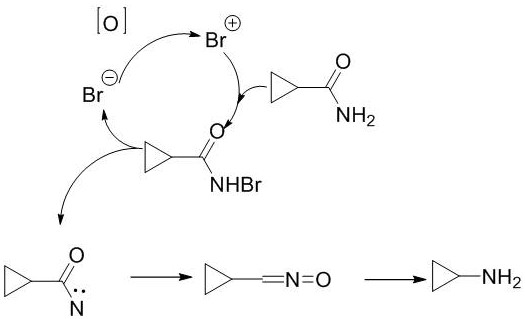
Figure 1
Abstract
Description
technical field
[0001] The invention relates to the field of organic chemistry, in particular to a method for preparing cyclopropylamine by utilizing hydrogen peroxide to carry out Hoffmann rearrangement reaction. Background technique
[0002] Cyclopropylamine, as a three-membered ring aliphatic amine, is an important intermediate or raw material for synthesizing quinolone antibacterial drugs. It can also be used in herbicides and pesticides. It is widely used. The market potential of cyclopropylamine is huge. At present, the last step of synthesizing cyclopropylamine in industry is mainly divided into two categories, namely catalytic hydrogenation reaction and Hoffmann rearrangement reaction. However, catalytic hydrogenation usually has high raw material cost, high equipment requirements and harsh reaction conditions. Therefore, Hofmann rearrangement to cyclopropylamine is still the mainstream process in current industrial production.
[0003] Hoffmann rearrangement react...
Examples
Embodiment 1
[0023] Dissolve 300 g (3.5 mol) of cyclopropanamide and 725 g (7.0 mol) of sodium bromide in water, cool down to 0 degrees Celsius, add catalyst orthorhombic titanium-silicon molecular sieve TS-11.2 g, and dropwise add hydrogen peroxide (27% ) 444g (7.0 mol) and 725g (7.0 mol) of sodium hydroxide aqueous solution (32%), incubated for 1 hour, then heated to 70 degrees Celsius, and distilled simultaneously to obtain 110 g (1.9 mol) of cyclopropylamine with a yield of 54%.
[0024] The above mother liquor is filtered, the catalyst is recovered, and the water is removed by concentration, crystallized after cooling, and the sodium carbonate is filtered off to obtain the filtrate as the mother liquor.
Embodiment 2
[0026] Dissolve 300 g (3.5 mol) of cyclopropanamide in the mother liquor, cool it to 0 degrees Celsius, add catalyst orthorhombic titanium-silicon molecular sieve TS-11.2 g, and dropwise add 444 g (3.5 mol) of hydrogen peroxide (27%) and hydrogen into it. Sodium oxide aqueous solution (32%) 725g (7.0 mol) was incubated for 1 hour, then heated to 70 degrees Celsius, and simultaneously distilled to obtain 125 g (2.2 mol) of cyclopropylamine with a yield of 61%.
[0027] The above mother liquor was concentrated to remove water, crystallized after cooling, and the sodium carbonate was filtered off to obtain the filtrate as mother liquor.
Embodiment 3
[0029] Dissolve 300 g (3.5 mol) of cyclopropanamide in the mother liquor, cool it to 0 degrees Celsius, add catalyst orthorhombic titanium-silicon molecular sieve TS-11.2 g, and dropwise add 444 g (3.5 mol) of hydrogen peroxide (27%) and hydrogen into it. Sodium oxide aqueous solution (32%) 725g (7.0 mol) was incubated for 1 hour, then heated to 90 degrees Celsius, and simultaneously distilled to obtain 131 g (2.3 mol) of cyclopropylamine with a yield of 64%.
[0030] The above mother liquor was concentrated to remove water, crystallized after cooling, and the sodium carbonate was filtered off to obtain the filtrate as mother liquor.