
Process for preparing surface material and skin material with improved mud elasticity
An elastic surface material and modified technology, applied in the field of materials, can solve the problems of raw material limitation, adverse effects, health effects of production workers, etc., and achieve the effect of good tensile strength and good elasticity
- Summary
- Abstract
- Description
- Claims
- Application Information
AI Technical Summary
Problems solved by technology
Method used
Image

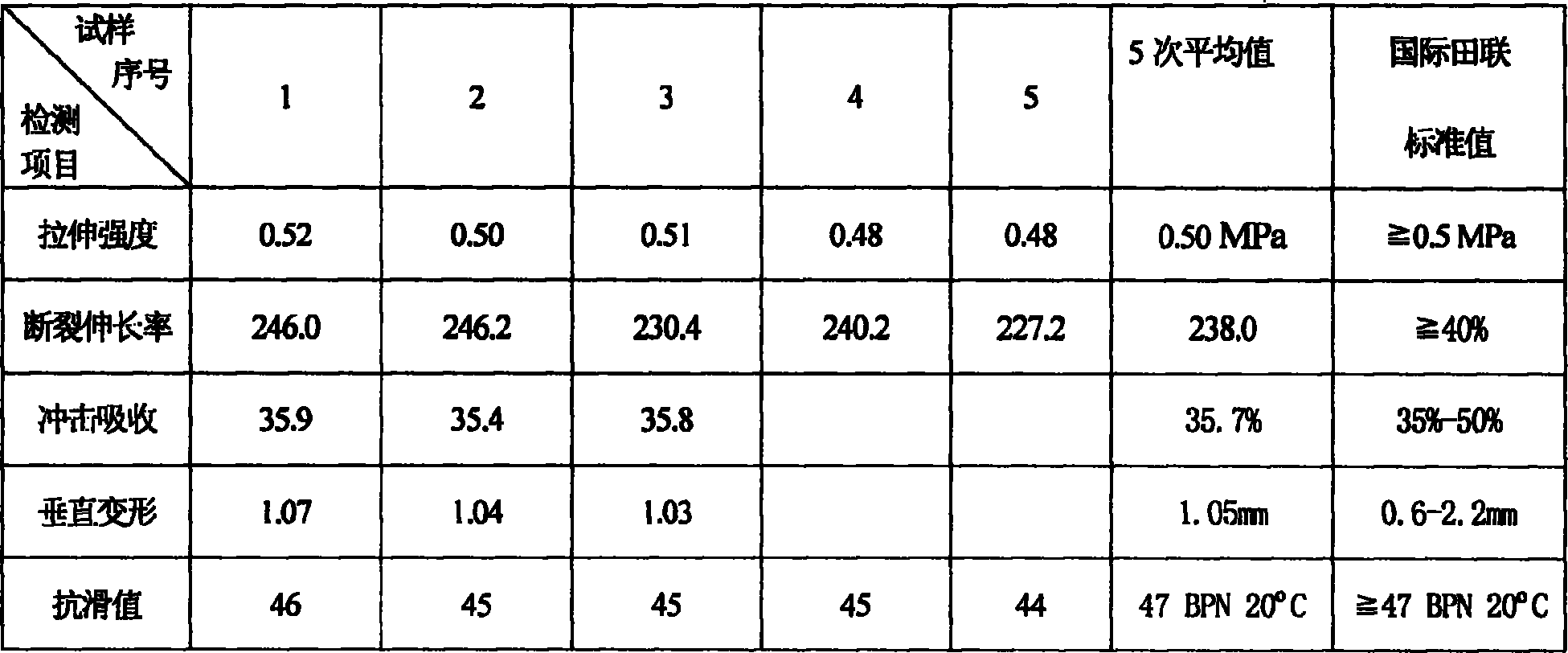
Examples
Embodiment 1
[0031] 40% of soil, 51% of acrylate polymer copolymer emulsion, 5% of water, 2% of flexible agent C (organic silicon surfactant), 2% of cross-linking agent EH (low molecular condensate of polyamine polyol) and mix and stir Evenly form a colloidal slurry, and apply the slurry repeatedly on the constant temperature formwork at 120°C until the required thickness is reached, then the mold can be ejected to form an elastic runway surface. The surface pattern of the resulting elastic runway surface is determined by the texture of the formwork.
Embodiment 2
[0033] 45% of soil, 45% of acrylate polymer copolymer emulsion, 5% of water, 3% of flexible agent C (organic silicon surfactant), 2% of cross-linking agent EH (polyamine polyol low molecular weight condensate) and mix well Colloidal mud, the mud is repeatedly coated on the 90 ℃ constant temperature formwork until the required thickness is reached, and then the mold can be released to form an elastic sports surface layer. The surface pattern of the formed elastic sports scene layer is determined by the texture of the template.
Embodiment 3
[0035] 52.5% of clay, 30% of acrylate polymer copolymer emulsion, 15% of water, 1% of flexible agent C (organic silicon surfactant), 1.5% of cross-linking agent EH (polyamine polyol low molecular weight condensate) and mix well Colloidal mud, the mud is repeatedly coated on the 80 ℃ constant temperature formwork until the required thickness is reached, and then the mold can be released to form an elastic wall veneer material.
PUM
 Login to View More
 Abstract
Description
Claims
Application Information
 Login to View More