Method for identification, selection and analysis of tumour cells

a tumour cell and selection technology, applied in the field of tumour cell identification, selection and analysis, can solve the problems of low sensitivity and specificity, widespread dosage of psa, poor sensitivity and specificity, and non-negligible costs for the health system, etc., to achieve high diagnostic and predictive reliability, high purity, and high accuracy.

a tumour cell and selection technology, applied in the field of tumour cell identification, selection and analysis, can solve the problems of low sensitivity and specificity, widespread dosage of psa, poor sensitivity and specificity, and non-negligible costs for the health system, etc., to achieve high diagnostic and predictive reliability, high purity, and high accuracy.

US10234447B2Active Publication Date: 2019-03-19MENARINI SILICON BIOSYSTEMS SPA

Image

Smart Image Click on the blue labels to locate them in the text.
Viewing Examples
Smart Image
  • Method for identification, selection and analysis of tumour cells
  • Method for identification, selection and analysis of tumour cells
  • Method for identification, selection and analysis of tumour cells

Examples

Experimental program
Comparison scheme
Effect test

example 1

[0175]Non-invasive evaluation of mutations (for example, in the K-RAS gene) in cancer patients.

[0176]Described in what follows is the case of isolation of CTCs from peripheral bloodflow of patients affected by metastatic Colon-Rectal Cancer (mCRC).

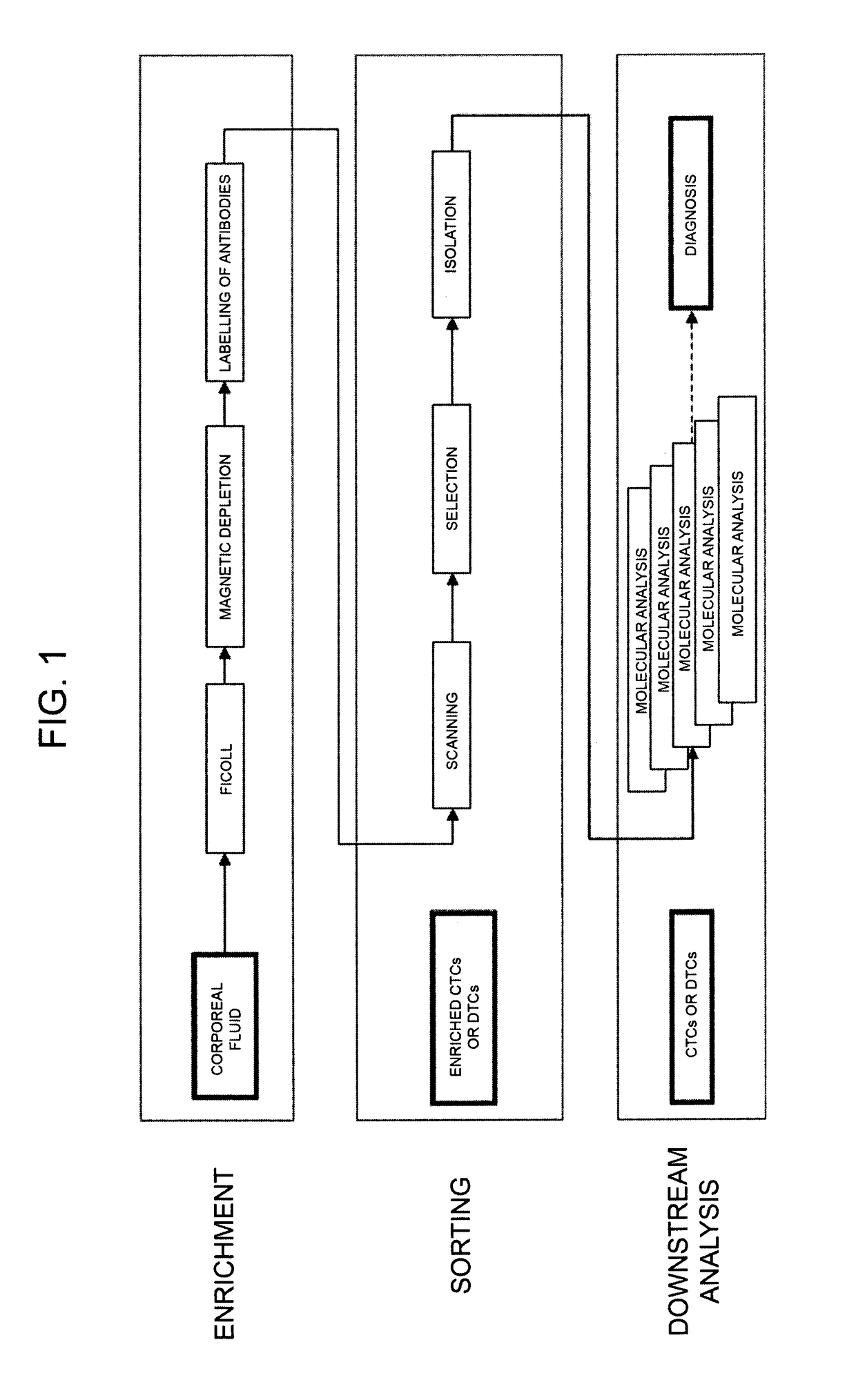
[0177]A specimen of 7.5 ml of peripheral bloodflow was drawn from the patient in Vacutainer tubes with EDTA anticoagulant (Beckton Dickinson). The specimen was analysed with Coulter Counter (Beckman Coulter) and presented 42×106 leukocytes (WBCs) and 43.95×10⁹ erythrocytes (RBCs). The PBMCs were then isolated via centrifugation (in Ficoll 1077). The PBMCs recovered (16.5×10⁶ on the basis of the count with Coulter Counter) were washed in PBS with BSA and EDTA (Running Buffer, Miltenyi) and were selected via depletion with magnetic microbeads conjugated to anti-CD45 and anti-GPA antibodies (Miltenyi) according to the instructions of the manufacturer. The resulting cells (negative fraction for CD45 and GPA) were fixated with 2% PFA in PBS for...

example 2

[0191]Evaluation on CTCs of deletions (for example, in prostate cancer) via single-cell whole-genome amplification and CGH array. In this case, there is advantageously performed isolation of the single cells to be recovered in different wells. In this way, the analysis takes into account the heterogeneity of the population, and supplies not only the average, but multiple signals regarding each cell so that it is easier to identify mutations present only in some of the tumour cells.

example 3

[0192]Non-invasive identification of the original tissue in CUP tumours, via genetic profile and / or profile of expression of the CTCs.

the structure of the environmentally friendly knitted fabric provided by the present invention; figure 2 Flow chart of the yarn wrapping machine for environmentally friendly knitted fabrics and storage devices; image 3 Is the parameter map of the yarn covering machine
Login to View More

PUM

PropertyMeasurementUnit
volumeaaaaaaaaaa
first wavelengthaaaaaaaaaa
third wavelengthaaaaaaaaaa
Login to View More

Abstract

The present invention relates to a method for the diagnosis of tumoural conditions and / or of the corresponding state of advance, wherein a specimen of an organic fluid taken from the patient and having a high probability of containing at least one circulating tumor cell (CTC) or a disseminated tumor cell (CTD) is enriched in a population of CTCs or CTDs. According to the invention, at least one type of CTCs or CTDs is isolated by selecting individually single cells in a microfluidic device so to constitute a diagnostic specimen having a purity of at least 90%. On the specimen thus obtained there is subsequently performed a molecular analysis such as to highlight a characteristic thereof suited to enabling diagnosis.

Description

CROSS-REFERENCE TO RELATED APPLICATIONS[0001]This is the U.S. national phase application of International Application No. PCT / IB2009 / 007316, filed Nov. 4, 2009, which claims the benefit of Italian Patent Application No. TO2008A 000814, filed Nov. 4, 2008.INCORPORATION BE REFERENCE OF MATERIAL SUBMITTED ELECTRONICALLY[0002]This application incorporates by reference in its entirety a computer-readable nucleotide / amino acid sequence listing identified as follows: One 607 byte ASCII (text) file name “46247_SeqListing.txt,” created Jan. 5, 2015.IN THE SEQUENCE LISTING[0003]Please introduce the computer-readable form of the Sequence Listing submitted herewith (filename: 46247_SeqListing.txt; Size: 607 bytes, Created: Jan. 5, 2015) as part of the application of the above-identified application as filed.FIELD OF THE ART[0004]The present invention relates, in general, to diagnostic methods based upon identification, isolation, and subsequent analysis of circulating or disseminated rare cells...

Claims

the structure of the environmentally friendly knitted fabric provided by the present invention; figure 2 Flow chart of the yarn wrapping machine for environmentally friendly knitted fabrics and storage devices; image 3 Is the parameter map of the yarn covering machine
Login to View More

Application Information

Patent Timeline
19 Mar 2019
Publication
US10234447B2
IPC
G01N33/50; G02B21/36; B03C5/00; G01N33/53
CPC
G01N33/5023; B03C5/005; G01N33/5302; G02B21/36; G01N33/5091; G01N2800/7028; G01N33/574; G01N33/52
Inventors
MANARESI, NICOL; MEDORO, GIANNI