Unlock instant, AI-driven research and patent intelligence for your innovation.

Photosensitive resin composition, photosensitive dry film, photosensitive resin coating, and pattern forming process

a resin coating and resin composition technology, applied in the field of resin compositions, photosensitive dry films, photosensitive resin coatings, and pattern forming processes, can solve the problems of peeling or cracking of cured coatings, less resistance to chemicals such as photoresist strippers, etc., to improve film properties including resistance to chemicals, easy processing, and fine size patterns

Active Publication Date: 2019-12-10
SHIN ETSU CHEM IND CO LTD
View PDF9 Cites 6 Cited by
  • Summary
  • Abstract
  • Description
  • Claims
  • Application Information

AI Technical Summary

Benefits of technology

The invention is a photosensitive resin composition and a photosensitive dry film that can be easily processed in thick film form to create fine size patterns. The composition has a wide range of thickness options and can be formed into a resin coating that has good resistance against chemicals and adhesion to various substrates. The coating has crack resistance and can be used as an insulating protective film for electronic parts and a film-forming material for bonding substrates. The resin composition also has improved film properties and is tenacious in its adhesion to substrates. The photosensitive dry film has advantages such as tenacious adhesion to substrates and improved flatness. Overall, the invention provides a reliable and effective photosensitive material for various applications.

Problems solved by technology

This photosensitive silicone composition is curable at low temperature and forms a coating which is flexible and fully reliable with respect to moisture resistant adhesion and other properties, but is less resistant against chemicals such as photoresist strippers having a high dissolving power, typically N-methyl-2-pyrrolidone (NMP).
This composition is improved in chemical resistance against photoresist strippers and the like, but still has the problem that the cured coating peels from the substrate or cracks in a thermal cycling test (repeating 1,000 cycles a test of holding at −25° C. for 10 minutes and holding at 125° C. for 10 minutes).

Method used

the structure of the environmentally friendly knitted fabric provided by the present invention; figure 2 Flow chart of the yarn wrapping machine for environmentally friendly knitted fabrics and storage devices; image 3 Is the parameter map of the yarn covering machine
View more

Image

Smart Image Click on the blue labels to locate them in the text.
Viewing Examples
Smart Image
  • Photosensitive resin composition, photosensitive dry film, photosensitive resin coating, and pattern forming process
  • Photosensitive resin composition, photosensitive dry film, photosensitive resin coating, and pattern forming process
  • Photosensitive resin composition, photosensitive dry film, photosensitive resin coating, and pattern forming process

Examples

Experimental program
Comparison scheme
Effect test

synthesis example 1

[0166]Synthesis of Benzoxazole Compound S-1a

[0167]In a 300-mL four-neck flask, 35.6 g (0.20 mol) of Compound A-2 was dissolved in 50 g of γ-butyrolactone under a nitrogen stream. To the flask, a solution of 41.2 g (0.20 mol) of dicyclohexylcarbodiimide in 50 g of γ-butyrolactone was added dropwise at 5° C. The contents were stirred for 20 minutes at the temperature of 5° C., after which a solution of 36.6 g (0.10 mol) of Compound A-1 in 50 g of γ-butyrolactone was added dropwise at 5° C. The contents were stirred at 5° C. for 3 hours, then at room temperature for a further 10 hours. At the end of stirring, the reaction system was heated at 200° C. whereupon ring-closing dehydration or cyclodehydration reaction was run for 20 hours. The cyclodehydration reaction was performed while removing water from the reaction system via a Dean-Stark trap. The reaction mixture was filtered to remove the by-product urea and recrystallized from isopropyl alcohol (pure water was added as a poor solv...

synthesis example 2

[0172]Synthesis of Benzoxazole Compound S-1b

[0173]In a 300-mL four-neck flask, 28.0 g (0.10 mol) of Compound B-1 and 50.8 g (0.20 mol) of Compound B-2 were dissolved in 100 g of N-methyl-2-pyrrolidone (NMP) under a nitrogen stream. The contents were heated at 180° C. for reaction while removing the by-product phenol from the reaction system under reduced pressure. After the reaction system was heated for 3 hours, it was restored to atmospheric pressure. It was then heated at 200° C. whereupon ring-closing dehydration or cyclodehydration reaction was run for 20 hours. The cyclodehydration reaction was performed while removing water from the reaction system via a Dean-Stark trap. The reaction solution was added to 1,000 mL of water for reprecipitation. The crystal precipitate was collected and washed with deionized water and methanol. Finally the crystal was dried at 120° C. for 3 hours, obtaining 44.5 g of benzoxazole compound S-1b (yield 78.9%). The 1H-NMR and 13C-NMR data are shown...

synthesis example 3

[0178]Synthesis of Benzoxazole Compound S-1c

[0179]In a 300-mL four-neck flask, 25.8 g (0.10 mol) of Compound C-1 and 62.0 g (0.20 mol) of Compound C-2 were dissolved in 100 g of NMP under a nitrogen stream. The contents were heated at 180° C. for reaction while removing the by-product phenol from the reaction system under reduced pressure. After the reaction system was heated for 3 hours, it was restored to atmospheric pressure. It was then heated at 200° C. whereupon ring-closing dehydration or cyclodehydration reaction was run for 20 hours. The cyclodehydration reaction was performed while removing water from the reaction system via a Dean-Stark trap. The reaction solution was added to 1,000 mL of water for reprecipitation. The crystal precipitate was collected and washed with deionized water and methanol. Finally the crystal was dried at 120° C. for 3 hours, obtaining 48.9 g of benzoxazole compound S-1c (yield 74.7%). The 1H-NMR and 13C-NMR data are shown in Tables 5 and 6, respe...

the structure of the environmentally friendly knitted fabric provided by the present invention; figure 2 Flow chart of the yarn wrapping machine for environmentally friendly knitted fabrics and storage devices; image 3 Is the parameter map of the yarn covering machine
Login to View More

PUM

PropertyMeasurementUnit
temperatureaaaaaaaaaa
radiation of wavelengthaaaaaaaaaa
temperatureaaaaaaaaaa
Login to View More

Abstract

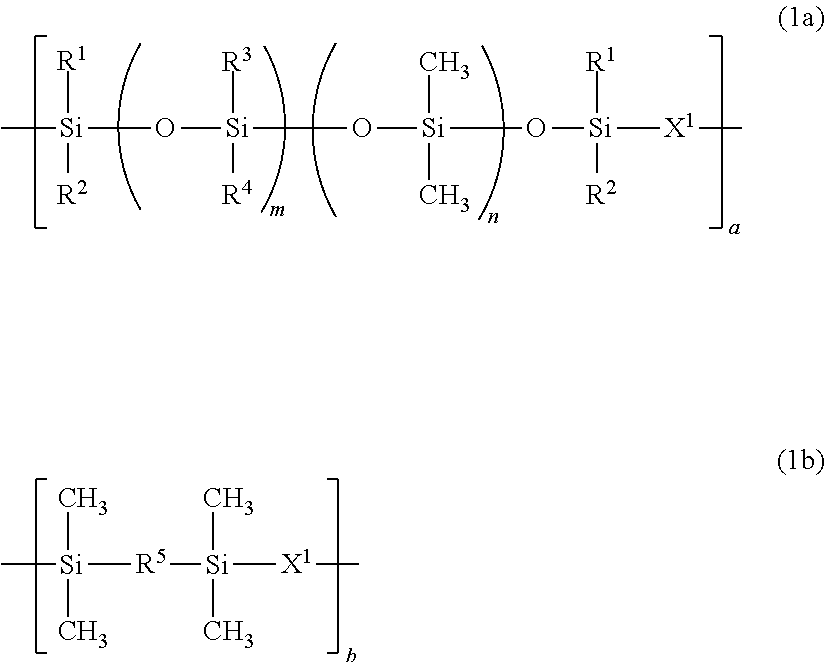
A photosensitive resin composition comprising (A) a silicone-modified polybenzoxazole resin and (B) a photoacid generator which is decomposed to generate an acid upon exposure to radiation of 190-500 nm is coated onto a substrate to form a thick coating, which is exposed to radiation, baked, and developed to form a pattern. The resin coating is capable of forming a fine pattern and has improved crack resistance and other film properties, and reliability.

Description

CROSS-REFERENCE TO RELATED APPLICATION[0001]This non-provisional application claims priority under 35 U.S.C. § 119(a) on Patent Application No. 2017-018353 filed in Japan on Feb. 3, 2017, the entire contents of which are hereby incorporated by reference.TECHNICAL FIELD[0002]This invention relates to a photosensitive resin composition, photosensitive dry film, photosensitive resin coating, and pattern forming process.BACKGROUND ART[0003]In the prior art, photosensitive protective films for semiconductor devices and photosensitive insulating films for multilayer printed circuit boards are formed of photosensitive polyimide compositions, photosensitive epoxy resin compositions, photosensitive silicone compositions, and the like. As the photosensitive material applied for the protection of such substrates and circuits, Patent Document 1 discloses a photosensitive silicone composition. This photosensitive silicone composition is curable at low temperature and forms a coating which is fle...

Claims

the structure of the environmentally friendly knitted fabric provided by the present invention; figure 2 Flow chart of the yarn wrapping machine for environmentally friendly knitted fabrics and storage devices; image 3 Is the parameter map of the yarn covering machine
Login to View More

Application Information

Patent Timeline
no application Login to View More
Patent Type & Authority Patents(United States)
IPC IPC(8): G03F7/038G03F7/075G03F7/30G03F7/039C08L83/04C08G73/22
CPCG03F7/0387G03F7/0757C08G73/22C08L83/04G03F7/039G03F7/0388G03F7/40G03F7/20G03F7/26
Inventor MARUYAMA, HITOSHIKONDO, KAZUNORIYANAGISAWA, HIDEYOSHI
Owner SHIN ETSU CHEM IND CO LTD