
Process for the preparation of bromoisophthalic acid compounds
a bromoisophthalic acid and compound technology, applied in the preparation of carboxylic compounds, organic chemistry, chemistry apparatus and processes, etc., can solve the problems of difficult brominate compounds having electron-attracting groups on their aromatic rings, and give the corresponding compounds only in a low yield, so as to achieve high yield
- Summary
- Abstract
- Description
- Claims
- Application Information
AI Technical Summary
Benefits of technology
Problems solved by technology
Method used
Image

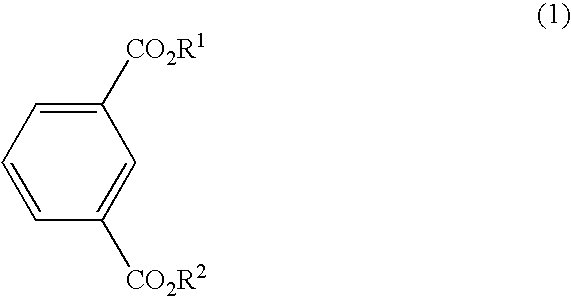
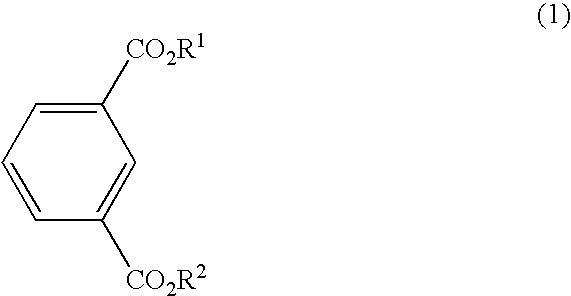
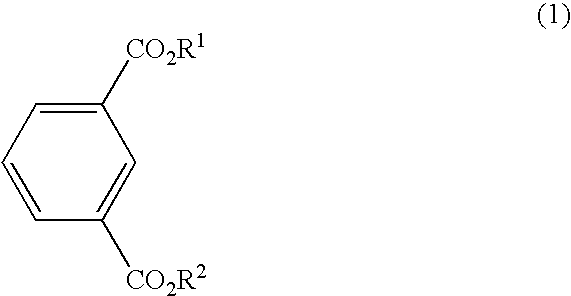
Examples
examples 2 to 7
[0033] Procedures were carried out similarly to that of Example 1 except that the reaction temperature, the concentration of fuming sulfuric acid and the amount of bromine were changed. The results on the resulting monobromo products were shown in Table 1.
1 TABLE 1 Concentration of Fuming Quantitative Yield (%) Ex. Sulfuric Acid Bromine Tempera- Time 4,5- 2,5-No. (wt %)-(g) g(mmol) ture(.degree. C.) (h.) 5BIP IP DBIP DBIP 2 10-6 1.6(10) 110 22 34.5 58.0 trace --3 20-6 1.6(10) 110 22 48.6 43.2 trace --4 30-6 1.6(10) 110 22 62.8 24.6 2.3 --5 10-6 1.6(10) 150 22 77.0 4.1 8.0 --6 20-6 1.6(10) 150 7 53.8 46.5 0.7 --7 10-6 3.2(20) 150 7 79.1 6.4 5.8 trace IP: Isophthalic Acid, 5BIP:5-Bromoisophthalic Acid, 4,5-DBIP: 4,5-Dibromoisophthalic Acid 2,5-DBIP: 2,5-Dibromoisophthalic Acid
example 8
[0034] Into a 50 ml pressure and sealable glass tube, 1.66 g (10 mmol) of isopthalic acid, 6.00 g of 30 wt % fuming sulfuric acid and 1.6 g (10 mmol) of bromine were charged, and the content was stirred at 150.degree. C. for 22 hours. After the conclusion of the reaction, the content was cooled to room temperature, and placed in a beaker containing ice water to give a solid. Then, the resulting solid was filtered off, washed with cooling, and further purified by column chromatography on silica gel (chloroform / methanol=6 / 1, v / v) to give 0.51 g (yield: 20.7%) of 5-bromoisophthalic acid, 0.76 g (yield: 23.5%) of 4,5-dibromoisophthalic acid and 0.07 g (yield: 2.1%) of 2,5-dibromoisophthalic acid. These crystals were identified by MASS, .sup.1H-NMR and melting point.
examples 9 to 16
[0035] Procedures were carried out similarly to that of Example 8 except that the reaction temperature, the concentration of fuming sulfuric acid and the amount of bromine were changed. The results on the resulting monobromo and dibromo products were shown in Table 2.
2 TABLE 2 Concentration of Fuming Quantitative Yield (%) Ex. Sulfuric Acid Bromine Tempera- Time 4,5- 2,5-No. (wt %)-(g) g(mmol) ture(.degree. C.) (h.) 5BIP IP DBIP DBIP 9 60-6 1.6(10) 110 22 45.0 1.4 18.7 1.0 10 20-6 1.6(10) 130 22 49.2 0.0 15.3 trace 11 30-6 1.6(10) 130 22 53.1 0.8 13.6 1.0 12 20-6 1.6(10) 150 22 43.1 0.0 20.0 0.8 13 20-6 3.2(20) 150 7 37.5 0.0 23.3 1.5 14 10-12 1.6(10) 150 7 47.0 0.6 18.1 1.2 15 20-12 1.6(10) 150 7 49.8 0.7 20.3 1.4 16 20-12 3.2(10) 150 7 11.9 0.0 26.2 4.9 IP: Isophthalic Acid, 5BIP:5-Bromoisophthalic Acid, 4,5-DBIP: 4,5-Dibromoisophthalic Acid 2,5-DBIP: 2,5-Dibromoisophthalic Acid
PUM
| Property | Measurement | Unit |
|---|---|---|
| temperature | aaaaa | aaaaa |
| temperature | aaaaa | aaaaa |
| temperature | aaaaa | aaaaa |
Abstract
Description
Claims
Application Information
 Login to View More