Unlock instant, AI-driven research and patent intelligence for your innovation.

Target-dependent reactions using structure-bridging oligonucleotides

a structure-bridging oligonucleotide and target-dependent technology, applied in the field of nucleic acid sequence detection and sequence change detection, can solve the problems of lack of sensitivity, lack of sensitivity, and inability to be practical and effective in clinical settings, and achieve the effect of rapid detection and identification of variants

Inactive Publication Date: 2005-01-20
GEN PROBE INC
View PDF1 Cites 31 Cited by
  • Summary
  • Abstract
  • Description
  • Claims
  • Application Information

AI Technical Summary

Benefits of technology

The present invention provides methods and compositions for detecting and characterizing nucleic acid sequences and sequence changes. The methods involve using probes that interact with folded nucleic acid strands to form complexes with specific sequences. The interactions between the probes and the targets can be standard or non-standard nucleic acid interactions, such as triplex structures or quadraplex aggregates. The methods can be used for clinical diagnostic purposes, including detection and identification of pathogens. The invention also provides probes that are designed to interact with non-contiguous regions of complementarity in the target nucleic acid. The probes can be DNA, RNA, PNA, or combinations thereof, and may include modified nucleotides or adducts. The methods can be used to detect and quantitate the presence of the probe / target complex.

Problems solved by technology

However, specialized equipment and highly trained personnel are required for DNA sequencing, and the method is too labor-intense and expensive to be practical and effective in the clinical setting.
However, this method requires the use of osmium tetroxide and piperidine, two highly noxious chemicals which are not suited for use in a clinical laboratory.
However, all of the mismatch cleavage methods lack sensitivity to some mismatch pairs, and all are prone to background cleavage at sites removed from the mismatch.
Furthermore, the generation of purified fragments to be used in heteroduplex formation is both labor intensive and time consuming.
RFLP analysis suffers from low sensitivity and requires a large amount of sample.
When RFLP analysis is used for the detection of point mutations, it is, by its nature, limited to the detection of only those single base changes which fall within a restriction sequence of a known restriction endonuclease.
Indeed, if the region of the target molecule that is complementary to the probe is involved in the formation of intramolecular structures with other regions of the target, this will reduce the binding efficiency of the probe.
Blocking of PCR by this method has had some degree of success, but, not all mismatches are able to block extension.
This dramatically limits the scope of application of PCR in this type of direct mutation identification.
Furthermore, the method requires specialized equipment to prepare the gels and maintain the high temperatures required during electrophoresis.
In addition, long running times are required for DGGE.
Both DGGE and CDGE are unsuitable for use in clinical laboratories.
This technique is extremely sensitive to variations in gel composition and temperature.
A serious limitation of this method is the relative difficulty encountered in comparing data generated in different laboratories, under apparently similar conditions.
While ddF is an improvement over SSCP in terms of increased sensitivity, ddF requires the use of expensive dideoxynucleotides and this technique is still limited to the analysis of fragments of the size suitable for SSCP (i.e., fragments of 200-300 bases for optimal detection of mutations).
In addition to the above limitations, all of these methods are limited as to the size of the nucleic acid fragment that can be analyzed.
For the direct sequencing approach, sequences of greater than 600 base pairs require cloning, with the consequent delays and expense of either deletion sub-cloning or primer walking, in order to cover the entire fragment.
SSCP and DGGE have even more severe size limitations.
Because of reduced sensitivity to sequence changes, these methods are not considered suitable for larger fragments.
The ddF technique, as a combination of direct sequencing and SSCP, is also limited by the relatively small size of the DNA that can be screened.
In many situations (e.g., in many clinical laboratories), electrophoretic separation and analysis may not be technically feasible, or may not be able to accommodate the processing of a large number of samples in a cost-effective manner.

Method used

the structure of the environmentally friendly knitted fabric provided by the present invention; figure 2 Flow chart of the yarn wrapping machine for environmentally friendly knitted fabrics and storage devices; image 3 Is the parameter map of the yarn covering machine
View more

Image

Smart Image Click on the blue labels to locate them in the text.
Viewing Examples
Smart Image
  • Target-dependent reactions using structure-bridging oligonucleotides
  • Target-dependent reactions using structure-bridging oligonucleotides
  • Target-dependent reactions using structure-bridging oligonucleotides

Examples

Experimental program
Comparison scheme
Effect test

example 1

The Presence of a Structure and a Probe Mismatch in Combination Provide More Sensitive Discrimination than does Either Effect Alone

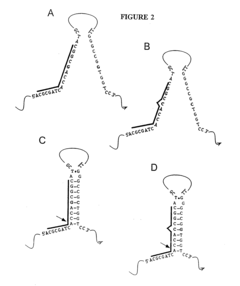
[0344] In this Example, the effects on oligonucleotide binding of either the formation of an occlusive structure, the presence of a single-base mismatch, or the presence of both at once were examined. To separate the effects on the efficiency of binding of structure from the effects of mismatches, four katG DNA target variants were chosen (SEQ ID NOS:1, 2, 3 and 4). The structures of these four targets in the region of the probe hybridization sites are shown in FIG. 2 and the existence of the large stem-loop in structures 2C and 2D (SEQ ID NOS:3 and 4, respectively) was confirmed by digestion with the structure-specific Cleavase®I nuclease (Third Wave) and the cleavage sites are indicated by the arrows on structures 2C and 2D. The dark bar on the left of each structure in FIG. 2 indicates the region to which the capture probe is expected to bind. The po...

example 2

Changes in DNA Secondary Structure Leads to Different Binding Abilities Between the Target DNA and the Capture Probe

[0359] The context of a target sequence (i.e., the length and identity of the flanking nucleic acid), can influence the secondary structure, and therefore the hybridization accessibility of the target segment. To illustrate this effect, a target segment of DNA was exposed, either with or without pretreatment with a restriction enzyme, to a capture probe that is complementary to a site that is unaffected by the restriction cleavage. The restriction enzyme BamHI was used to digest the 391 bp 5′-fluorescein labeled fragments of katG DNA, either wild-type (FIG. 2C) or the S315T mutant (FIG. 2B), prepared as described in Example 1. The restriction enzyme shortens the 5′ labelled fragment from 391 nt to 256 nt. The capture probe is complementary to sequence located within the first 50 nt of these katG DNA targets. Equal amounts of the DNA targets were used in all the reacti...

example 3

Hybridization Analysis Using Multiple Capture Probes For HCV Genotyping

[0361] Because both mismatches and structures are used in the method of the present invention for discrimination between similar nucleic acids by hybridization, the patterns created by the use of a structure specific nuclease, e.g., Cleavase® I nuclease can be, used as a way of selecting regions likely to demonstrate different binding behaviors with different variants. Because the CFLP® method indicates the presence of structure in a DNA fragment of interest, and because the variations in the structures tend to be proximal to the actual sequence changes, choosing capture probes at or near the CFLP® cleavage sites increases the probability of choosing a sequence that changes in accessibility in the different variants. FIG. 5 shows a diagram depicting this means of probe selection as applied to the comparison of fragments from the Hepatitis C virus. In FIG. 5, the left panel shows an fluoroimager scan of sequencin...

the structure of the environmentally friendly knitted fabric provided by the present invention; figure 2 Flow chart of the yarn wrapping machine for environmentally friendly knitted fabrics and storage devices; image 3 Is the parameter map of the yarn covering machine
Login to View More

PUM

PropertyMeasurementUnit
temperatureaaaaaaaaaa
Login to View More

Abstract

The present invention relates to methods and compositions for analyzing nucleic acids. In particular, the present invention provides methods and compositions for the detection and characterization of nucleic acids and sequence changes. The methods of the present invention permit the detection and / or identification of genetic polymorphism such as those associated with human disease and permit the identification of pathogens (e.g., viral and bacterial strain identification).

Description

FIELD OF THE INVENTION [0001] The present invention relates to methods and compositions for analyzing nucleic acids, and in particular, methods and compositions for detection and characterization of nucleic acid sequences and sequence changes. BACKGROUND OF THE INVENTION [0002] The detection and characterization of specific nucleic acid sequences and sequence changes have been utilized to detect the presence of viral or bacterial nucleic acid sequences indicative of an infection, the presence of variants or alleles of mammalian genes associated with disease and cancers, and the identification of the source of nucleic acids found in forensic samples, as well as in paternity determinations. As nucleic acid sequence data for genes from humans and pathogenic organisms accumulates, the demand for fast, cost-effective, and easy-to-use tests for as yet unknown, as well as known, mutations within specific sequences is rapidly increasing. [0003] A handful of methods have been devised to scan...

Claims

the structure of the environmentally friendly knitted fabric provided by the present invention; figure 2 Flow chart of the yarn wrapping machine for environmentally friendly knitted fabrics and storage devices; image 3 Is the parameter map of the yarn covering machine
Login to View More

Application Information

Patent Timeline
no application Login to View More
Patent Type & Authority Applications(United States)
IPC IPC(8): C12Q1/68
CPCC12Q1/6832C12Q1/701C12Q2565/133C12Q2521/301
Inventor DONG, FANGLYAMICHEV, VICTORPRUDENT, JAMESFORS, LANCENERI, BRUCEBROW, MARY ANNANDERSON, TODDDAHLBERG, JAMES
Owner GEN PROBE INC