
Semiconductor integrated circuit device and semiconductor memory using the same
a technology of integrated circuits and semiconductors, applied in the direction of semiconductor devices, electrical devices, transistors, etc., can solve the problems of ineffective i-type gates, etc., and achieve the effect of enhancing the degree of integration
- Summary
- Abstract
- Description
- Claims
- Application Information
AI Technical Summary
Benefits of technology
Problems solved by technology
Method used
Image

Examples
Embodiment Construction
[0028] Exemplary embodiments according to this invention will be described below with reference to drawings.
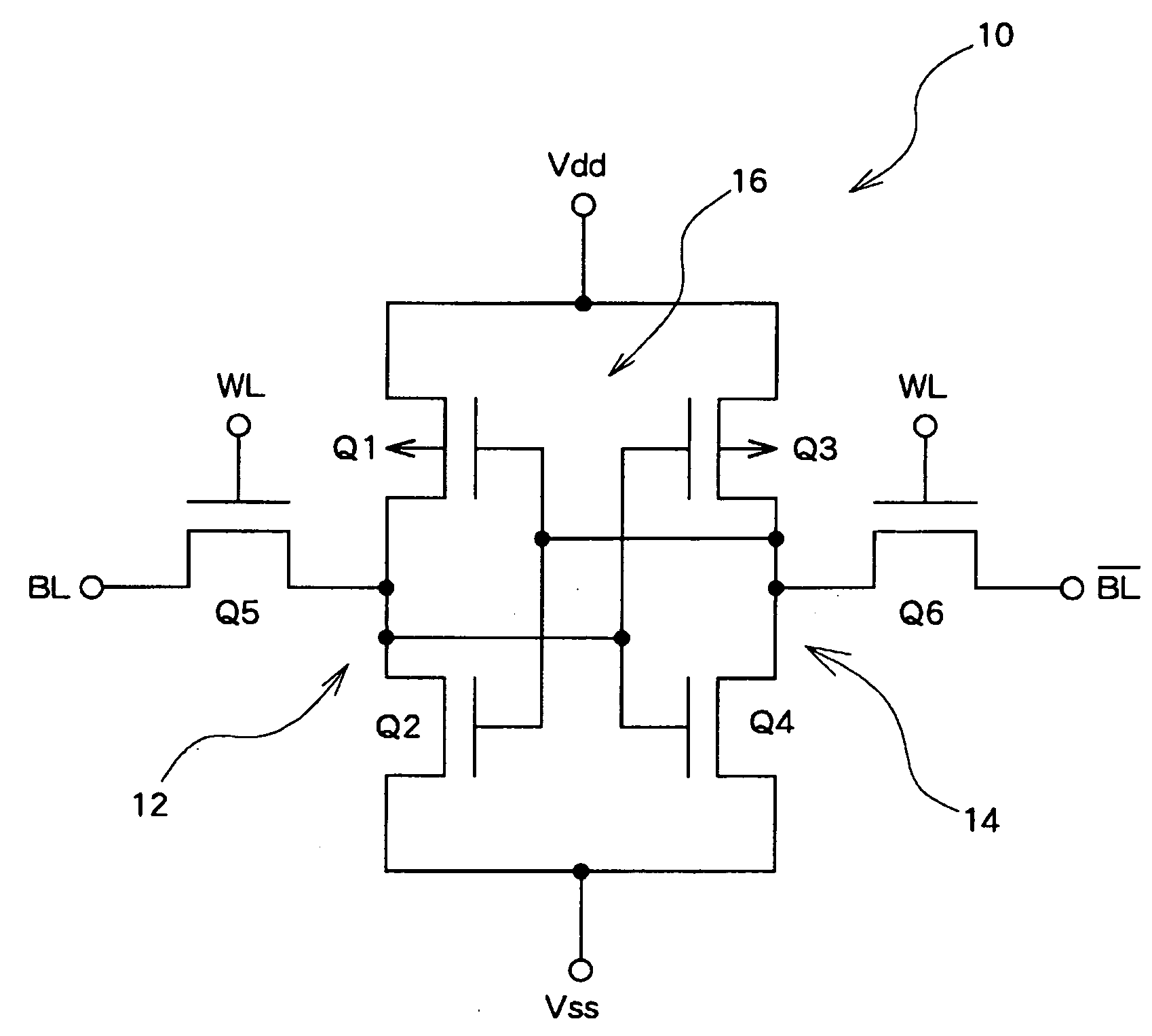
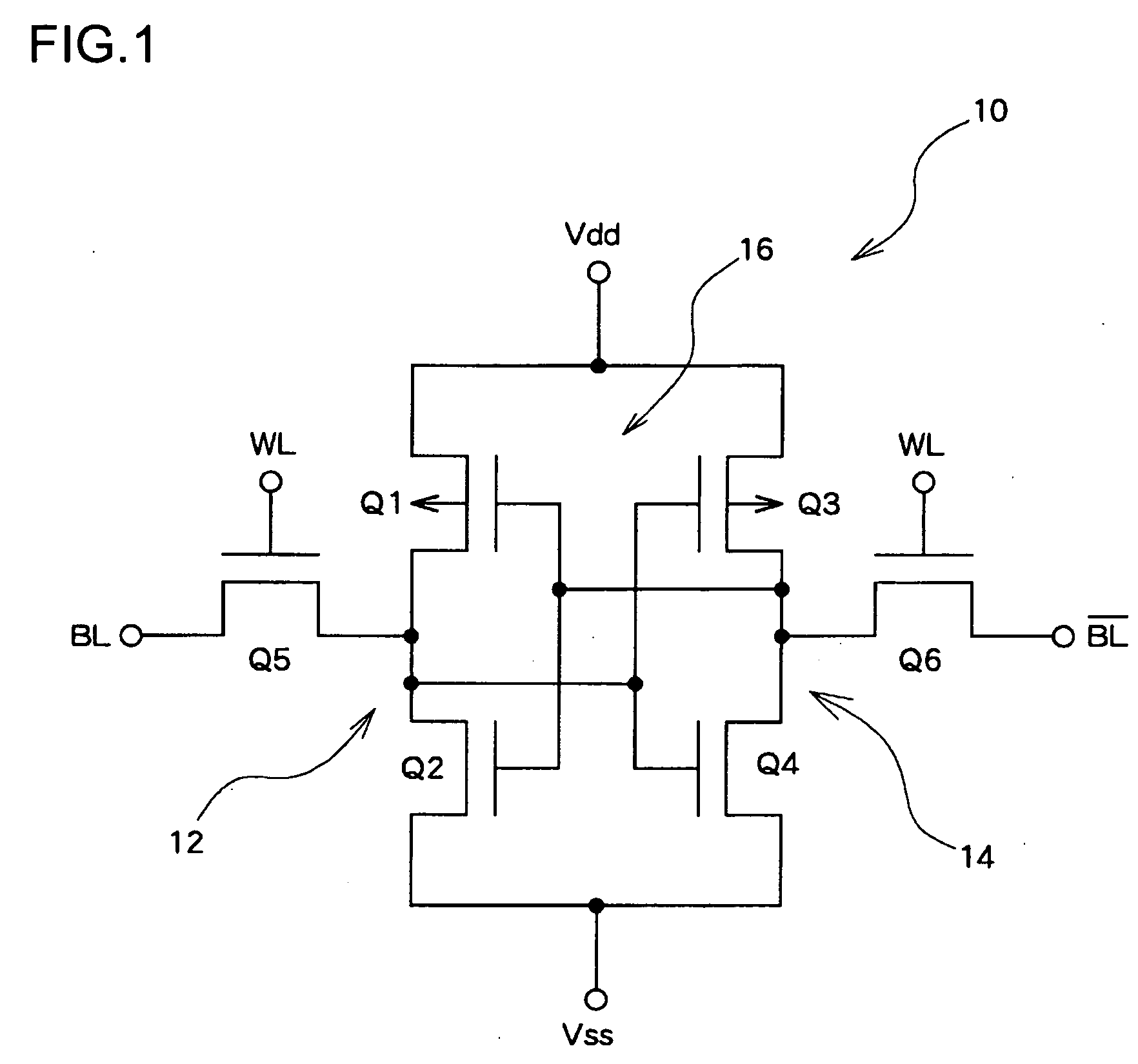
[0029]FIG. 1 is an exemplary circuit diagram of a memory cell of an SRAM which is a semiconductor device of this invention. A memory cell 10 is formed by six MOS electric field effect transistors. A first CMOS inverter 12 is formed by a p-channel load transistor Q1 and a n-channel drive transistor Q2 serially connected thereto. A second CMOS inverter 14 is formed by another p-channel load transistor Q3 and another n-channel drive transistor Q4 serially connected thereto. To a source of the two n-channel drive transistors Q2 and Q4, there is connected a Vss power supply line, while, to a source of the two n-channel drive transistors Q1 and Q3, there is connected a Vdd power supply line. And by cross coupling the first and the second inverter 12 and 14, a flip-flop 16 is formed. This flip-flop 16 is connected to a bit line BL and an inverse bit line {overscore (BL)} by two n-ch...
PUM
 Login to View More
 Abstract
Description
Claims
Application Information
 Login to View More