

Chemical treatment for removing cellular and nuclear material from naturally occurring extracellular matrix-based biomaterials
a biomaterial and chemical treatment technology, applied in the field of tissue decellularization, can solve the problems of compromising biocompatibility, high residual content of chemical in the ecm, and few successful removal of all residual nucleic acids without compromising mechanical, biological,
- Summary
- Abstract
- Description
- Claims
- Application Information
AI Technical Summary
Benefits of technology
Problems solved by technology
Method used
Image

Examples
example 1
Materials and Methods
[0072] Materials were obtained commercially as follows: NaOH (Sigma), Methionine (Fluka), Cysteine (Sigma), Ascorbic Acid (Sigma), Hydrogen peroxide (Swan), PAMAM (Sigma), Poly-L-lysine (Sigma), EDTA (Sigma), NaCl (Sigma), Polyethyleneimine (Sigma). Solutions of NaOH, ascorbic acid, cysteine, methionine, EDTA were prepared at a concentration of 0.1 M. PAMAM, poly-1-lysine and polyethyleneimine were prepared in concentrations of 0.5 mg / ml aqueous solutions. Papain (Sigma) digested samples were used for the DNA assays. DNA measurements were done using the PicoGreen® reagent kit as purchased from Molecular Probes. Samples were read on a Biorad Versaflour at an excitation of 480 nm and emission of 520 nm. The PicoGreen® reagent and kit provide a sensitive, one-step, fluorescence-based assay for DNA analysis in solution.
example 2
Preparation of a Decellularized Tissue
[0073] The following method describes the examination of various chemicals for their ability to remove nuclear DNA content from a tissue, such as a small intestinal submucosa (SIS), without substantially affecting the biochemical and mechanical properties of the ECM.
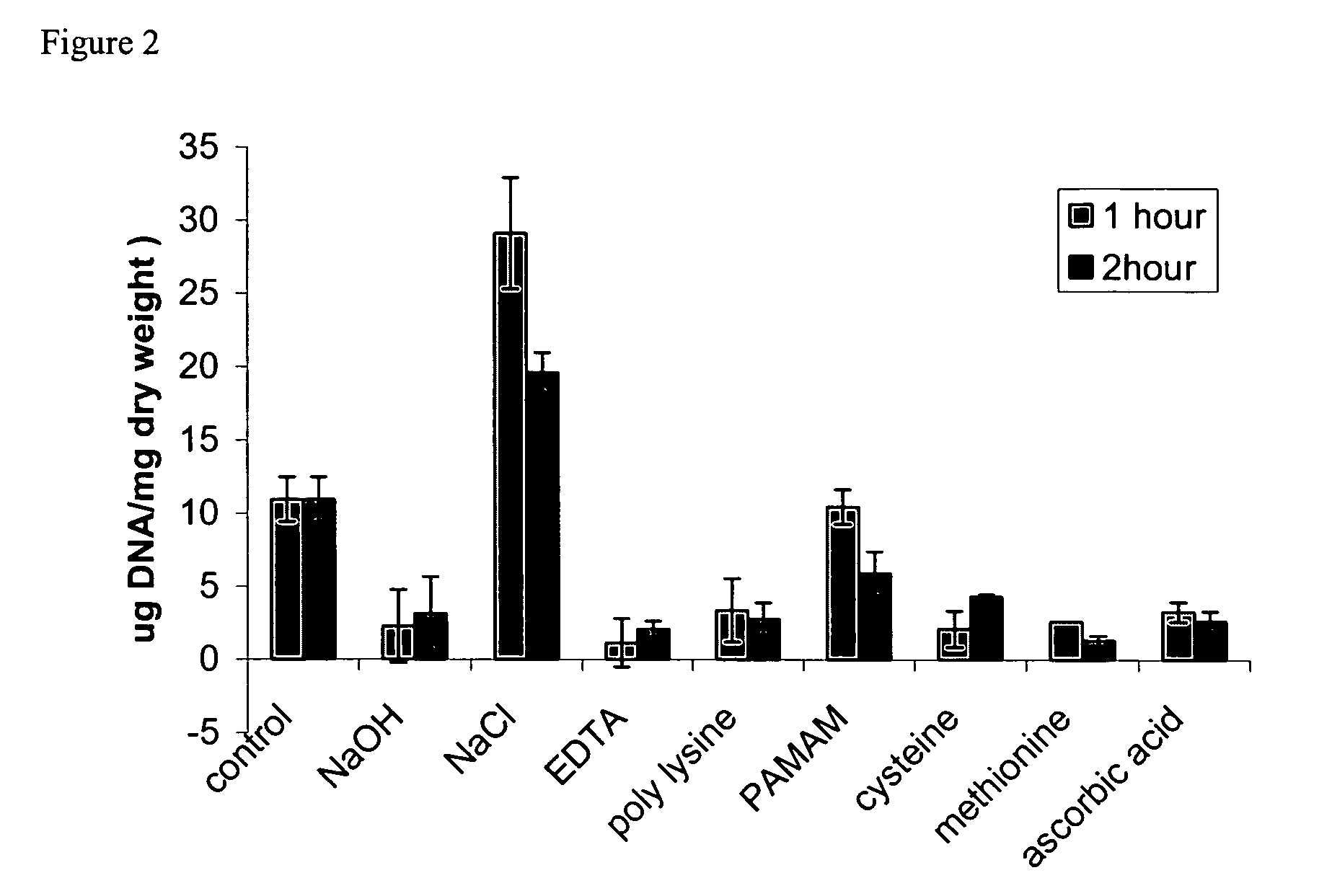
[0074] The SIS was obtained from a porcine slaughterhouse. Approximately 1 cm length samples of SIS trimmings were treated with solutions of various chemicals as shown in FIG. 2. The different chemicals were selected for their ability to interact with DNA, or their ability to damage DNA. The chemical treatments included incubation of the SIS with 0.1 M concentrations of NaOH, NaCl, EDTA, polylysine, PAMAM, cycteine, methionine, and ascorbic acid. The SIS trimmings were placed in an eppendorf tube comprising 1 ml the chemical, and incubated with the different chemicals at room temperature. The SIS trimmings were removed from the tubes and the amount of DNA in the tissue was measured...
example 3
DNA Content after Liquid Nitrogen Treatment
[0077] To assess if liquid nitrogen freeze / thaw cycles affected the DNA content within the matrix, 1 cm length SIS trimmings were subject to four different freeze thaw cycles (the cycle involved freezing for one minute, and thawing for a one minute), and measuring the DNA content after each cycle. The results show that even after four repeated cycles, there was no significant reduction in the DNA content, as can be seen from FIG. 4. Thus, the freeze / thaw cycles was not effective in removing residual DNA.
PUM
| Property | Measurement | Unit |
|---|---|---|
| temperature | aaaaa | aaaaa |
| temperature | aaaaa | aaaaa |
| temperature | aaaaa | aaaaa |
Abstract
Description
Claims
Application Information
 Login to View More