Zwitterionic chromophores and macromolecules containing such chromophores
Inactive Publication Date: 2006-09-07
WANG ZHIYUAN
View PDF1 Cites 9 Cited by
Summary
Abstract
Description
Claims
Application Information
AI Technical Summary
This helps you quickly interpret patents by identifying the three key elements:
Problems solved by technology
Method used
Benefits of technology
Benefits of technology
[0011] Also, according to the invention, applicant provides a zwitterionic chromophore with proper functional groups that are able to be converted into macromolecular chromophores, such as linear and hyperbranched macromolecules, for easy formulation of NLO materials, better purification and improved solubility.
[0013] Yet further, the present invention provides generally a new type of zwitterionic chromophore that contains several different functional groups and substituents, which permit it to be grafted onto a host polymer and to be polymerized or copolymerized to form linear or hyperbranched macromolecules, and methods of making such a chromophore. The invention also provides generally a new type of NLO macromolecules containing a high content of the said chromophore and showing a good solubility in organic solvents and good compatibility with a variety of conventional host polymers. The invention further provides generally a new type of NLO polymer blends that are formulated by mixing the said chromophores or chromophore-containing macromolecules with a variety of conventional host polymers. Furthermore, the invention provides generally the use of the inventive chromophores and corresponding macromolecules and blends as NLO materials in a device showing useful EO response after thermal poling under the electrical field.
[0015] Yet another feature of this invention is that the ester group can impart the solubility to the said chromophore and prevent the chromophores from close stacking, which leads to the diminished dipole-dipole interaction, due to the ester's more flexible and larger size than the cyano group.
Problems solved by technology
However, extended conjugation in molecules tends to lead to poor thermal and photochemical stability.
Thus, such a dipole interaction can lead to the diminished dipole orientation or even completely cancellation of dipole orientation of chromophores during the poling process, which gives rise to low or no EO response.
However, phase separation over time and poor temporal stability of the poled NLO materials are common as reported in literature, due to poor solubility and facile dipole relaxation of chromophores in a non-crosslinked polymer matrix.
But they also show poor solubility and strong dipole-dipole interaction.
Method used
the structure of the environmentally friendly knitted fabric provided by the present invention; figure 2 Flow chart of the yarn wrapping machine for environmentally friendly knitted fabrics and storage devices; image 3 Is the parameter map of the yarn covering machine
View more
Image
Smart Image Click on the blue labels to locate them in the text.
Viewing Examples
Smart Image
Click on the blue label to locate the original text in one second.
Reading with bidirectional positioning of images and text.
Smart Image
Examples
Experimental program
Comparison scheme
Effect test
example 1
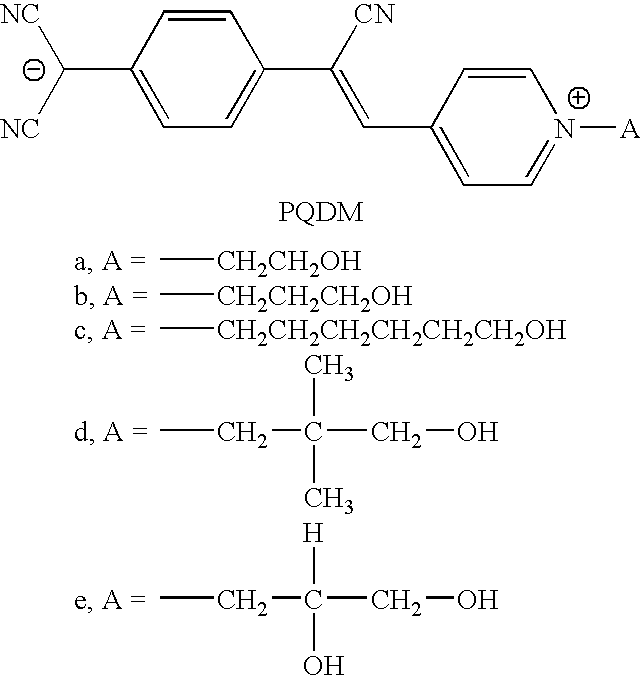
N-(2-hydroxyethyl)-4-picolinium bromide (Ia) and its Derivative Ie
[0046] In a 3-neck, round-bottomed flask flushed with nitrogen, 2-bromo-1-ethanol (40.01 mmol), 4-picoline (43.57 mmol) and absolute ethanol (16 mL) were combined and heated for 3.5 hours at 50° C. under nitrogen with stirring. The reaction was stopped and the contents of the flask were transferred to a one-neck round-bottomed flask. The solvent was removed under vacuum and the residue was washed with diethyl ether (4×100 mL) and any remaining solvent was removed under vacuum. The product was obtained as a viscous orange liquid in 34% yield. 1H NMR (200 MHz, CDCl3) 8.9 (2H, protons on pyridine ring), 8.0 (2H, protons on pyridine ring), 2.6 (3H, CH3), 4.6 (2H, —CH2O), 3.8 (2H, —NCH2—), 5.2 (1H, —OH); IR (neat, cm−1) 3303 (OH), 1640 (aromatic C═N), 1474 (aromatic C═C).
[0048] A solution of 4.65 g of 4-picoline (50 mmol), 9.90 g of 1-bromohexane (60 mmol) and 30 mL of acetonitrile was refluxed for three hours and then cooled to room temperature. The viscous mixture was then added dropwise into 100 mL of ether with vigorous stirring. The mixture was let to stand for a while and then the upper ether layer was decanted. The residual viscous solution was dissolved in 10 mL of acetonitrile again and dispersed into 100 mL of ether. This procedure was repeated two more times in order to completely remove the unreacted starting materials. The resulting viscous liquid was dried under vacuum to give 11.8 g of off-white wax (92% yield). 1H NMR (DMSO-d6, 400 MHz): 0.89 (t, 3H), 1.26 (m, 4H), 1.85 (m, 4H), 2.64 (s, 3H), 4.81 (t, 2H), 8.0 (m, 2H), 8.9 (m, 2H); IR (CHCl3, cm−1): 1398 (C═C), 1635 (C═N), 2975 (N—C).
[0049] A solution of 2.53 g of benzyl chloride (20 mmol), 1.86 g of 4-picoline (20 mmol) and 20 mL of acetonitrile was refluxed for three hours, cooled to room temperature and then frozen in refrigerator. Pale pink crystals precipitated from the solution, which were collected by filtration and washed with ether (3×5 mL) to afford 4.09 g of the product (92% yield). 1HNMR (DMSO-d6, 400 MHz): δ 9.1 (s, 2H), 8.0 (d, 2H, J=6.24), 7.5 (s, 2H), 7.4 (m, 3H), 5.8 (s, 2H), 2.6 (s, 3h); 13C NMR (DMSO-d6, 100 MHz): δ 159.0, 143.5, 134.3, 128.9, 128.8, 128.3, 61.9, 21.1.
the structure of the environmentally friendly knitted fabric provided by the present invention; figure 2 Flow chart of the yarn wrapping machine for environmentally friendly knitted fabrics and storage devices; image 3 Is the parameter map of the yarn covering machine
Login to View More
PUM
Property
Measurement
Unit
Percent by mass
aaaaa
aaaaa
Percent by mass
aaaaa
aaaaa
Temperature
aaaaa
aaaaa
Login to View More
Abstract
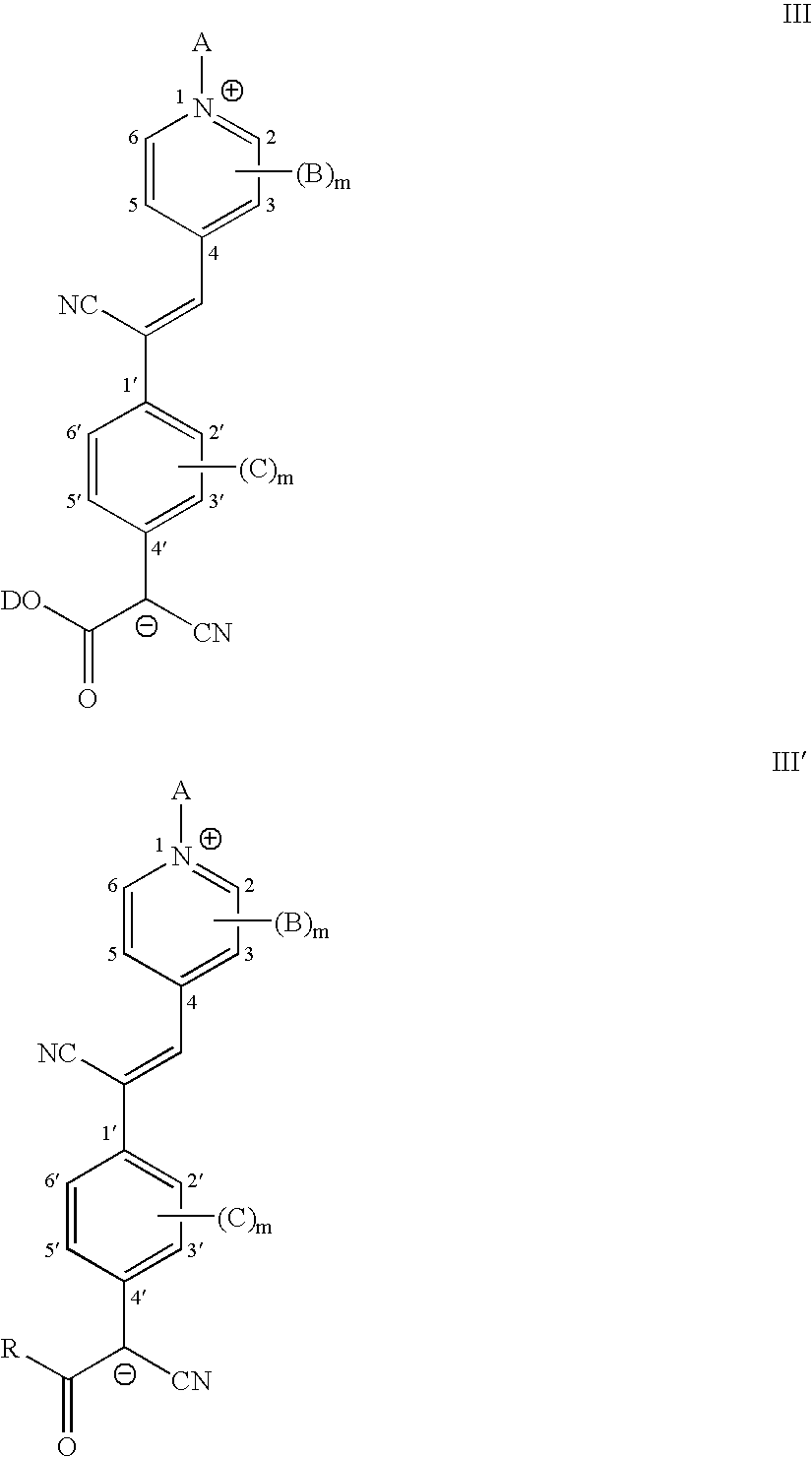
The invention disclosed relates to functionalized zwitterionic chromophores of structural formula III and III′. Wherein A is a linear or branched alkyl group having up to 20 carbon atoms and the desired functional groups, B is hydrogen, alkyl, aryl, halo, heterocyclic, alkoxy or nitro groups at 2, 3, 5 or 6 positions on the pyridine ring, C is hydrogen, aryl or a linear or branched alkyl group at 2′, 3′, 5′ or 6′ positions on the benzene ring, which has up to 70 carbon atoms and contains the desired functional group, D is a linear or branched alkyl, aryl or substituted aryl group, which has up to 70 carbon atoms and contains the desired functional group, R is C1-C4 alkyl or aryl, and m is an integer of from 0 to 4.
Description
[0001] This application claims benefit of U.S. Provisional Application 60 / 658,162 filed Mar. 4, 2005.FIELD OF THE INVENTION [0002] This invention relates to functionalized zwitterionic chromophores, and macromolecules including such chromophores, and methods for making them. BACKGROUND OF THE INVENTION [0003] Second-order nonlinear optical (NLO) chromophores and polymers are being actively pursued for applications in high-speed electro-optic (EO) modulators, and other integrated optoelectronic and microwave devices [(a) Kajzar, F.; Lee, K.-S.; Jen, A. K.-Y. Adv. Polym. Sci. 2003, 161, 1. (b) Dalton, L. Adv. Polym. Sci. 2002, 158, 1.] Since the EO effect is not a naturally occurring property in polymers, the poling under an electrical field is needed to induce the linear EO coefficient, which is parallel to an applied field as given by: χzzz(2)=Nβ111fω2f02μE / 5kT [0004] where N is the density of NLO chromophore, β111 is the first hyperpolarizability of the molecular chromophore in the...
Claims
the structure of the environmentally friendly knitted fabric provided by the present invention; figure 2 Flow chart of the yarn wrapping machine for environmentally friendly knitted fabrics and storage devices; image 3 Is the parameter map of the yarn covering machine
Login to View More
Application Information
Patent Timeline
Application Date:The date an application was filed.
Publication Date:The date a patent or application was officially published.
First Publication Date:The earliest publication date of a patent with the same application number.
Issue Date:Publication date of the patent grant document.
PCT Entry Date:The Entry date of PCT National Phase.
Estimated Expiry Date:The statutory expiry date of a patent right according to the Patent Law, and it is the longest term of protection that the patent right can achieve without the termination of the patent right due to other reasons(Term extension factor has been taken into account ).
Invalid Date:Actual expiry date is based on effective date or publication date of legal transaction data of invalid patent.


 Login to View More