New imidazole derivatives, preparation method thereof and organic electronic device using the same
Active Publication Date: 2007-01-25
LG CHEM LTD
View PDF3 Cites 360 Cited by
Summary
Abstract
Description
Claims
Application Information
AI Technical Summary
This helps you quickly interpret patents by identifying the three key elements:
Problems solved by technology
Method used
Benefits of technology
Benefits of technology
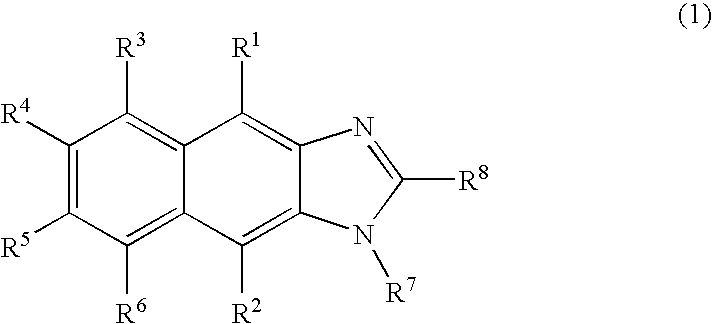
[0062] The compound of the above formula (1) having amphoteric properties can exhibit stronger n-type or p-type behavior of the whole molecule by introducing various substituents into the A or B portion. For example, when a specific substituent is introduced into the B portion of the formula (1) and the compound of the formula (1) exhibits one behavior stronger than the other behavior, the compound of the formula (1) can be a compound that more suitably meets the requirements as a hole-injecting or hole-transporting material, an electron-injecting or electron-transporting material, or a light-emitting material. For example, when R8 of the B portion is substituted with an alkyl group having an amine group, a cycloalkyl group having an amine group, an aryl group having an amine group, a heteroaryl group having an amine group, and the like, the compound of the formula (1) is widely applied as a material for the hole-injecting layer and hole-transporting layer. On the other hand, when R8 is substituted with a material having high electron affinity, such as an heteroaryl group, nitrile, nitro, carbonyl and amide, the compound of the formula (1) can be applied as a material for the electron-injecting or electron-transporting layer. Further, when R8 is substituted with alkenyl such as anthracene, perylene, pyrene and stilbene, the compound of the formula (1) can be applied for the light-emitting layer. A principle in which various substituents are introduced at R8, can be applied even when various substituents are introduced at R1 to R7,
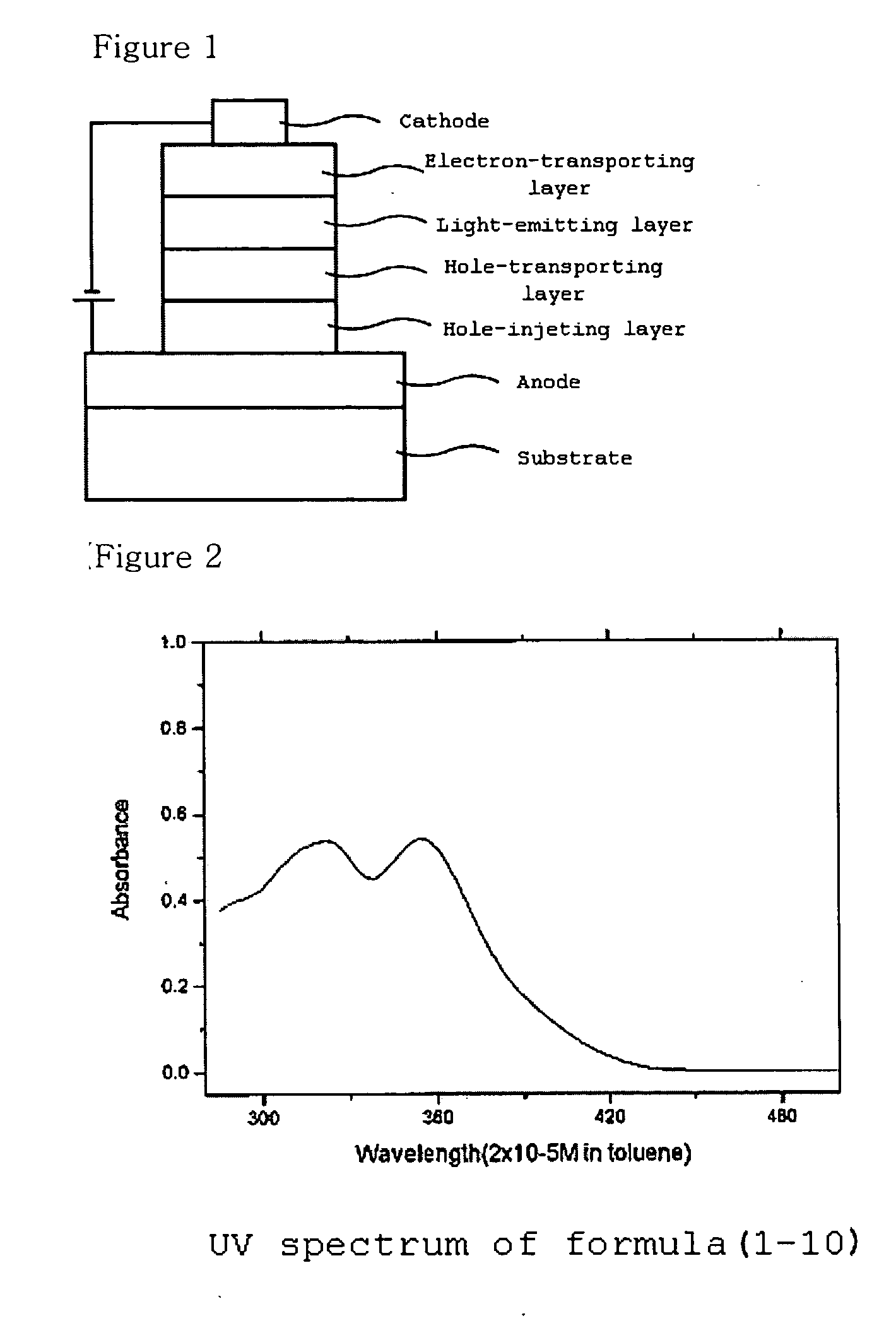
[0078] The compound of the invention is a new compound in which the compound can perform functions of hole injection, hole transportation, electron injection, electron transportation, and / or light emission in an organic electronic device including an organic light-emitting device, and further can perform a function of a light-emitting host together with a suitable dopant. By applying the compound of the invention to the organic electronic device including the organic light-emitting device, it is possible to achieve excellent effects in terms of an efficiency of a device, drive voltage and stability.
Problems solved by technology
However, the development of a stable and efficient organic material layer material for the organic light-emitting device has not yet been fully realized.
Method used
the structure of the environmentally friendly knitted fabric provided by the present invention; figure 2 Flow chart of the yarn wrapping machine for environmentally friendly knitted fabrics and storage devices; image 3 Is the parameter map of the yarn covering machine
View more
Image
Smart Image Click on the blue labels to locate them in the text.
Viewing Examples
Smart Image
Click on the blue label to locate the original text in one second.
Reading with bidirectional positioning of images and text.
Smart Image
Examples
Experimental program
Comparison scheme
Effect test
example 1
Synthesis of Compounds of Formula (1-10)
[0082] 1. Synthesis of the Compound of the Following Formula (10A)
[0083] 2,3-Dichloronaphthoquinone (22.7 g, 100 mmol), aniline (9.3 g, 100 mmol), N,N-dimethylaniline (50 mL) and acetic acid (200 mL) were mixed and heated for 6 hours. The reaction mixture turned to a dark red solution as the reaction proceeded. The reactants were cooled to room temperature, and the solid formed was filtered under reduced pressure and then dried under vacuum to obtain the compound of the above formula (10A) (22 g, yield 78%).
[0084] MS: [M+H]+=284(Cl×1)
[0085] 2. Synthesis of the Compound of the Following Formula (10B)
[0086] The compound of the formula (10A) (22 g, 77.6 mmol) and sodiumazide (NaN3, 10.1 g, 155.2 mmol) were dissolved in dimethylformamide (DMF, 200 mL) and water (H2O, 30 ml) was added thereto, and then the reactants were heated with stirring at 120° C. for 20 hours. The reactants were cooled to room temperature, and the black solid formed w...
example 2
Synthesis of Compounds of Formula (1-13)
[0101] 1. Synthesis of the Compound of the Following Formula (13C)
[0102] The compound of the above formula (13C) was prepared in the same manner as in the preparation of the compound of the formula (10C-1) except that 2-formylnaphthalene was used instead of 4-bromobenzaldehyde in Example 1-3.
[0103] MS [M+H]+=401
[0104] 2. Synthesis of the Compound of the Following Formula (13E)
[0105] Distilled water (165 ml), sodiumhydroxide (NaOH, 62 mmol, 24.8 g) and the compound of the above formula (13C) (12.2 mmol, 4.85 g) were introduced into activated zinc (Zinc, 20 g) and the reaction mixture was heated with stirring for 24 hours. Subsequently, the mixture was cooled to room temperature and filtered through Celite. The filtrate was extracted with dichloromethane (50 ml×3), dried over anhydrousmagnesiumsulfate and filtered under reduced pressure. The solvent was removed from the filtrate under reduced pressure, and the residue was recrystallize...
example 3
Synthesis of Compound of Formula (1-38)
[0113]
[0114] The solid compound of the formula (1-38) was prepared in the same manner as in the preparation of the compounds of the formula (10C-1), the formula (10D) and the formula (1-10) by using the compound of the above formula (10B) (5.28 g, 20 mmol) and quinoline-2-carboxaldehyde as a starting material.
[0115] Tg: 195° C., Tm: N.D(2nd)
[0116] MS: [M+H]+=511
the structure of the environmentally friendly knitted fabric provided by the present invention; figure 2 Flow chart of the yarn wrapping machine for environmentally friendly knitted fabrics and storage devices; image 3 Is the parameter map of the yarn covering machine
Login to View More
PUM
Property
Measurement
Unit
Light
aaaaa
aaaaa
Injection velocity
aaaaa
aaaaa
Login to View More
Abstract
The present invention relates to a new imidazole derivative, a method for preparing the derivative, and an organic electronic device using the derivative. The imidazole derivative according to the invention can perform functions of hole injection, hole transportation, electron injection, electron transportation, and / or light emission in an organic electronic device including an organic light-emitting device. The organic electronic device according to the invention exhibits excellent characteristics in terms of efficiency, drive voltage and stability.
Description
TECHNICAL FIELD [0001] The present invention relates to a new imidazole derivative, a method for preparing the same and an organic electronic device using the same. [0002] This application claims the benefit of the filing date of Korean Patent Application Nos. 10-2005-0066730, filed on Jul. 22, 2005, in the Korean Intellectual Property Office, the disclosure of which is incorporated herein in its entirety by reference. BACKGROUND ART [0003] The term “organic electronic device” as used in the present specification refers to a device requiring charge exchange between an electrode and an organic material, using holes and / or electrons. The organic electronic device can be largely classified into two types according to its operational principle as follows: One type is an electronic device having a configuration in which an exciton is formed in an organic material layer by photons flown from an external light source into the device and the exciton is separated into an electron and a hole,...
Claims
the structure of the environmentally friendly knitted fabric provided by the present invention; figure 2 Flow chart of the yarn wrapping machine for environmentally friendly knitted fabrics and storage devices; image 3 Is the parameter map of the yarn covering machine
Login to View More
Application Information
Patent Timeline
Application Date:The date an application was filed.
Publication Date:The date a patent or application was officially published.
First Publication Date:The earliest publication date of a patent with the same application number.
Issue Date:Publication date of the patent grant document.
PCT Entry Date:The Entry date of PCT National Phase.
Estimated Expiry Date:The statutory expiry date of a patent right according to the Patent Law, and it is the longest term of protection that the patent right can achieve without the termination of the patent right due to other reasons(Term extension factor has been taken into account ).
Invalid Date:Actual expiry date is based on effective date or publication date of legal transaction data of invalid patent.



 Login to View More