
Non-ionic non-aqueous vehicles for topical and oral administration of carrier-complexed active agents
a carrier complex and non-aqueous technology, applied in the field of non-ionic non-aqueous carriers for oral or topical administration of active agents, can solve the problems of increasing patient compliance and cost, and achieve the effects of increasing patient compliance, reducing costs, and increasing stability
- Summary
- Abstract
- Description
- Claims
- Application Information
AI Technical Summary
Benefits of technology
Problems solved by technology
Method used
Image

Examples
example 1
Preparation of Chlorphenramine Loaded Ion-exchange Resins (Lot 6)
[0135] A. Loading of Chlorpheniramine (Maleate salt) to Amberlite IRP-69 (Na-form):
IngredientQuantity / BatchChlorpheniramine Maleate 37 gAmberlite IRP-69, Na+ form100 gDI Water USPqs
Procedure:
[0136] Chlorpheniramine was bound to ion exchange resin particles in a single stage binding procedure at room temperature. Briefly, Amberlite IRP-69 resin (100 g) was added to de-ionized water (80 mL). The resulting slurry was well mixed. Chlorpheniramine Maleate (37 g) was added to the resin slurry and subjected to mixing at room temperature for 2 hours to allow binding to occur. The resinate particles were collected by vacuum filtration. The reaction suspension was then filtered using vacuum filtration and washed three times with 1300 mL of de-ionized water. The resulting active agent-resin complex was dried in a forced draft oven at 45° C. until the further loss of water upon complete drying was less than 10% (as measured w...
example 2
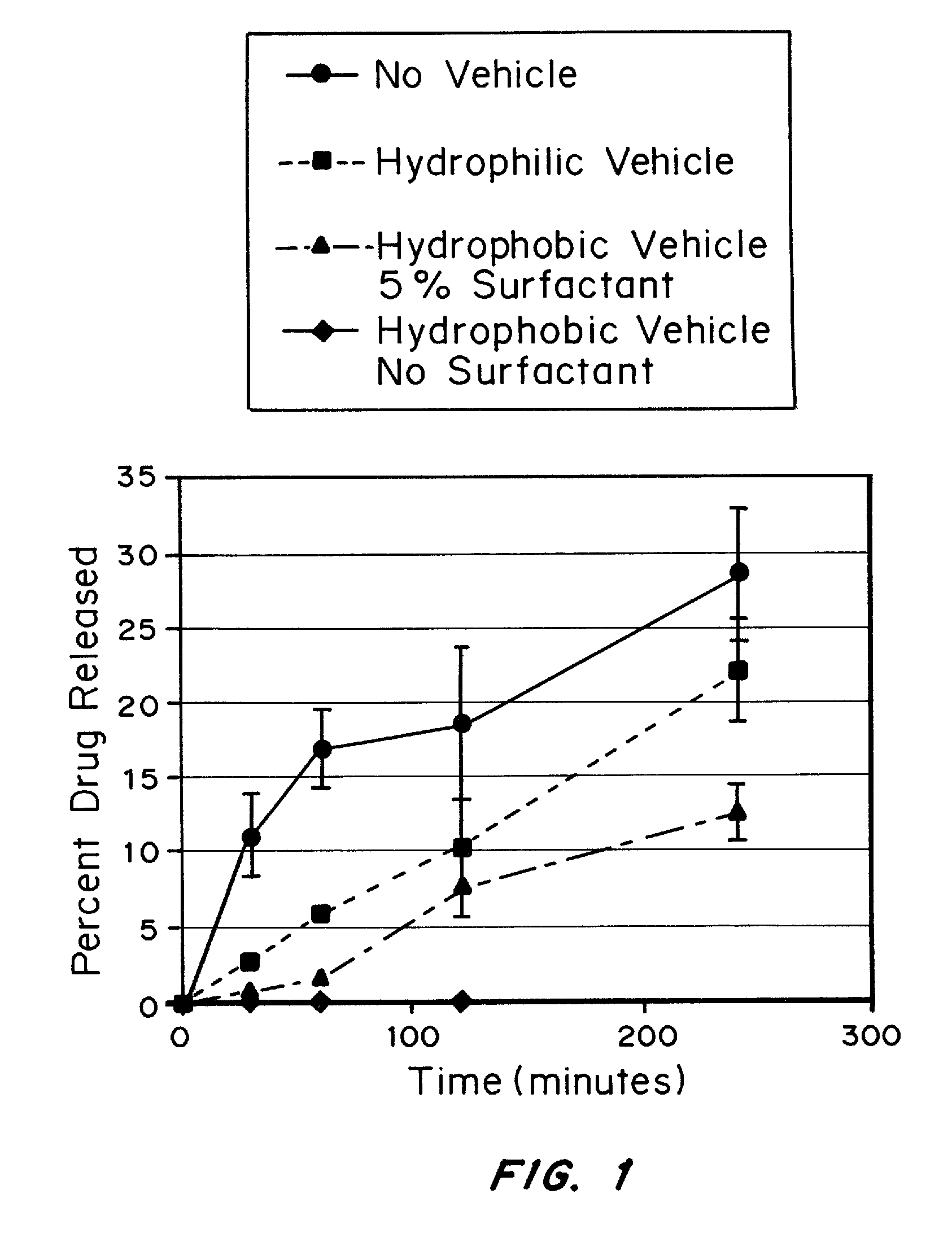
Release Profiles of Albuterol-Carrier Complexes in Different NINA Vehicles
Complexation of Albuterol to an Ion-Exchange Resin
[0142] Albuterol is a light-sensitive drug and should be protected from light during analysis. Amberlite IRP-69 was converted to the H+form by placing 100 g dry resin into 1000 g of 3N HCl and incubating the mixture at room temperature for 3 hrs. The resin was recovered on a glass fiber filter in a large Buchner funnel. The resin was washed in the funnel 3 times with 1500 g deionized water, and dried at 45° C. until the “loss on drying” of an aliquot at 110° C. for 1 hour was less than 10% by weight of the resin.
[0143] The H+ resin (25 g) was taken up in 250 g deionized water in a beaker and stirred for 15 minutes. The beaker was shielded from light, and then 27 g of albuterol was added to the resin slurry. The mixture was stirred for 3 hours. The resin was collected on a glass fiber filter in a Buchner funnel and rinsed successively with 150 ml DI water, 2...
PUM
| Property | Measurement | Unit |
|---|---|---|
| diameter | aaaaa | aaaaa |
| particle diameter | aaaaa | aaaaa |
| size | aaaaa | aaaaa |
Abstract
Description
Claims
Application Information
 Login to View More