Oligonucleotides comprising a ligand tethered to a modified or non-natural nucleobase

US20070054279A1Active Publication Date: 2007-03-08ALNYLAM PHARM INC

Image

Smart Image Click on the blue labels to locate them in the text.
Viewing Examples
Smart Image
  • Oligonucleotides comprising a ligand tethered to a modified or non-natural nucleobase
  • Oligonucleotides comprising a ligand tethered to a modified or non-natural nucleobase
  • Oligonucleotides comprising a ligand tethered to a modified or non-natural nucleobase

Examples

Experimental program
Comparison scheme
Effect test

example 1

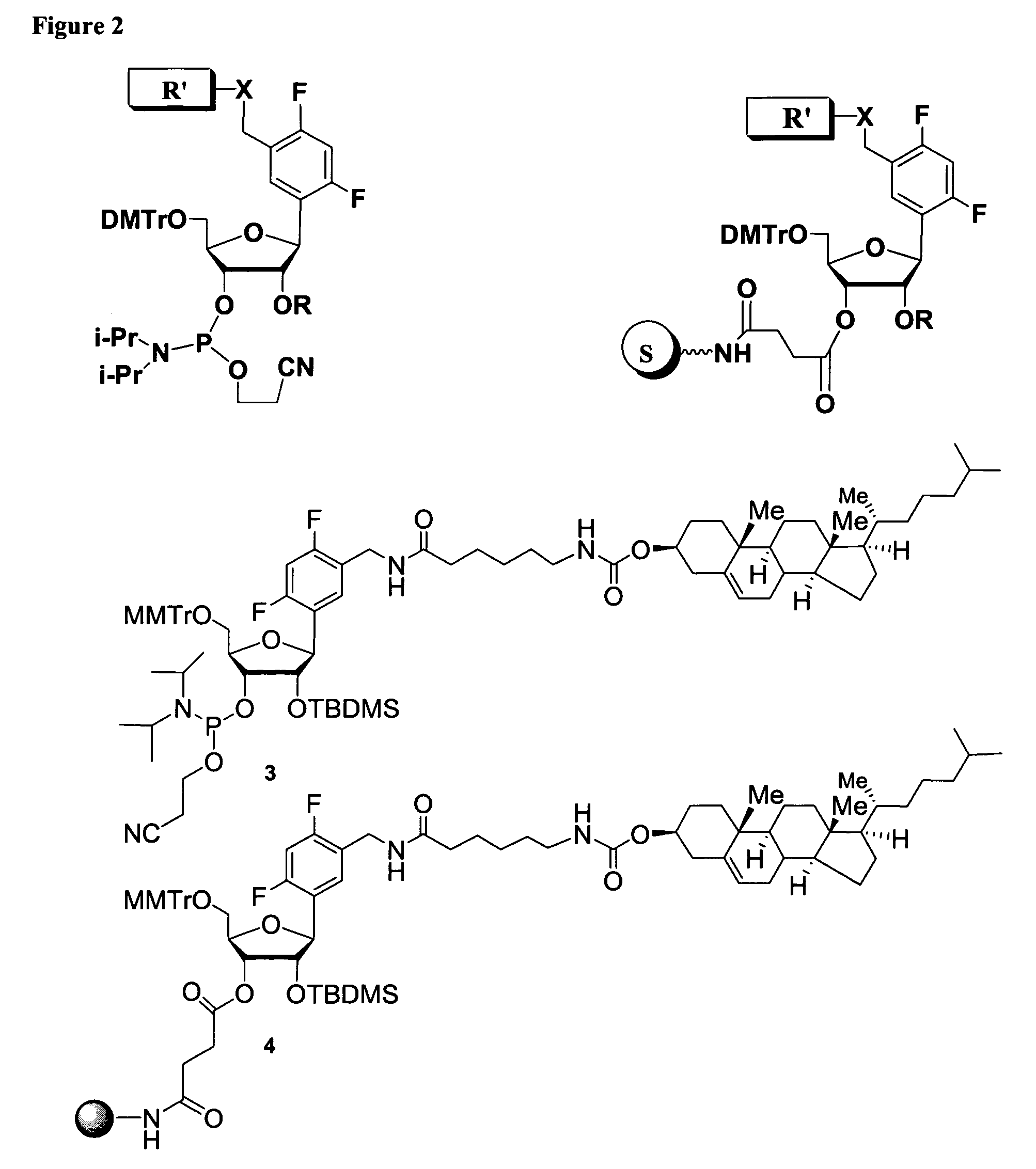
Part I: Synthesis of 5′-O-(4,4′-dimethoxitrityl)-2′-O-(tert-butyldimethylsilyl)-1′-(2,4-difluorotoluene)-D-riboside-3′-O-cyanoethyl-N,N-diisopropylphosphoramidate and 5′-O-(4,4′-Dimethoxitrityl)-3′-O-(tert-butyldimethylsilyl)-1′-(2,4-difluorotoluene)-D-riboside-2′-O-cyanoethyl-N,N-diisopropylphosphoramidate

General Procedures

[0735] TLC was conducted on glass plates precoated with a 0.25-mm layer of Silica Gel 60 F-254 (Merck analysis). The compounds were visualized either by exposure to UV light or by spraying with 5% H2SO4, and 0.2% p-anisaldehyde in a solution of ethanol and heating or both. Solutions were concentrated under reduced pressure at 1H-NMR spectra were recorded at 30° C. with 400 MHz spectrometer. The values of δ (ppm) are given relative to the signal (δ 0) for internal Me4Si for solutions in CDCl3, CD3OD, and DMSO-d6. 13C-NMR spectra were recorded at 303.0 K with a 400.0 MHz or 500 MHz spectrometer using CDCl3 (77.0 ppm), CD3OD (49.15 ppm), and DMSO-d6 (39.5 ppm) as...

example 2

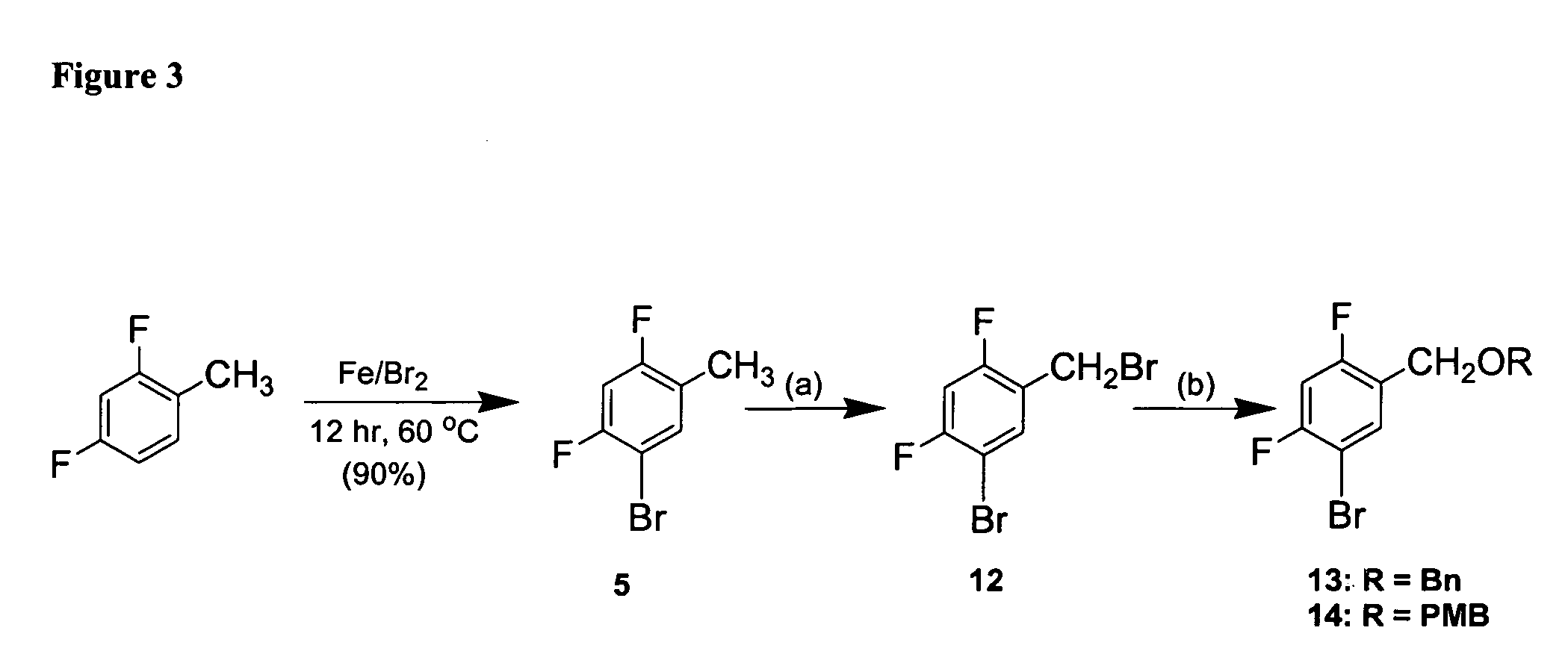
[0753] 2,4-Difluoro-5-Bromo-(α-bromomethyl)benzene (12). To a solution of 2,4-difluoro-5-bromotoluene 5 (57 g, 0.28 mol), NBS (51.5 g, 0.29 mol) in dry CC14 (277 mL) was added benzyol peroxide (1.99 g, 8.2 mmol) and stirred at 80° C. for 6 h under an argon atmosphere. The solids were filtered off and the filtrate was concentrated into a crude residue which was applied to a column of silica gel eluted with hexanes to give a pure compound 12 (46.98 g, 60%) as a clean oil. 1H-NMR (CDCl3, 400 MHz): δ 7.60 (t, 1H, J=7.6 Hz, ArH), 6.90 (t, 1H, J=8.6 Hz, ArH), 4.45 (s, 2H, CH2Br). 19F-NMR (CDCl3, 399.8 MHz): δ−126.84 (q, 1 F), −138.45 (q, 1 F). 13C-NMR (CDCl3, 100 MHz): δ 160.79 (dd, J=10.6 Hz, J=59.5 Hz), 158.23 (dd, J=10.7 Hz, J=62.8 Hz), 135.03 (dd), 123.13 (dd, J=3.9 Hz, J=15.7 Hz), 105.50 (t, J=26 Hz), 104.11 (dd, J=4.6 Hz, J=21.4 Hz), 53.54 (CH2Br). Anal. of C7H4F2Br2: 283.6. ESIMS (m / z): Found: 283.5 [M]+.

example 3

[0754] 5-Bromo-(α-O-benzyl)-2,4-difluorobenzyl alcohol (13). To a solution of benzyl alcohol (504 mg, 4.67 mmol) in dry THF (3 mL) was added sodium hydride (467 mg, 11.68 mmol, 60% dispersion in mineral oil) and stirred at room temperature under an argon atmosphere for 30-40 min. 2,4-Difluoro-5-(α-bromomethyl)benzene 12 (1.46 g, 5.14 mmol) in dry THF (1 mL) was then added to the above reaction mixture and stirred at the same temperature under an argon atmosphere for 2-3 h. The reaction mixture was quenched with cold water and concentrated to removal of THF and extracted with dichloromethane (3×50 mL). The organic phase was washed with sodium bicarbonate, brine, dried (Na2SO4), and concentrated into a crude residue which was applied to a column of silica gel eluted with hexane-ethyl acetate (2:1) to give a pure compound 13 (976 mg, 67%) as a clear oil. 1H-NMR (CDCl3, 400 MHz): δ 7.66 (t, 1H, J=7.6 Hz, ArH), 7.40-7.29 (m, 5H, ArH), 6.88 (t, 1H, J=8.8 Hz, ArH), 4.60 (s, 2H, CH2O), 4.54...

the structure of the environmentally friendly knitted fabric provided by the present invention; figure 2 Flow chart of the yarn wrapping machine for environmentally friendly knitted fabrics and storage devices; image 3 Is the parameter map of the yarn covering machine
Login to View More

PUM

PropertyMeasurementUnit
Temperatureaaaaaaaaaa
Login to View More

Abstract

One aspect of the present invention relates to a double-stranded oligonucleotide comprising at least one ligand tethered to an altered or non-natural nucleobase. In certain embodiments, the non-natural nucleobase is difluorotolyl, nitropyrrolyl, or nitroimidazolyl. In certain embodiments, the ligand is a steroid or aromatic compound. In certain embodiments, only one of the two oligonucleotide strands comprising the double-stranded oligonucleotide contains a ligand tethered to an altered or non-natural nucleobase. In certain embodiments, both of the oligonucleotide strands comprising the double-stranded oligonucleotide independently contain a ligand tethered to an altered or non-natural nucleobase. In certain embodiments, the oligonucleotide strands comprise at least one modified sugar moiety. Another aspect of the present invention relates to a single-stranded oligonucleotide comprising at least one ligand tethered to an altered or non-natural nucleobase. In certain embodiments, the non-natural nucleobase is difluorotolyl, nitropyrrolyl, or nitroimidazolyl. In certain embodiments, the ligand is a steroid or aromatic compound. In certain embodiments, the ribose sugar moiety that occurs naturally in nucleosides is replaced with a hexose sugar, polycyclic heteroalkyl ring, or cyclohexenyl group. In certain embodiments, at least one phosphate linkage in the oligonucleotide has been replaced with a phosphorothioate linkage.

Description

RELATED APPLICATIONS [0001] This application claims the benefit of priority to U.S. Provisional Patent Application Ser. No. 60 / 598,596, filed Aug. 4, 2004; the application is hereby incorporated by reference in its entirety.BACKGROUND OF THE INVENTION [0002] Oligonucleotide compounds have important therapeutic applications in medicine. Oligonucleotides can be used to silence genes that are responsible for a particular disease. Gene-silencing prevents formation of a protein by inhibiting translation. Importantly, gene-silencing agents are a promising alternative to traditional small, organic compounds that inhibit the function of the protein linked to the disease. siRNA, antisense RNA, and micro-RNA are oligonucleotides that prevent the formation of proteins by gene-silencing. siRNA [0003] RNA interference (RNAi) is an evolutionarily conserved gene-silencing mechanism, originally discovered in studies of the nematode Caenorhabditis elegans (Lee et al, Cell 75:843 (1993); Reinhart et...

Claims

the structure of the environmentally friendly knitted fabric provided by the present invention; figure 2 Flow chart of the yarn wrapping machine for environmentally friendly knitted fabrics and storage devices; image 3 Is the parameter map of the yarn covering machine
Login to View More

Application Information

Patent Timeline
08 Mar 2007
Publication
US20070054279A1
IPC
C12Q1/68; C07H21/02; C07F9/6512; C07F9/6533
CPC
A61K31/7115; C07F9/6561; C12Q1/6883; C07H21/02; C07H21/00; Y02A50/30
Inventors
MANOHARAN, MUTHIAH; RAJEEV, KALLANTHOTTATHIL