Check patentability & draft patents in minutes with Patsnap Eureka AI!

Hydrogenation of aromatic amines to alicyclic amines using a lithium aluminate-based catalyst

a lithium aluminate and catalyst technology, applied in the field of hydrogenation processes of aromatic compounds, can solve the problems of rapid decline in activity and hydrogenation efficiency, unsuitable ruthenium catalysts for hydrogenation of feeds containing impurities, etc., and achieve the effect of stable compound

Inactive Publication Date: 2007-03-22
EVONIK OPERATIONS GMBH
View PDF14 Cites 5 Cited by
  • Summary
  • Abstract
  • Description
  • Claims
  • Application Information

AI Technical Summary

Benefits of technology

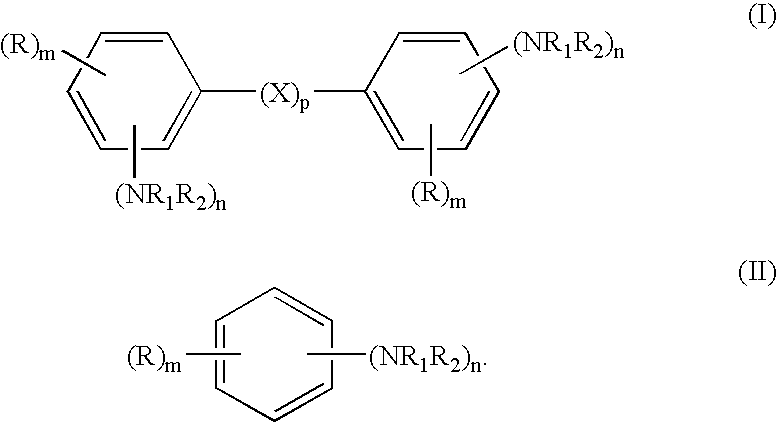
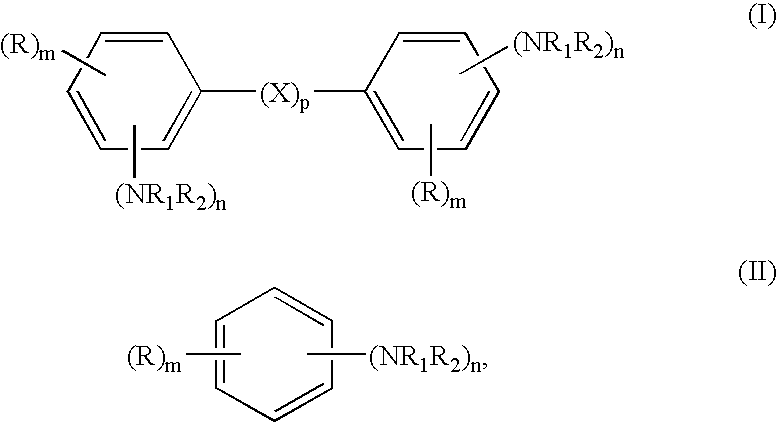
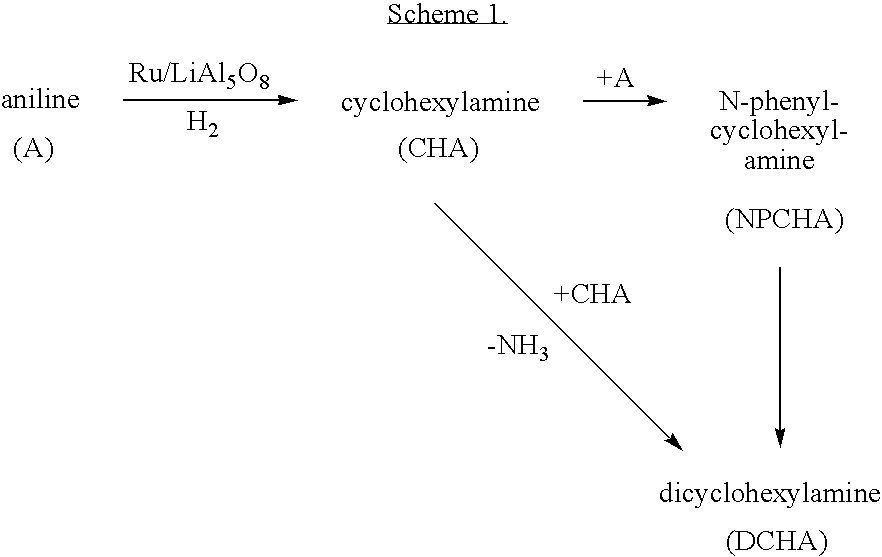
The present invention provides an improved process for producing cycloaliphatic amines, such as cyclohexylamine and bis(para-aminocyclohexyl)methane, by the catalytic hydrogenation of aromatic amines. The process involves contacting the aromatic amine with hydrogen in the presence of a ruthenium catalyst on a mixed metal support, specifically a lithium aluminate support. The invention also provides a method of making cyclohexylamine from aniline using the same ruthenium catalyst on a lithium aluminate support. The technical effects of this invention include improved yields and purity of the desired cycloaliphatic amines, as well as simplified and efficient production methods.

Problems solved by technology

Ruthenium catalysts, although commonly used for hydrogenation, were reportedly not suited for hydrogenation of a feed containing impurities. e.g., isomeric impurities.
These impurities in the feed allegedly caused a rapid decline in activity and hydrogenation efficiency.
The problem with using many of these previously-described supported catalyst systems in commercial scale hydrogenations of functionalized aromatics, such as aromatic amines, is that these supported catalysts simultaneously catalyze coupling reactions that give undesirable byproducts.

Method used

the structure of the environmentally friendly knitted fabric provided by the present invention; figure 2 Flow chart of the yarn wrapping machine for environmentally friendly knitted fabrics and storage devices; image 3 Is the parameter map of the yarn covering machine
View more

Image

Smart Image Click on the blue labels to locate them in the text.
Viewing Examples
Smart Image
  • Hydrogenation of aromatic amines to alicyclic amines using a lithium aluminate-based catalyst
  • Hydrogenation of aromatic amines to alicyclic amines using a lithium aluminate-based catalyst
  • Hydrogenation of aromatic amines to alicyclic amines using a lithium aluminate-based catalyst

Examples

Experimental program
Comparison scheme
Effect test

example 1

Preparation of Lithium Aluminate (LiAl5O8) from Lithium Acetate

[0063] Lithium acetate (CH3COOLi.2H2O, 40.0 g) was added to Gibbsite (C31 alumina 153 g) in a plastic container and mixed. The mixture was then transferred to a ceramic dish and dried at 110° C. for 24 h and calcined at 1000° C. in air for 20 h (ramp: 5° C. / min). (Ramp refers to increasing the temperature from room temperature to the final temperature at a specified rate per minute.) Yield: ˜100 g of white powder (powder x-ray diffraction (XRD) indicated LiAl5O8 with a purity over 98%).

example 2

Preparation of Lithium Aluminate (LiAl5O8) from Lithium Carbonate

[0064] Lithium carbonate (Li2CO3, 14.5 g) was added to Gibbsite (C31 alumina from Alcoa, 153 g) in a plastic container and mixed well. The mixture is then transferred to a ceramic dish and calcined at 1000° C. in air for 24 h (ramp: 5° C. / min). Yield: ˜100 g of white powder (XRD indicated LiAl5O8 with a purity over 98%.)

[0065] The above example exhibits synthesizing LiAl5O8 by solid state reaction between a lithium salt and aluminum hydroxide with the elimination of the use of any solvents. This method is especially suitable for large scale synthesis.

example 3

Preparation of Lithium Aluminate (LiAl5O8) from Lithium Hydroxide

[0066] Lithium hydroxide (LiOH.H2O, 8.25 g) was added to Gibbsite (C31 alumina, 76.6 g) in 40 ml D.I. (deionized) water. The free-flow suspension was heated on a hot plate with stirring for 30 min to remove water. The resulting solid cake was broken into small pieces and dried in a oven at 110° C. for 16 h. The solid was then ground and calcined at 600° C. (ramp: 5° C. / min) for 20 h. Yield: 53 g white powder.

the structure of the environmentally friendly knitted fabric provided by the present invention; figure 2 Flow chart of the yarn wrapping machine for environmentally friendly knitted fabrics and storage devices; image 3 Is the parameter map of the yarn covering machine
Login to View More

PUM

PropertyMeasurementUnit
hydrogenation pressureaaaaaaaaaa
temperatureaaaaaaaaaa
pressureaaaaaaaaaa
Login to View More

Abstract

The present invention relates to processes for the catalytic hydrogenation of aromatic amines to their acyclic counterparts using a ruthenium catalyst on a lithium aluminate support. The hydrogenation process comprises contacting an aromatic amine with hydrogen in the presence of a ruthenium catalyst under temperature and pressure conditions suitable to effect ring hydrogenation. The process is especially useful for hydrogenating aniline to cyclohexylamine.

Description

FIELD OF THE INVENTION [0001] The present invention provides processes for hydrogenating aromatic compounds in which there is at least one amino functionality bonded to an aromatic nucleus and, more specifically, processes for hydrogenating aromatic amino compounds to the corresponding cycloaliphatic amino compounds. In particular, a process for hydrogenating aromatic amines to alicyclic amines using ruthenium on a lithium aluminate support is disclosed. DESCRIPTION OF RELATED ART [0002] Supported metal catalysts have been widely used in the petroleum and petrochemical industry for reforming, isomerization, and cracking among other applications. Supported transition-metal catalysts are used in steam reforming, hydrocracking, hydrodesulfurisation, and Fischer-Tropsch (FT) synthesis for the conversion of natural gas into liquid fuels with low sulfur content, low aromaticity, low centane number and good cold flow properties. [0003] Selective hydrogenation reactions using supported tran...

Claims

the structure of the environmentally friendly knitted fabric provided by the present invention; figure 2 Flow chart of the yarn wrapping machine for environmentally friendly knitted fabrics and storage devices; image 3 Is the parameter map of the yarn covering machine
Login to View More

Application Information

Patent Timeline
no application Login to View More
Patent Type & Authority Applications(United States)
IPC IPC(8): C07C209/72
CPCC07C209/72C07C2101/14C07C211/35C07C211/36C07C2601/14C07C211/33C07C211/34C07C209/00
Inventor VEDAGE, GAMINI ANANDADING, HAOENGEL, MATTHEW J.LUTZ, EUGENE GEORGEEMIG, LENORE ANN
Owner EVONIK OPERATIONS GMBH
Features
  • R&D
  • Intellectual Property
  • Life Sciences
  • Materials
  • Tech Scout
Why Patsnap Eureka
  • Unparalleled Data Quality
  • Higher Quality Content
  • 60% Fewer Hallucinations
Social media
Patsnap Eureka Blog
Learn More