Unlock instant, AI-driven research and patent intelligence for your innovation.

Flexible EL device and methods

Inactive Publication Date: 2007-03-29
THOMAS GARY E +1
View PDF3 Cites 2 Cited by
  • Summary
  • Abstract
  • Description
  • Claims
  • Application Information

AI Technical Summary

Benefits of technology

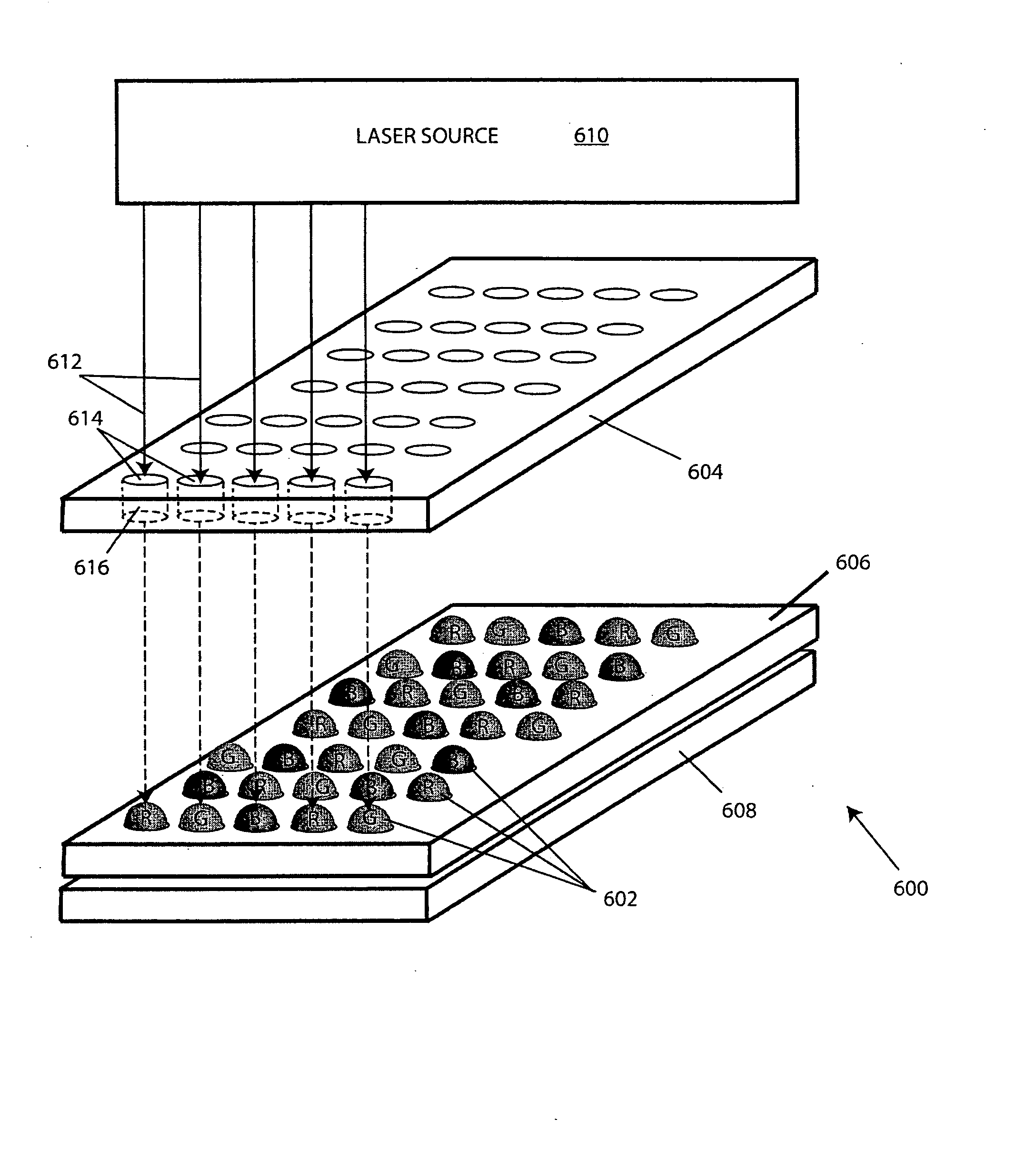
[0021] In another exemplary embodiment, the EL particles are provided to spot-heated target areas of a polymer by dropping the EL particles on the polymer. The EL particles may be provided by various means such as, by way of example and not limitation, pouring them from a container, carrying them on an air stream, or providing them on a roll. For example, a plurality of target areas may be locally heated in a polymer substrate by a laser so that the target areas become molten. EL particles may then be poured onto the polymer substrate from a container so that some of the EL particles contact the molten target areas (receiving areas) and adhere to the molten material so that they are retained by the polymer substrate. EL particles that do not contact the molten target areas do not adhere to the polymer substrate and, therefore, are not retained. These non-adhered particles can be removed from the polymer substrate and collected for later use. For example, they can be brushed or blown off the substrate and captured in a container. An advantage of this embodiment is that it eliminates the difficulties and limitations associated with the use of a carrier tray. Furthermore, a wide variety of EL particle patterns may be achieved by changing the location of the heated target areas by simply reprogramming the laser.
[0024] The present invention provides means to avoid the multistep heating process of the prior art method described above, as well as the need to heat the entire polymer substrate. In addition, it avoids the EL particle arrangement limitations intrinsic to use of a carrier tray. The method is also sufficiently reliable and high-speed to produce sufficient throughput for industrial scale applications. In addition, the method can produce desired RGB pixel structures or other arrangements suitable for EL display applications. Because the polymer substrate is not subjected to overall heating its structural integrity is preserved so as to facilitate the accurate transfer of the phosphor-coated EL particles to provide a desired pixel arrangement.

Problems solved by technology

These dielectrics do not always provide optimum EL performance due to their relatively low dielectric constants.
While all of these dielectrics exhibit a sufficiently high figure of merit (defined as the product of the breakdown electric field and the relative dielectric constant) to function in the presence of high electric fields, some of these materials do not offer sufficient chemical stability and compatibility in the presence of high processing temperatures that may be required to fabricate an EL device.
Also, it is difficult to form high dielectric constant insulating layers as thin films with good breakdown protection.
Glass substrates are commonly used in commercial production, but, at temperatures significantly higher than 500° C., glass softens and stresses within the glass may cause mechanical deformation.
), warping or compaction of the glass will occur, particularly if a long annealing time is required.
Although these dielectrics offer good breakdown protection due to their thickness, they limit the processing temperature of phosphors that are on top of the dielectric layer, as phosphors that require high-temperature processing (700° C. or higher) may be contaminated by the dielectric formulation at these temperatures.
Also, substrate cost is much higher for ceramics than for glass, particularly for large size ceramics over ˜30 cm in length or width, since cracking and warping of large ceramic sheets is hard to prevent or control.
During operation, however, these Cu2-XS tips lose their sharpness, and the electric field decreases, resulting in weaker luminescence.
Furthermore, the use of a carrier tray is complicated and time consuming, and limits the arrangement of the EL spheres in the polymer to the arrangements of the pits in the tray.

Method used

the structure of the environmentally friendly knitted fabric provided by the present invention; figure 2 Flow chart of the yarn wrapping machine for environmentally friendly knitted fabrics and storage devices; image 3 Is the parameter map of the yarn covering machine
View more

Image

Smart Image Click on the blue labels to locate them in the text.
Viewing Examples
Smart Image
  • Flexible EL device and methods
  • Flexible EL device and methods
  • Flexible EL device and methods

Examples

Experimental program
Comparison scheme
Effect test

Embodiment Construction

[0040] Generally speaking, the systems and methods described herein are directed to incorporating EL particles in a flexible substrate to form a flexible EL apparatus. As required, embodiments of the present invention are disclosed herein. However, the disclosed embodiments are merely exemplary, and it should be understood that the invention may be embodied in many various and alternative forms. The figures are not to scale and some features may be exaggerated or minimized to show details of particular elements while related elements may have been eliminated to prevent obscuring novel aspects. Therefore, specific structural and functional details disclosed herein are not to be interpreted as limiting but merely as a basis for the claims and as a representative basis for teaching one skilled in the art to variously employ the present invention. For purposes of teaching and not limitation, the illustrated embodiments are directed to an EL apparatus that may be used to form a display. ...

the structure of the environmentally friendly knitted fabric provided by the present invention; figure 2 Flow chart of the yarn wrapping machine for environmentally friendly knitted fabrics and storage devices; image 3 Is the parameter map of the yarn covering machine
Login to View More

PUM

No PUM Login to View More

Abstract

A method of incorporating EL particles includes preparing target areas to receive EL particles and providing EL particles to the target areas. The method may include spot-heating target areas of a flexible substrate to form molten receiving areas adapted to receive an EL particle. EL particles may be provided to the target areas by a carrier tray or by a random process so that the EL particles adhere to the substrate at the target areas and form an EL apparatus. Pressure may be applied to embed the EL particles to a desired depth and top and bottom electrodes may be provided to the EL apparatus to form an EL display. A system for incorporating EL particles into a substrate may include a heat source adapted to spot-heat target areas and a carrier for providing EL particles to the target areas.

Description

CROSS-REFERENCE TO RELATED APPLICATIONS [0001] This application claims priority benefit to co-pending U.S. Provisional Application No. 60 / 720,695 filed on Sep. 27, 2005, entitled Method For Transferring EL Spheres to Polymer Film, which is entirely incorporated herein by reference.FIELD OF THE INVENTION [0002] The present invention relates to electroluminescent (EL) devices and methods for making such devices, and more particularly, to methods for incorporating EL particles into a substrate to form a flexible EL apparatus. BACKGROUND OF THE INVENTION [0003] Thin film electroluminescent (TFEL) devices typically consist of a laminar stack of thin films deposited on an insulating substrate. These thin films may include a transparent electrode layer, an electroluminescent (EL) layered structure comprising an EL phosphor sandwiched between a pair of insulating layers, and a second electrode layer. In matrix-addressed TFEL panels the front and rear electrodes form orthogonal arrays of row...

Claims

the structure of the environmentally friendly knitted fabric provided by the present invention; figure 2 Flow chart of the yarn wrapping machine for environmentally friendly knitted fabrics and storage devices; image 3 Is the parameter map of the yarn covering machine
Login to View More

Application Information

Patent Timeline
no application Login to View More
IPC IPC(8): B05D5/06B05C5/00B05B13/02B05B7/16
CPCG02F1/133603H05B33/20H05B33/10H01L51/0013H10K71/18
Inventor THOMAS, GARY E.KITAI, ADRIAN H.
Owner THOMAS GARY E