[0005]A cylindrical plastic-film
balloon envelope design is used to provide an inexpensive buoyant platform. This design is well-known to those skilled in the art as being easy to manufacture in quantity, because it does not require the design specific curved scams of a so-called “natural shape” envelope. A range of envelope sizes can be provided so that a deployable
system can fly individual platforms at any altitude as required by the application and weather conditions; for example, five “family” sizes can cover the range from 60,000 feet to 100,000 feet altitude for one specific payload
mass range. A novel adjustable end-fitting can be provided so the specific
balloon volume for the desired altitude required can be set at
launch time. The system operator simply selects the smallest family size that can reach the required altitude, adjusts the end fitting to the precise
balloon length needed, and cuts off excess material. While cylindrical envelopes are used in an embodiment to provide inexpensive lift, other shapes can be used in an alternate embodiment to optimize the flight differently. For example, a natural shape envelope could be used to increase envelope performance or efficiency. Additionally, an aerodynamically shaped envelope could be used to provide a tactically launched high altitude airship. In this case the PRV would be powered to provide the airships propulsion system.
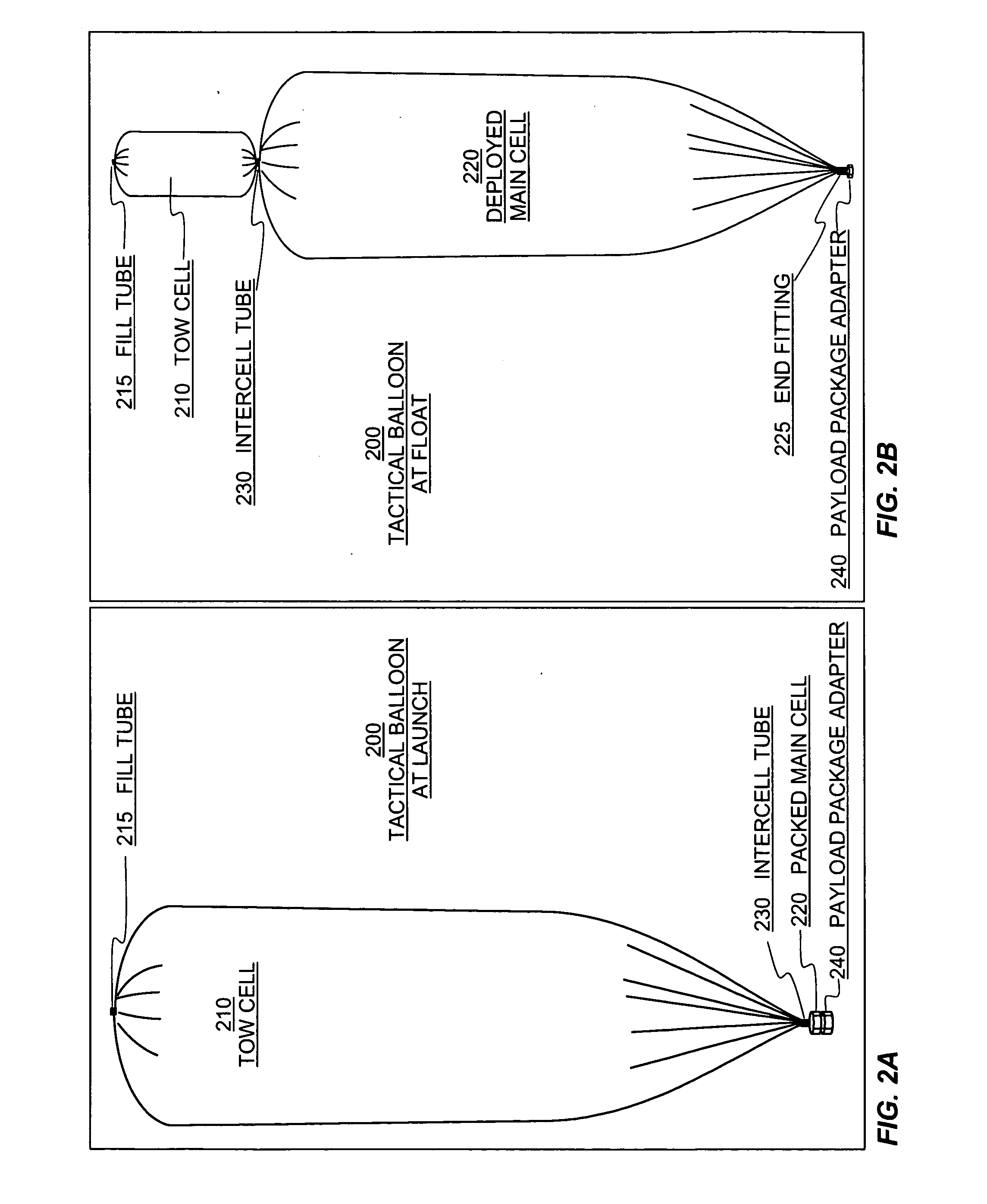
[0006]A pair of techniques from prior art are used to simplify launch procedures and reduce personnel requirements. Because these balloons are very large, when filled they present significant surface area to any wind present at launch. This can be a substantial safety
hazard to launch personnel, and creates a great risk of equipment loss. To reduce the surface area at launch, thereby reducing the risks and allowing the platform to be launched in higher winds, a two-
cell design is used. A smaller tow
cell is attached to the larger main
cell, so that the main cell remains unfilled until the pair has accelerated to a speed close to that of the
prevailing winds, thereby minimizing the effective wind load on the large main envelope. In addition, the main balloon cell is packed in a deployment bag which includes an automatic release mechanism. When an appropriate altitude or time after launch is achieved, a
control system activates the release mechanism, thereby deploying the main cell. Rather than a large sail area at launch, the packed main cell is a compact bundle that does not catch any wind. This
elimination of surface area reduces the potential for damage to the gossamer structure due to high wind loading; it also reduces the number of personnel required by making the “launch
train” dramatically shorter, in turn eliminating related hazards to personnel and equipment at launch. The tow cell and the main cell are connected via an intercell tube fitting, so that as the combination rises the buoyant gas expands to fill both envelopes.
[0007]For certain flight requirements, management of lifting-gas flow between the tow cell and the main cell may be accomplished via a valve in the intercell tube fitting. This valve is controlled by the platform management computer (see below) via a
wireless local
communication link that is separate from the main platform communication links described below. Using a
wireless link for this local communication avoids the complication of adding flexible wires to the packed main cell, and is a novel approach. During ascent, closing this valve prevents further expansion of the
lifting gas into the main cell envelope, which stops the ascent at a particular altitude. Reopening the valve permits the
lifting gas to continue expanding into the main cell, thereby resuming the ascent. In an alternate embodiment, the valve may be installed in the tow cell's top fitting, allowing the ascent to be slowed or stopped by venting
lifting gas rather than forcing it into the main cell. Depending on altitude, duration, and the amount of free lift required for a particular flight profile, to store the extra lifting gas that may be used in either of these
altitude control schemes the tow cell may be enhanced to “super-pressure” capability so that it can accommodate the
gas pressure that builds behind the closed valve as the platform rises. While super-pressure balloons themselves are known to those skilled in the art, their simultaneous application as a tow cell and as a gas reservoir in a multicell platform is novel.



 Login to View More
  Login to View More