
Benzoimidazole compound capable of inhibiting prostaglandin d synthetase
a benzoimidazole compound and prostaglandin d synthetase technology, applied in the field of new benzimidazole compounds, can solve the problems of insufficient activity, insufficient medicinal action, inability to say sufficient activity, etc., and achieve excellent prostaglandin d synthetase inhibitory activity, and high inhibitory activity
- Summary
- Abstract
- Description
- Claims
- Application Information
AI Technical Summary
Benefits of technology
Problems solved by technology
Method used
Image

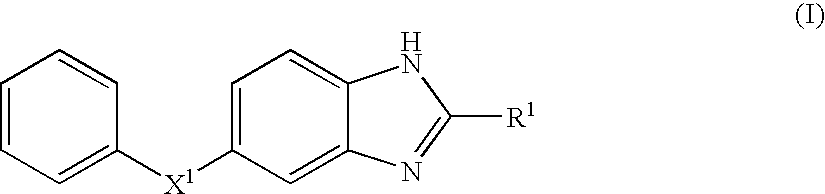
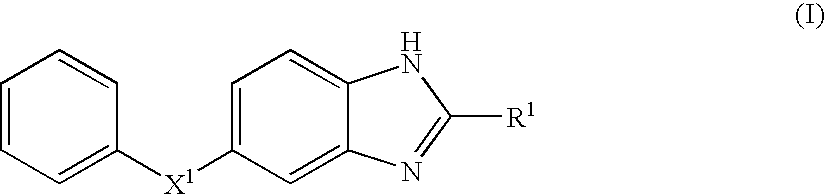
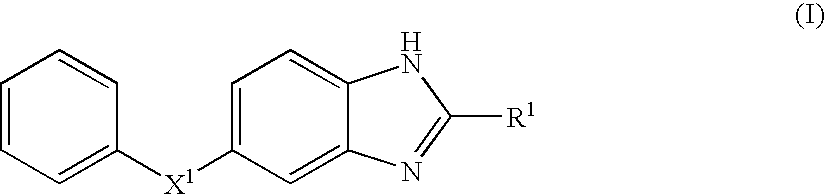
Examples
example 1
5-Benzoyl-2-(2,4-dimethylfuran-3-yl)-benzimidazole (1)
[0359]
[0360]2,4-Dimethylfuran-3-carboxylic acid (30 mg, 0.21 mmol) and 4-(4,6-dimethoxy-1,3,5-triazine-2-yl)-4-methylmorpholinium chloride (65 mg, 0.23 mmol) were added to a methanol (3 ml) solution of 3,4-diaminobenzophenone (43 mg, 0.19 mmol) and stirred overnight, and the solvent was concentrated at reduced pressure. A chloroform / methanol mixture (7:1) and a saturated sodium carbonate were added to the residue and stirred for 30 minutes, and then the mixture was extracted using a chloroform / methanol mixture (7:1). The combined organic layer was washed with a saturated sodium chloride and dried with anhydrous magnesium sulfate.
[0361]The residue obtained by concentration at reduced pressure was purified using medium pressure silica gel flash column chromatography (chloroform:methanol=99:1). The obtained adduct was dissolved in acetic acid (4 ml) and stirred at 80° C. overnight. The solution was allowed to cool to room temperatur...
example 2
4-(5-Benzoylbenzimidazol-2-yl)-3,5-dimethylfuran-2-carboxamide (2)
Example 2 (1)
3,5-Dimethyl-4-ethoxycarbonylfuran-2-carboxylic acid (starting material for compound according to Example 2)
[0364]
[0365]2,4-Dimethyl-5-formylfuran-3-carboxylic acid ethyl ester (1.78 g, 9.1 mmol) reported in the references was dissolved in a mixture of acetic acid (32 ml) and water (8 ml). Amidosulfuric acid (1.19 g, 12.2 mmol) was added to the solution, and cooled to 0° C. in an ice bath. Sodium chlorite was added and stirred for 2 hours, and after addition of water to reaction mixture, precipitate was collected by filtration, thereby giving 3,5-dimethyl-4-ethoxycarbonylfuran-2-carboxylic acid (1.01 g, 52%) as a white solid.
[0366]1H-NMR (CDCl3): δ (ppm) 1.38 (t, J=7.3 Hz, 3H), 2.56 (s, 3H), 2.64 (s, 3H), 4.33 (q, J=7.3 Hz, 2H).
Example 2 (2)
3,5-Dimethyl-4-ethoxycarbonylfuran-2-carboxamide (intermediate for compound according to Example 2)
[0367]
[0368]1-Ethyl-3-(3-dimethylaminopropyl)carbodiimide hydrochlor...
example 2 (
3)
4-(5-Benzoylbenzimidazol-2-yl)-3,5-dimethylfuran-2-carboxamide (2)
[0370]
[0371]The 3,5-dimethyl-4-ethoxycarbonylfuran-2-carboxamide (176 mg, 0.83 mmol) obtained in Example 2 (2) was dissolved in ethanol (4 ml), and 0.13 ml of a 4 N sodium hydroxide aqueous solution was added and stirred at 75° C. for 4 hours. The solution was neutralized with 1 N hydrochloric acid at room temperature, and after the evaporation, a precipitate (crude carboxylic acid) was collected by filtration and used directly for the subsequent reaction.
[0372]The crude carboxylic acid (39 mg, 0.21 mmol) and 4-(4,6-dimethoxy-1,3,5-triazine-2-yl)-4-methylmorpholinium chloride (65 mg, 0.23 mmol) were added to a methanol (3 ml) solution of 3,4-diaminobenzophenone (43 mg, 0.19 mmol) and stirred overnight, and the solvent was concentrated at reduced pressure. A chloroform / methanol mixture (7:1) and a saturated sodium carbonate were added to the residue and stirred for 30 minutes, and then the mixture was extracted using...
PUM
| Property | Measurement | Unit |
|---|---|---|
| Volume | aaaaa | aaaaa |
| Mass | aaaaa | aaaaa |
| Mass | aaaaa | aaaaa |
Abstract
Description
Claims
Application Information
 Login to View More