Selective sintering of structurally modified polymers

a technology of structural modification and sintering, applied in the direction of additive manufacturing process, manufacturing tools, electric/magnetic/electromagnetic heating, etc., can solve the problem of insufficient attention to and achieve the effect of improving the mechanical properties of manufactured objects

a technology of structural modification and sintering, applied in the direction of additive manufacturing process, manufacturing tools, electric/magnetic/electromagnetic heating, etc., can solve the problem of insufficient attention to and achieve the effect of improving the mechanical properties of manufactured objects

US20090295042A1Active Publication Date: 2009-12-03EOS ELECTRO OPTICAL SYST

Image

Smart Image Click on the blue labels to locate them in the text.
Viewing Examples
Smart Image
  • Selective sintering of structurally modified polymers
  • Selective sintering of structurally modified polymers
  • Selective sintering of structurally modified polymers

Examples

Experimental program
Comparison scheme
Effect test

example 1 (

According to the Invention)

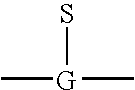
[0124]A powder producible from a structurally modified PAEK having the structural formula

, which may have an average particle size distribution of <100 μm, is thermally treated above the glass transition temperature in an oven.

[0125]The PAEK powder is processed on a laser sintering machine of the type P700, that was modified by EOS company for high temperature applications. The temperature of the process chamber is for example 10° C. below the melting point of the PAEK powder.

[0126]After the laser sinter process is finished, the cooling rate is controlled by post-heating between the temperature of the process chamber and Tg of the PAEK such that the cooling rate shows a maximum average of 0.3° C. / min.

example 2 (

According to the Invention)

[0127]A powder producible from a structurally modified PEEK having the structural formula

, which has an average particle size distribution of 50 μm, wherein the PEEK polymer has a molecular weight of Mn=32,000 and Mw=65,000, is thermally treated above the glass transition temperature in an oven.

[0128]The PEEK powder is processed on a laser sintering machine of the type P700, that was modified by EOS company for high temperature applications. The temperature of the process chamber is for example 335° C.

[0129]After the laser sinter process is finished, the cooling rate is controlled by post-heating between 335° C. and Tg of the PEEK (about 145° C.) such that the cooling rate shows a maximum average of 0.3° C. / min.

example 3 (

According to the Invention)

[0130]A powder producible from Polyamid PA6-3-T having the structural formula

repeating unit A:

repeating unit B:

, which may have an average particle size distribution of <100 μm is thermally treated above the glass transition temperature in an oven.

[0131]The polyamide powder is processed on a laser sintering machine of the type P700, that was modified by EOS company for high temperature applications. The temperature of the process chamber is for example 5° C. below the melting point of the polyamide.

[0132]After the laser sinter process is finished, the cooling rate is controlled by post-heating between the temperature of the process chamber and Tg of the polyamide such that the cooling rate shows a maximum average of 0.3° C. / min.

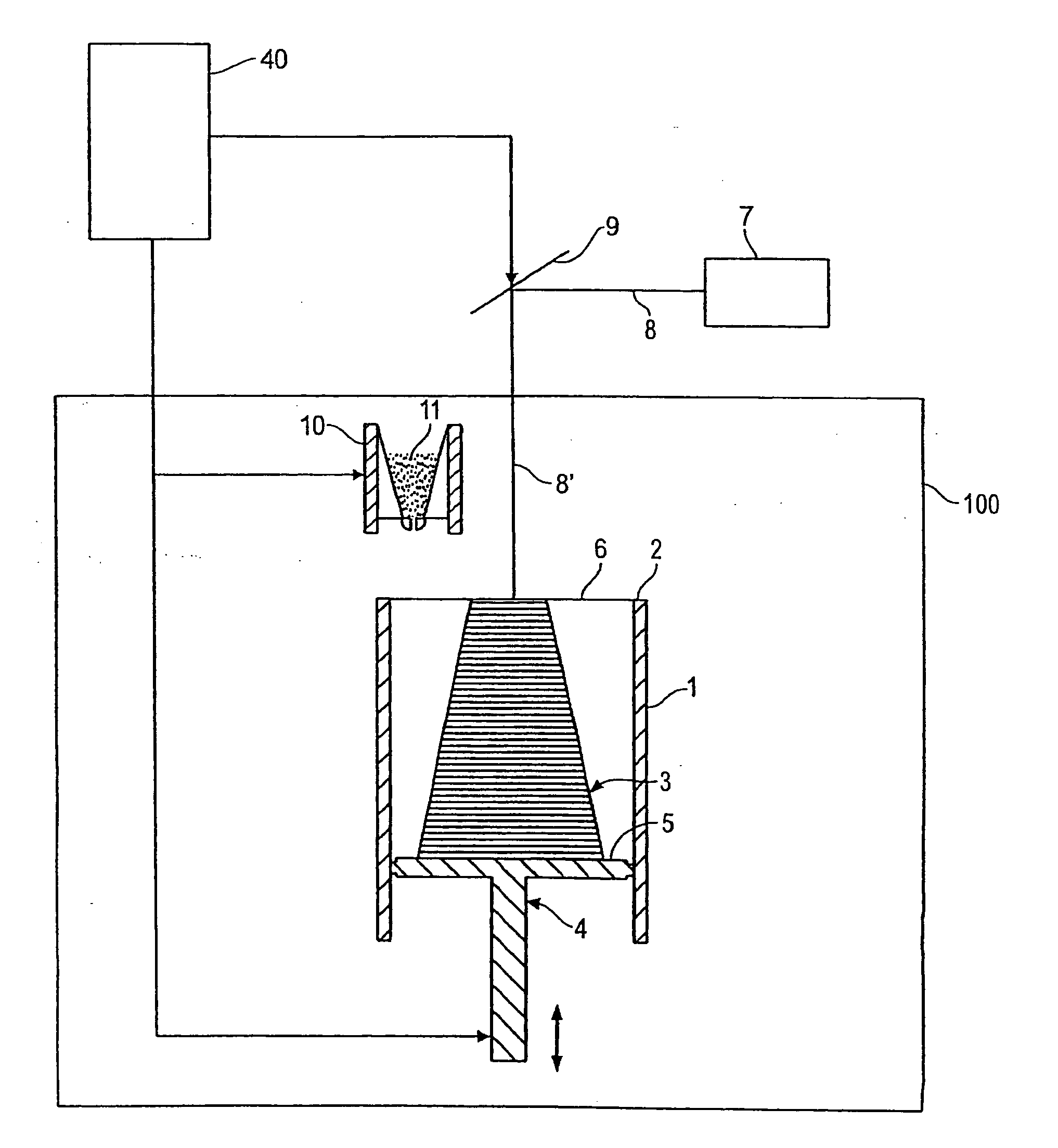
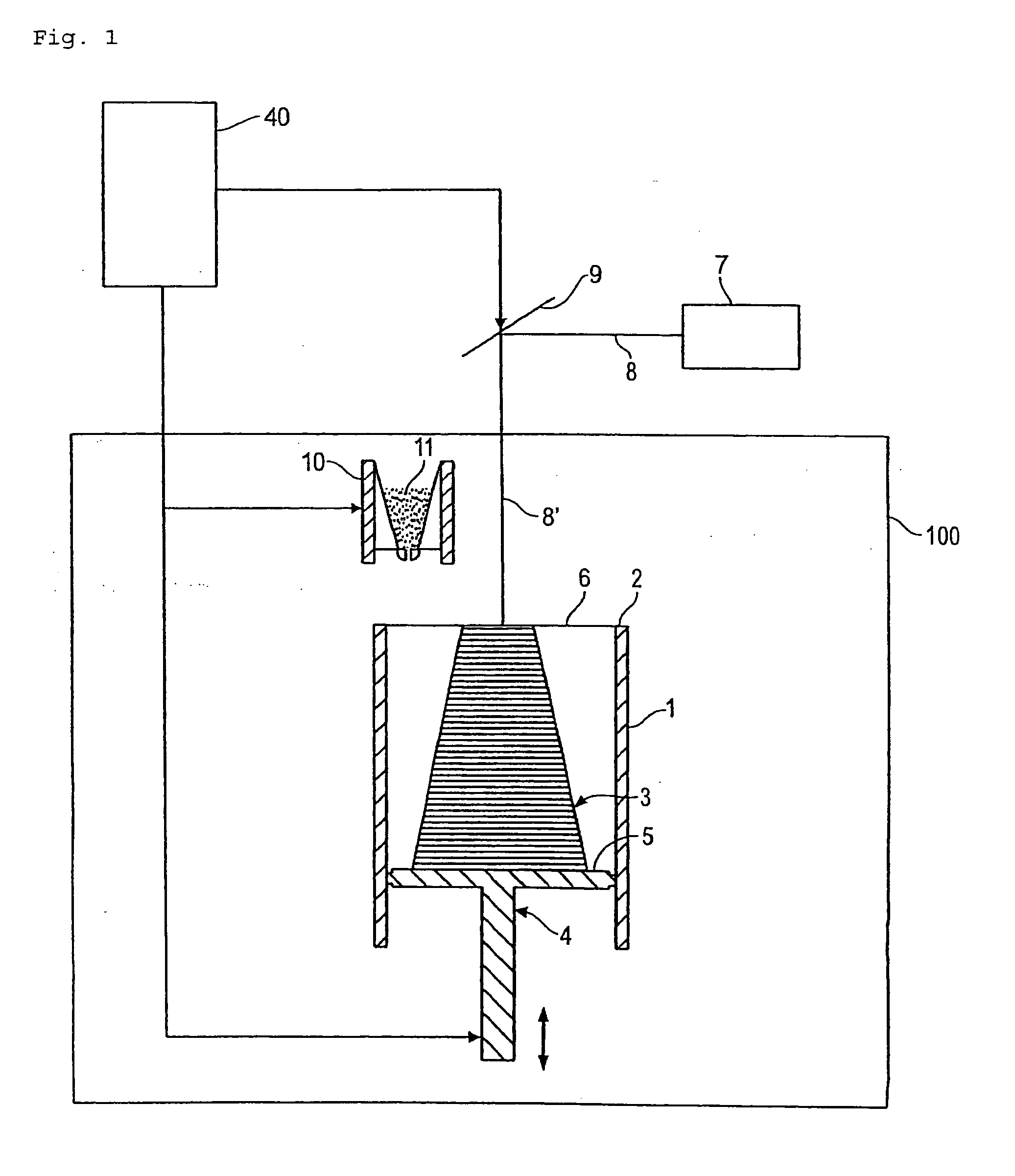
the structure of the environmentally friendly knitted fabric provided by the present invention; figure 2 Flow chart of the yarn wrapping machine for environmentally friendly knitted fabrics and storage devices; image 3 Is the parameter map of the yarn covering machine
Login to View More

PUM

PropertyMeasurementUnit
Temperatureaaaaaaaaaa
Login to View More

Abstract

A three-dimensional object is manufactured by selective sintering by means of electromagnetic radiation, wherein the powder comprises a polymer or copolymer having at least one of the following structural characteristics:(i) at least one branching group in the backbone chain of the polymer or copolymer, provided that in case of the use of polyaryletherketones (PAEK) the branching group is an aromatic structural unit in the backbone chain of the polymer or copolymer;(ii) modification of at least one end group of the backbone chain of the polymer or copolymer;(iii) at least one bulky group within the backbone chain of the polymer of copolymer, provided that in case of the use of polyaryletherketones (PAEK) the bulky group is not selected from the group consisting of phenylene, biphenylene, naphthalene and CH2— or isopropylidene-linked aromatics;(iv) at least one aromatic group non-linearly linking the backbone chain.

Description

FIELD OF THE INVENTION[0001]The present invention relates to a process for manufacturing a three-dimensional object from a powder by selective sintering by means of electromagnetic radiation, wherein the powder comprises a polymer or copolymer. Furthermore, the present invention relates to a three-dimensional object manufactured by said process, an apparatus for manufacturing a three-dimensional object by means of said process and the use of a preselected polymer powder in said process.[0002]As for example known from DE 44 10 046, a process for manufacturing a three-dimensional object by selective sintering by means of electromagnetic radiation may be carried out layer-wise by means of a source for electromagnetic radiation. In such a process, a three-dimensional object is manufactured layer-wise by applying layers of powder and bonding these layers to each other by selective solidification of the powder at positions corresponding to cross-sections of the object.DESCRIPTION OF BACKG...

Claims

the structure of the environmentally friendly knitted fabric provided by the present invention; figure 2 Flow chart of the yarn wrapping machine for environmentally friendly knitted fabrics and storage devices; image 3 Is the parameter map of the yarn covering machine
Login to View More

Application Information

Patent Timeline
03 Dec 2009
Publication
US20090295042A1
IPC
B29C35/08; C08G6/00; H05B6/00
CPC
B29C67/0077; B29C2035/0838; C08L77/06; C08J3/28; B29K2071/00; B29C64/153; B33Y70/00; B29B9/12
Inventors
PFISTER, ANDREAS; MUELLER, FRANK