Method and apparatus for separating and refining high purity 2,6-naphthalene dicarboxylic acid using crystallization
a technology of dicarboxylic acid and crystallization method, which is applied in the separation/purification of carboxylic acid esters, carboxylic compound preparation, organic chemistry, etc., can solve the problems of poor quality of glycol and 2,6-nda containing various impurities, unnecessary addition of equipment as above, and achieve high purity 2,6-nda, low yield, and more economical
- Summary
- Abstract
- Description
- Claims
- Application Information
AI Technical Summary
Benefits of technology
Problems solved by technology
Method used
Image

Examples
example 1
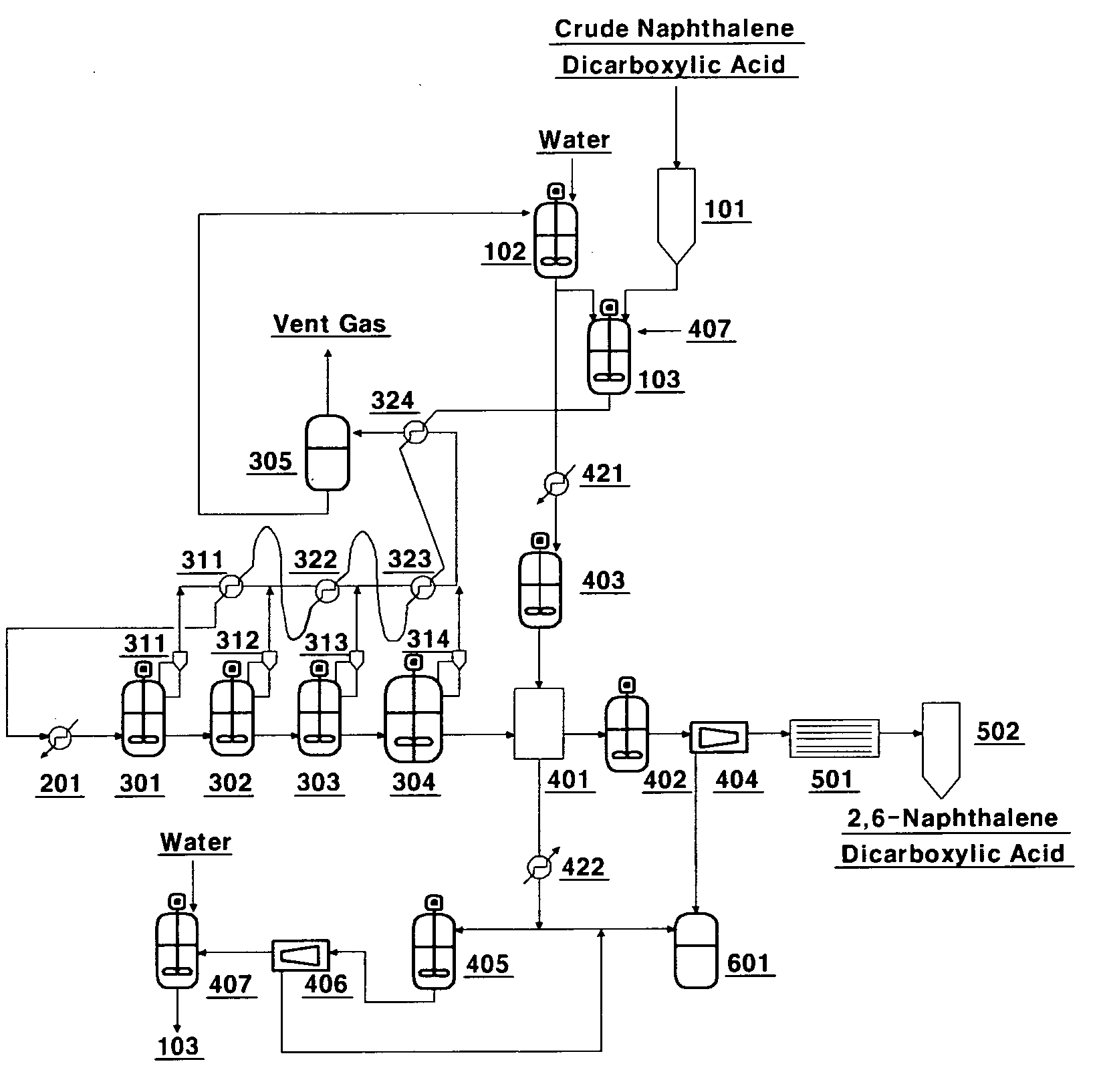
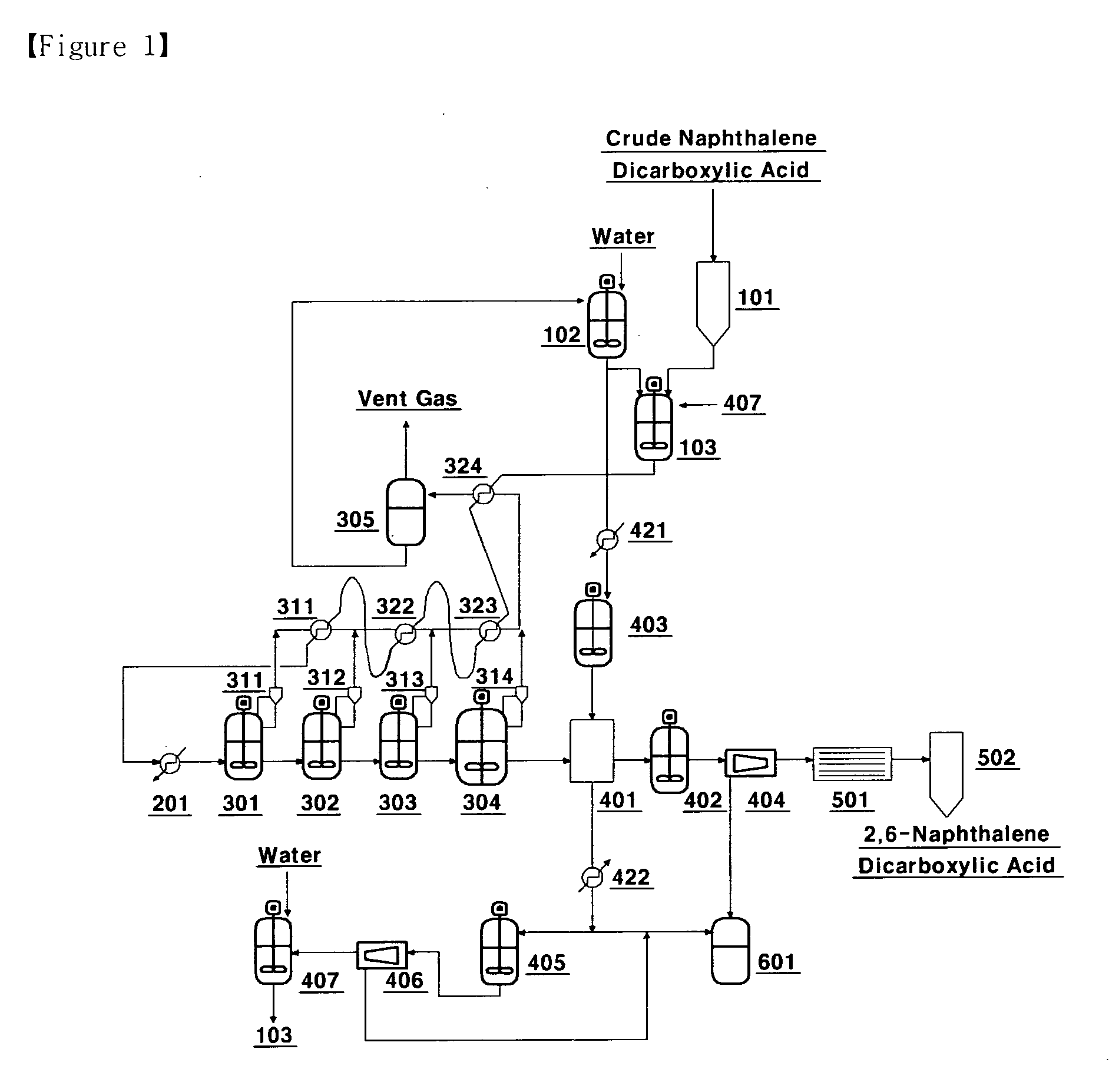
[0031]Crude 2,6-NDA having a purity of 98.0˜99.5% is mixed with water to prepare a slurry having a concentration of 7%. The slurry thus prepared passes through a heat exchanger at the top of the crystallization unit at a rate of 80 L / hr, primarily preheated with some melted. And through the preheater, its temperature of 310° C. is maintained. The first crystallization unit has a temperature of 260° C. with a pressure of 65 kg / cm2, and the second has a temperature of 215° C. with a pressure of 25 kg / cm2 to grow 2,6-NDA crystal. Condensed water is discharged to the upper part of the crystallization unit due to a drop in pressure, which is about 10% of the slurry mass. The remaining crystal slurry is transferred to the washing unit to be filtered primarily.
[0032]After the filtration, hot water at 215° C. is fed to the inside of the washing unit for washing twice. After the washing, filtered crystal powder and water having ten times more weight of that crystal powder is sent to the resl...
example 2
[0034]The process is carried out in the same manner as Example 1, except that three crystallization units are linked, wherein the temperature and pressure of the three crystallization units are each set at 260 to 280° C. and 60 to 85 kg / cm2 in the first crystallization unit, 240 to 260° C. and 40 to 65 kg / cm2 in the second, and 200 to 220° C. and 20 to 35 kg / cm2 in the third. The result is shown in table 4.
TABLE 4Purity (%)Impurities (%)2,6-NDANAMNATMLAFNADCTBr-NDAHeavyUnknownYield (%)99.9265%0.0557N / ANA / N / AN / AN / A0.01220.005693.9AveragePurity (%)Inorganic metal impurities (ppm)Chromaticitycrystal2,6-NDACoMnBrFeNaL*b*size (μm)99.9265%N / AN / A5~15LessLess95.83.3835~55than 2than 2*L: Lightness, b: Yellow chromaticity
example 3
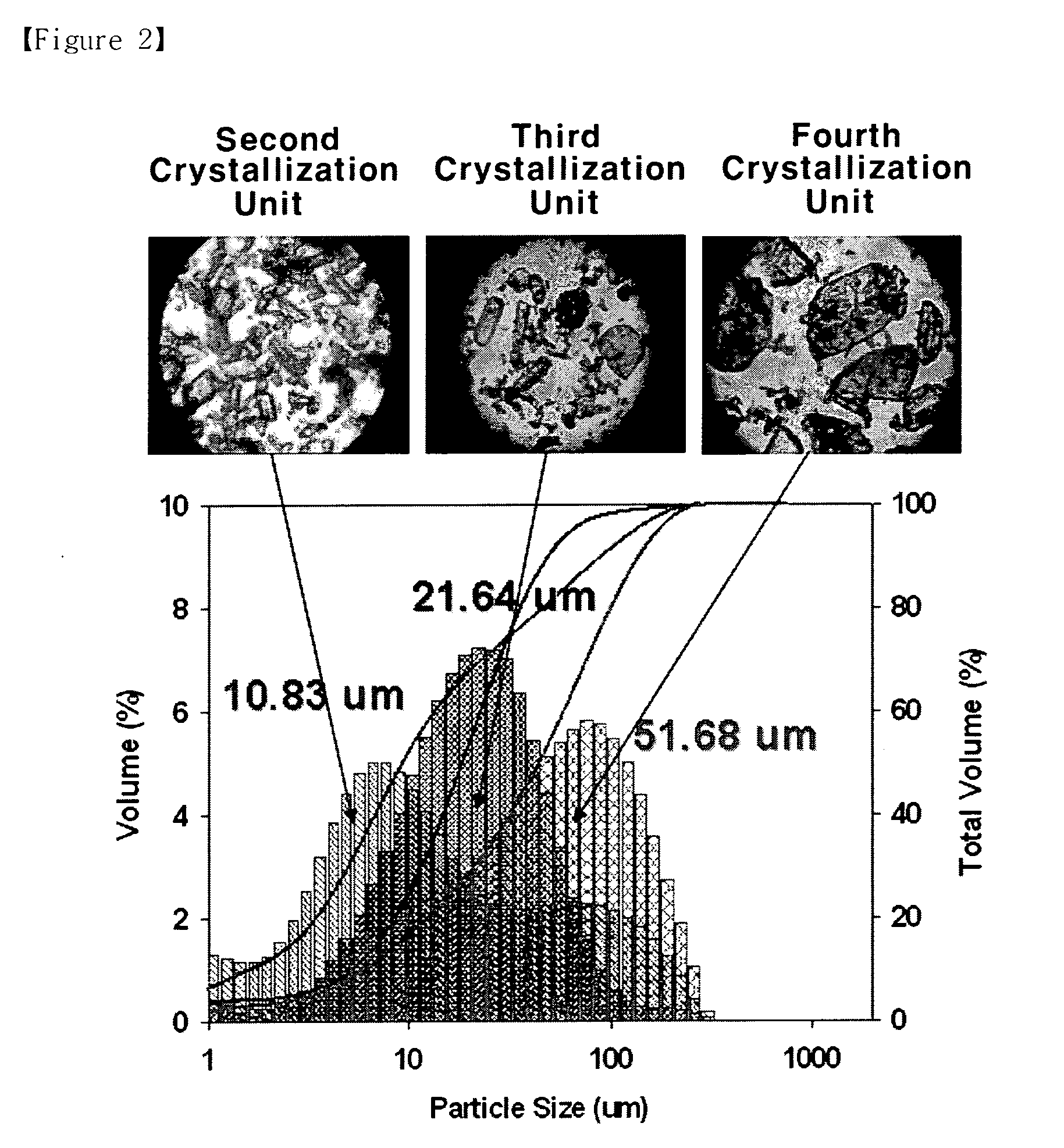
[0035]The process is carried out in the same manner as Example 1, except that four crystallization units are linked, wherein the temperature and pressure of the four crystallization units are each set at 260 to 280° C. and 60 to 85 kg / cm2, in the first crystallization unit, at 240 to 260° C. and 40 to 65 kg / cm2 in the second, and at 220 to 240° C. and 30 to 45 kg / cm2 in the third, and in the fourth at 200 to 220° C. and 20 to 35 kg / cm2. The analysis result on the crystals obtained is shown in table 5. FIG. 2 is a photograph showing the particle size and distribution of the crystals obtained in the second, third and fourth crystallization processes.
TABLE 5Purity (%)Impurities (%)2,6-NDANAMNATMLAFNADCTBr-NDAHeavyUnknownYield (%)99.9519%0.0327N / ANA / N / AN / AN / A0.01170.003794.1AveragePurity (%)Inorganic metal impurities (ppm)Chromaticitycrystal2,6-NDACoMnBrFeNaL*b*size (μm)99.9519%N / AN / AN / ALessLess96.73.3140~75than 2than 2*L: Lightness, b: Yellow chromaticity
PUM
| Property | Measurement | Unit |
|---|---|---|
| constant temperature | aaaaa | aaaaa |
| temperature | aaaaa | aaaaa |
| temperature | aaaaa | aaaaa |
Abstract
Description
Claims
Application Information
 Login to View More
 - R&D
- Intellectual Property
- Life Sciences
- Materials
- Tech Scout
- Unparalleled Data Quality
- Higher Quality Content
- 60% Fewer Hallucinations
Browse by: Latest US Patents, China's latest patents, Technical Efficacy Thesaurus, Application Domain, Technology Topic, Popular Technical Reports.
© 2025 PatSnap. All rights reserved.Legal|Privacy policy|Modern Slavery Act Transparency Statement|Sitemap|About US| Contact US: help@patsnap.com