
High Concentration Factor VII Polypeptide Formulations Comprising an Aromatic Preservative and an Antioxidant
- Summary
- Abstract
- Description
- Claims
- Application Information
AI Technical Summary
Benefits of technology
Problems solved by technology
Method used
Image


Examples
embodiment
PREFERRED EMBODIMENT
[0099]The present inventors have presently identified the following embodiment as particularly advantageous, namely the liquid, aqueous pharmaceutical composition as defined herein, which comprises:
[0100]10-90 mg / mL of a Factor VII polypeptide (i);
[0101]a buffering agent (ii) suitable for keeping pH in the range of from about 5.0 to about 9.0;
[0102]at least one aromatic preservative (iii) in a concentration of 0.1-20 mg / mL; and
[0103]at least one antioxidant (iv) in a concentration of 0.1-5.0 mg / mL.
Stability
[0104]The compositions according to the present invention are useful as stable ready-to-use compositions of Factor VII polypeptides. The compositions should typically be stable for at least six months, and preferably up to 36 months, when stored at temperatures ranging from 2° C. to 8° C.
[0105]The term “Stable” is intended to denote that (i) after storage for 6 months at 2° C. to 8° C. the composition retains at least 50% of its initial biological activity as m...
working examples
Example 1
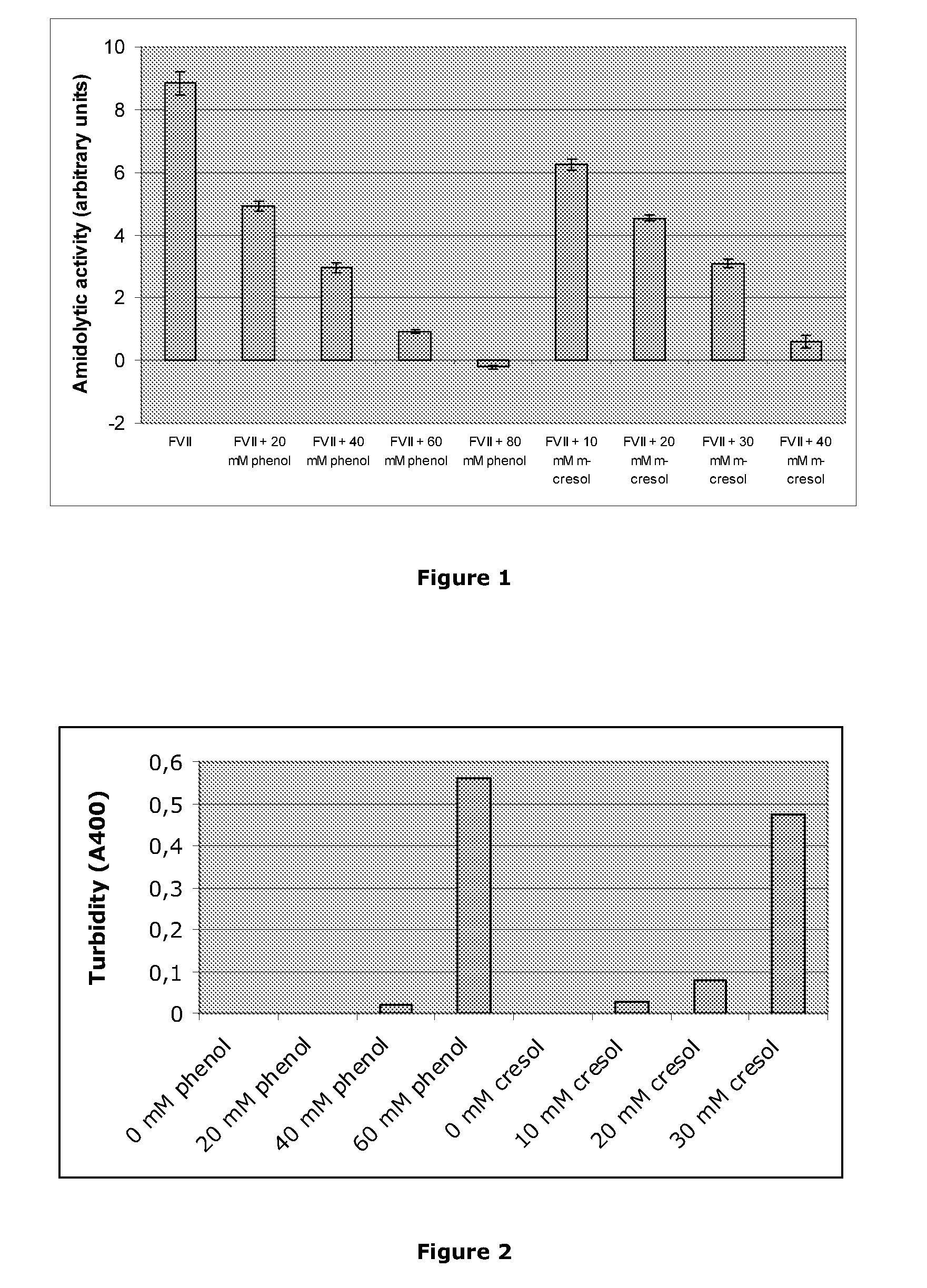
[0147]The amidolytic activity of activated Factor VII was measured by degradation of D-ILE-PRO-ARG-P-NITROANILIDE as described above, under the following conditions: 3 μM activated Factor VII50 mM imidazole, pH 6.5, 20 mM CaCl2, 50 mM NaCl, 0.5 mg / mL bovine serum albumin, 1 mM S-2288. The activity was measured at a number of different concentrations of meta-cresol and phenol. All experiments were performed in duplicate. FIG. 1 shows the amidolytic activity at different preservative concentrations, in arbitrary units. Surprisingly, it is seen that the activity decreases with increasing preservative concentration.
example 2
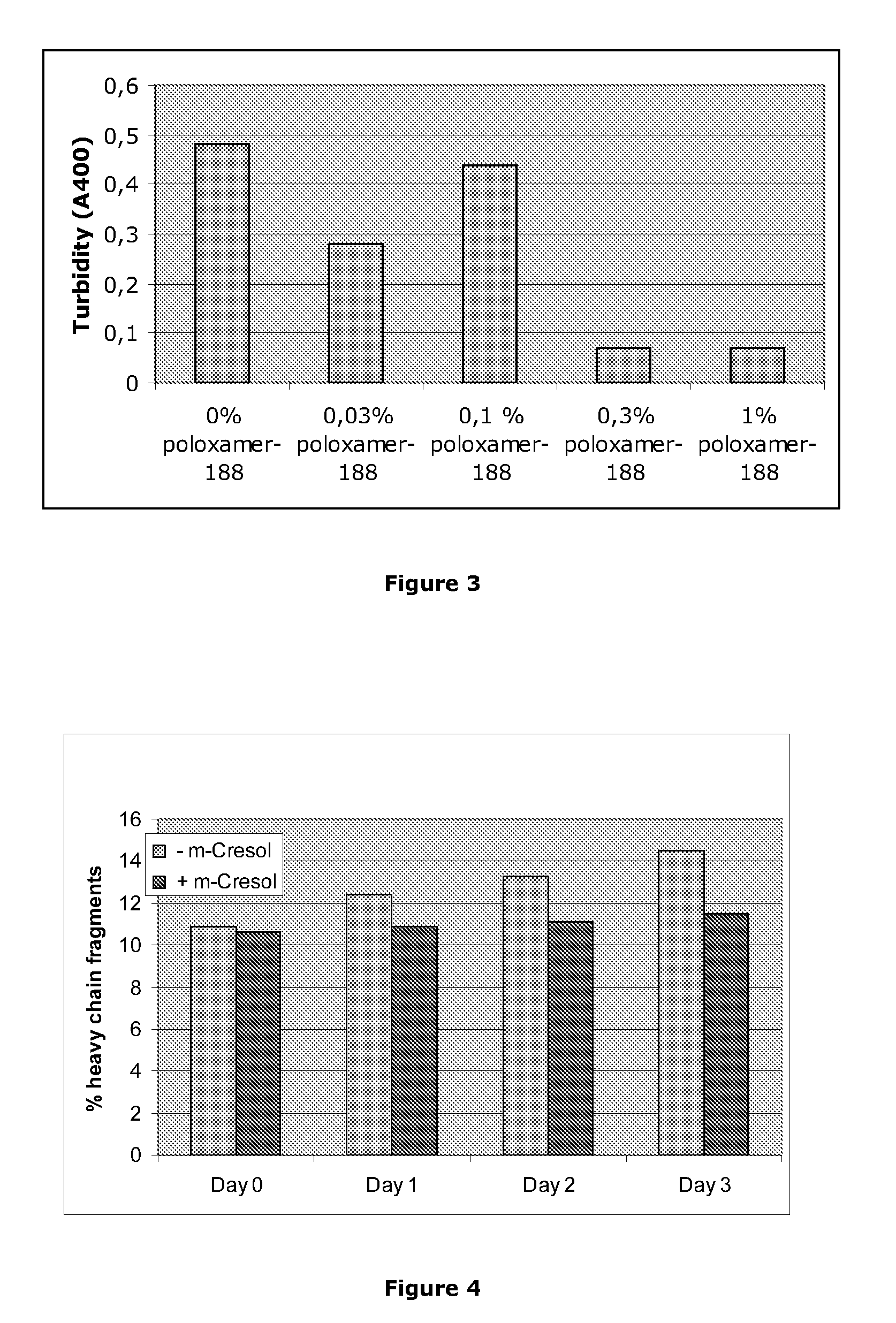
[0148]Activated Factor VII was mixed with different concentrations of meta-cresol or phenol under the following conditions: 15 mg / mL Activated Factor VII, 10 mM histidine, pH 6.0, 20 mM CaCl2, 8% sucrose. Samples with total volumes of 100 μl were dispensed into a quartz microtiter plate (Hellma) and the turbidity was assessed by measuring the absorption at 400 nm in a plate reader. Turbidity is a sign of precipitation in the sample. It is seen that at the highest preservative concentrations investigated, there is significant precipitation in the samples. This phenomenon can limit the use of meta-cresol and phenol without the addition of further excipients to remedy the precipitation.
PUM
| Property | Measurement | Unit |
|---|---|---|
| Concentration | aaaaa | aaaaa |
| Concentration | aaaaa | aaaaa |
| Density | aaaaa | aaaaa |
Abstract
Description
Claims
Application Information
 Login to View More