Process for Preparation of Polyolefins Via Living Coordinative Chain Transfer Polymerization
- Summary
- Abstract
- Description
- Claims
- Application Information
AI Technical Summary
Benefits of technology
Problems solved by technology
Method used
Image



Examples
example 1
[0092]Preparation of (η5-C5Me5)*Hf(Me)2[N(Et)C(Me)N(Et)] (1).
[0093]To a solution of (η5-C5Me5)HfCl3 (1.26 g, 3.0 mmol) in 120 mL Et2O at −60° C. was added 5.8 mL of a solution of MeLi (1.7 M in Et2O) via syringe over a period of 10 min. The mixture was allowed to warm to −10° C. over a period of 3 hours whereupon the any remaining MeLi was quenched with the addition of 0.30 mL of Me3SiC1 at −30° C. via syringe. At this time, a solution of diethyl carbodiimide (0.29 g, 3.0 mmol) in 10 mL of Et2O was added via cannula at −30° C. over a period of 45 min. The mixture was then allowed to warm to −10° C. over a period of 1.5 hours whereupon the volatiles were removed in vacuo. The resulting white residue was extracted with pentane and filtered through a small pad of Celite in a glass fit. The pentane filtrate was concentrated and cooled to −25° C. whereupon the final product was isolated as a white crystalline material (0.92 g, 67% yield). The solid-state molecular structure of the produc...
example 2
[0096]Polymerization of propene in chlorobenzene.
[0097]To a solution of 1 (4.6 mg, 10 μmol) in 0.5 mL chlorobenzene at −10° C. was added the co-catalyst 2 (8.0 mg, 10 μmol) in 0.5 mL chlorobenzene. This solution was then rapidly added to a 250-mL Schlenk flask charged with 9.0 mL of chlorobenzene at −10° C., which was previously pressurized to 5 psi with propene and stirred for at least 10 minutes. The flask was then repressurized and the pressure maintained at 5 psi for 30 min with stirring, whereupon the polymerization was quenched with the addition of 0.5 mL of methanol. The reaction mixture was then precipitated into 800 mL acidic methanol to isolate the polymer product. The final polypropene was collected and dried in vacuo. Yield: 1.04 g. GPC: Mw=154,000; Mn=137,000; PDI=1.12.
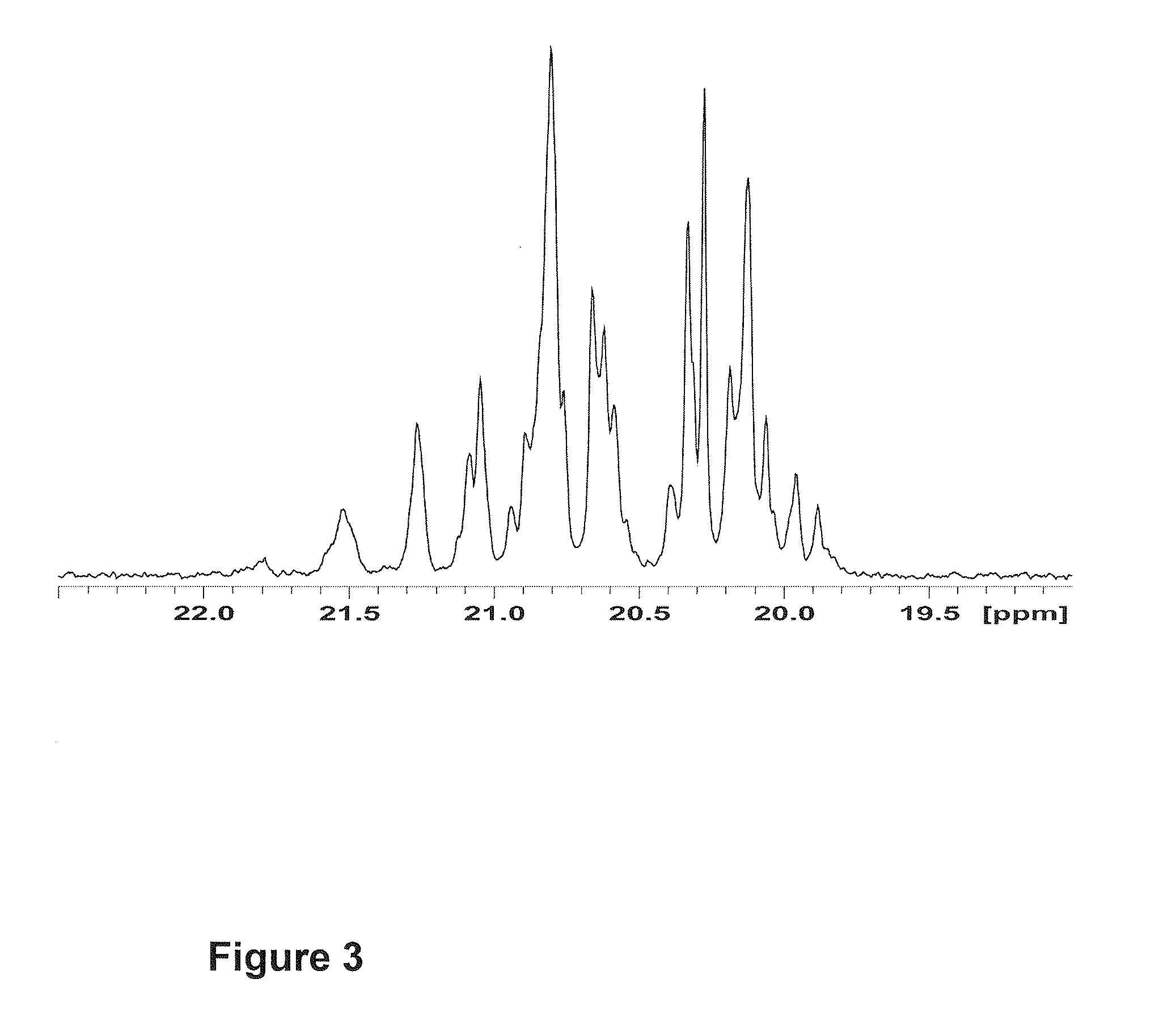
[0098]Characterization of amorphous atactic polypropene (aa-PP).
[0099]The stereochemical microstructure of PP material was analyzed by 13C {1H} NMR spectroscopy (125 MHz, using 1,1,2,2-tetrachloroethane-d...
example 3
[0100]Synthesis of ultra-high molecular weight polypropene.
[0101]The polymerization was conducted under conditions similar to Example 2 except 100 mL of chlorobenzene was used and the reaction time was prolonged to 15 hours. At the end of polymerization, the reaction mixture gelled and the stirring stopped. At this time, 400 mL of toluene was added to dissolve the polypropene before precipitation into 3 L of acidic methanol. Yield: 8.22 g. GPC: Mw=2,020,000; Mn=830,000; PDI=2.43.
PUM
| Property | Measurement | Unit |
|---|---|---|
| Temperature | aaaaa | aaaaa |
| Temperature | aaaaa | aaaaa |
| Time | aaaaa | aaaaa |
Abstract
Description
Claims
Application Information
 Login to View More
 - R&D
- Intellectual Property
- Life Sciences
- Materials
- Tech Scout
- Unparalleled Data Quality
- Higher Quality Content
- 60% Fewer Hallucinations
Browse by: Latest US Patents, China's latest patents, Technical Efficacy Thesaurus, Application Domain, Technology Topic, Popular Technical Reports.
© 2025 PatSnap. All rights reserved.Legal|Privacy policy|Modern Slavery Act Transparency Statement|Sitemap|About US| Contact US: help@patsnap.com