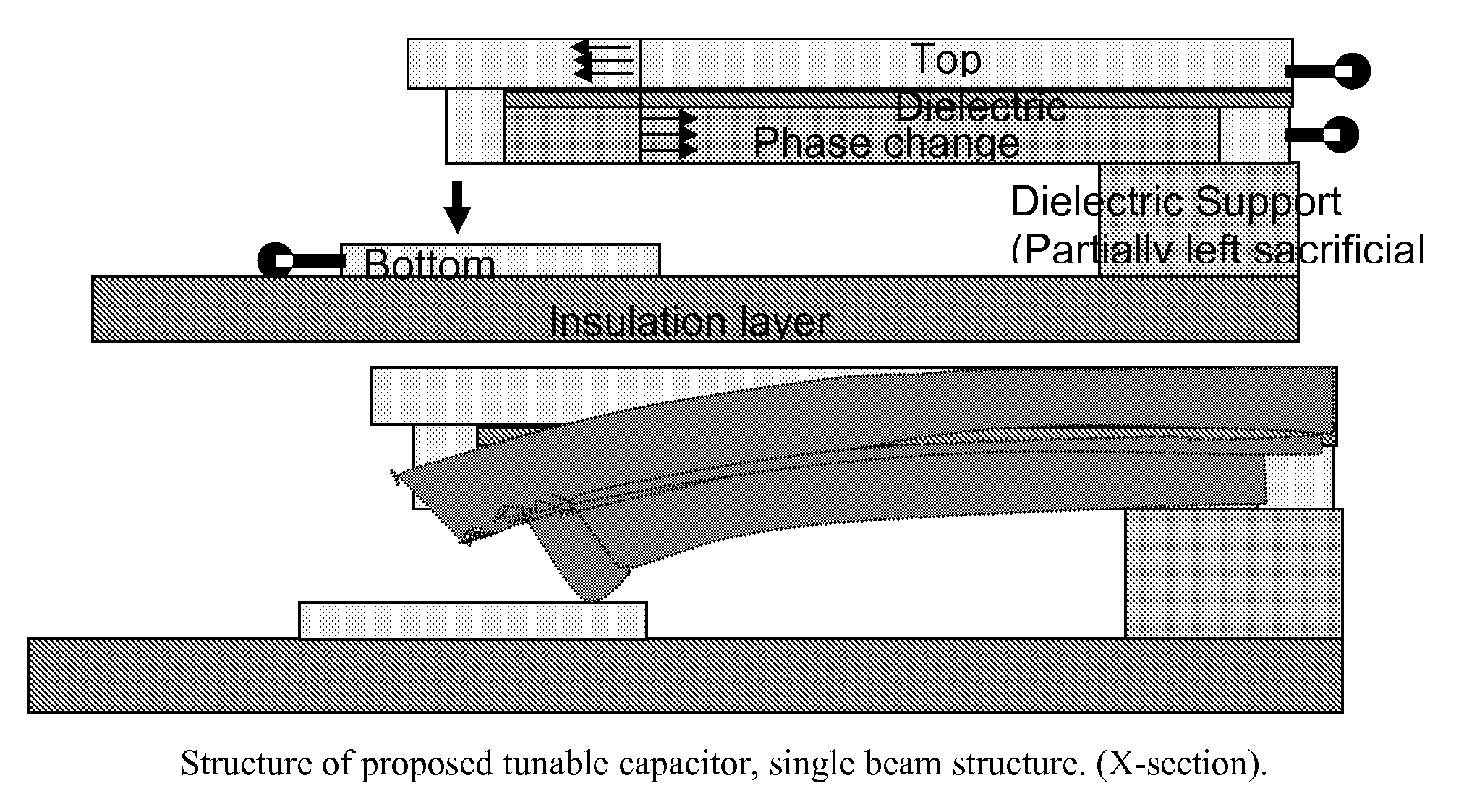
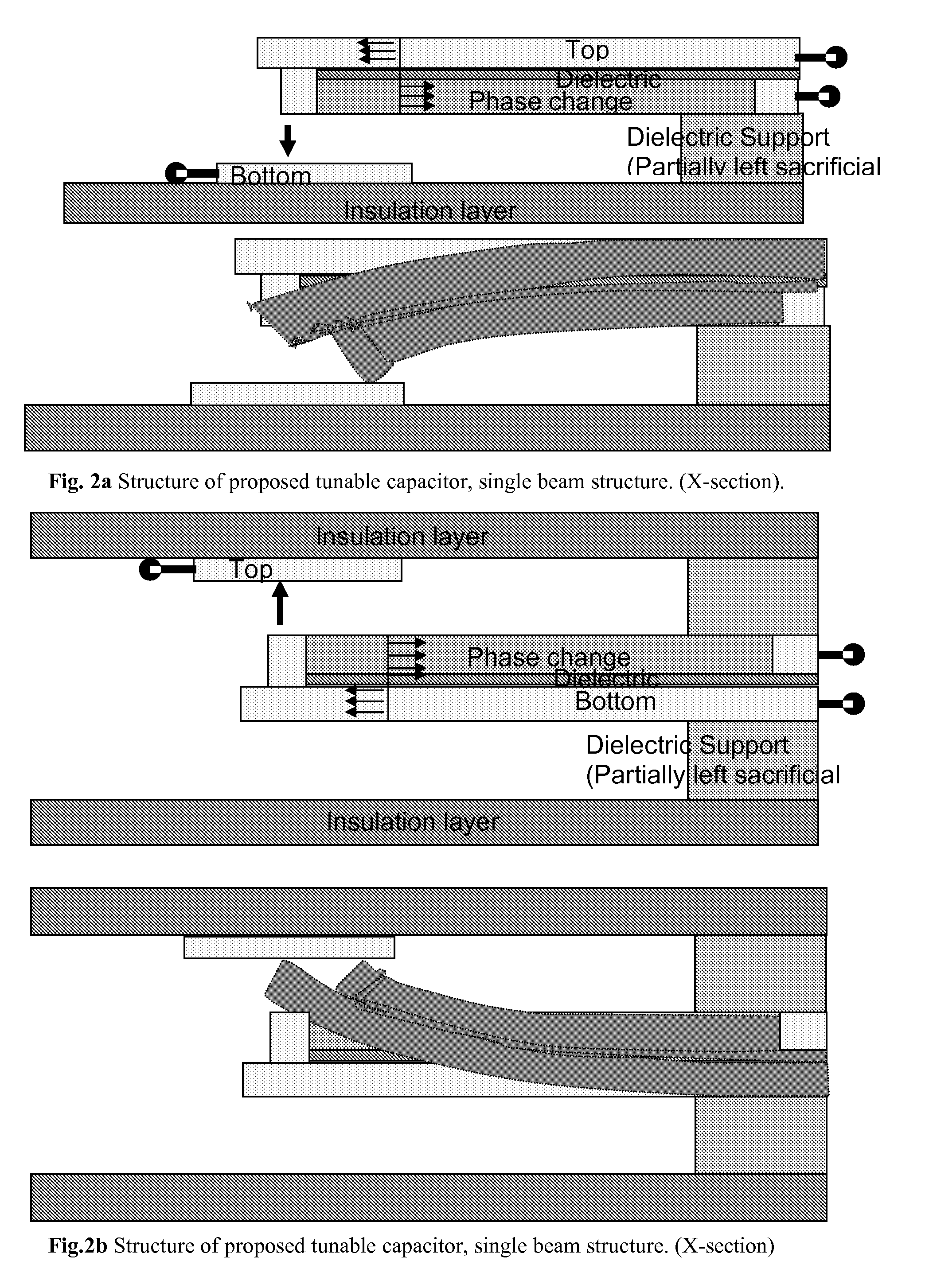
[0019]The present MEMS itself is regarded to function as a micro-
actuator, being of a small size and implementing a process. As such it can be used in a switch, in a tunable capacitor, or as a mirror, if provided with a
reflective layer, or combinations thereof Examples of MEMS structures are given in the drawings. It is noted that in fact the MEMS may be smaller than one micron, and therefore may also refer to a Nano type MEMS, also referred to as NEMS. A NEMS has advantages in terms of heat dissipation, being better if the NEMS is relatively smaller. As such, a further
advantage is that a NEMS or a MEMS is easily integrated in
CMOS technology.
[0024]The
phase change is preferably accomplished by applying an
electrical current, which current causes the present
phase change material to heat up, or by absence of said current, to cool down. The phase change results in a thermodynamically metastable or stable situation of the material, i.e. no phase change will take place by itself within a normal applicable
time limit, such as minutes, or hours, or even years. As a result of actuation the volume of the present
phase change material (PCM) will have changed. The present process is well controllable, by applying an
electrical current which heats up the PCM to the required temperature, or by cooling. Furthermore, the present process is relatively quick, i.e. it takes place within a few microseconds. Adequate design allows for even shorter switching times. Examples of designs are given in the drawings. Therewith, switching times in the order of a few microseconds have been achieved. In other words, the present invention refers to a bi-stable actuation. It means that no electrical
voltage is needed to maintain the position of the beam. An on
current pulse is enough for that purpose. A (bi-)stable actuation is therefore very simple. A continuous actuation is possible by e.g. partial
crystallization. It may also be achieved by segmenting the phase change layer and actuating a part of the beam, for instance by a multi-step actuation, for instance leading to multiple positions of the beam, or for instance leading to a stepped capacitor.
[0030]a high tunability, which may depend on material composition, such as having an εmax / εmin of more than 5, preferably more than 10, such as more than 20, or even more than 50, such as more than 100;
[0033]it is possible to control temperature. In the present invention the temperature of the beam (comprising a
phase change material) is controlled by applying a current through the material for the beam. Further, a same or similar scheme for controlling temperature for the
system may be used, wherein an array present can be used as a heater, allowing a high accuracy and reliability of the present tunable capacitor. It is noted that typically electrical properties are in the present respect detrimentally affected by temperature, for instance, electrical resistivity of metals increases with temperature, while the resistivity of semiconductors decreases with increasing temperature in general. Therefore, controlling temperature can provide an accurate electrical response, independent of circumstances, e.g. one of a
resistor or capacitor present may be a temperature sensor, as shown in e.g. FIG. 4.
[0035]In a preferred embodiment the present invention relates to a
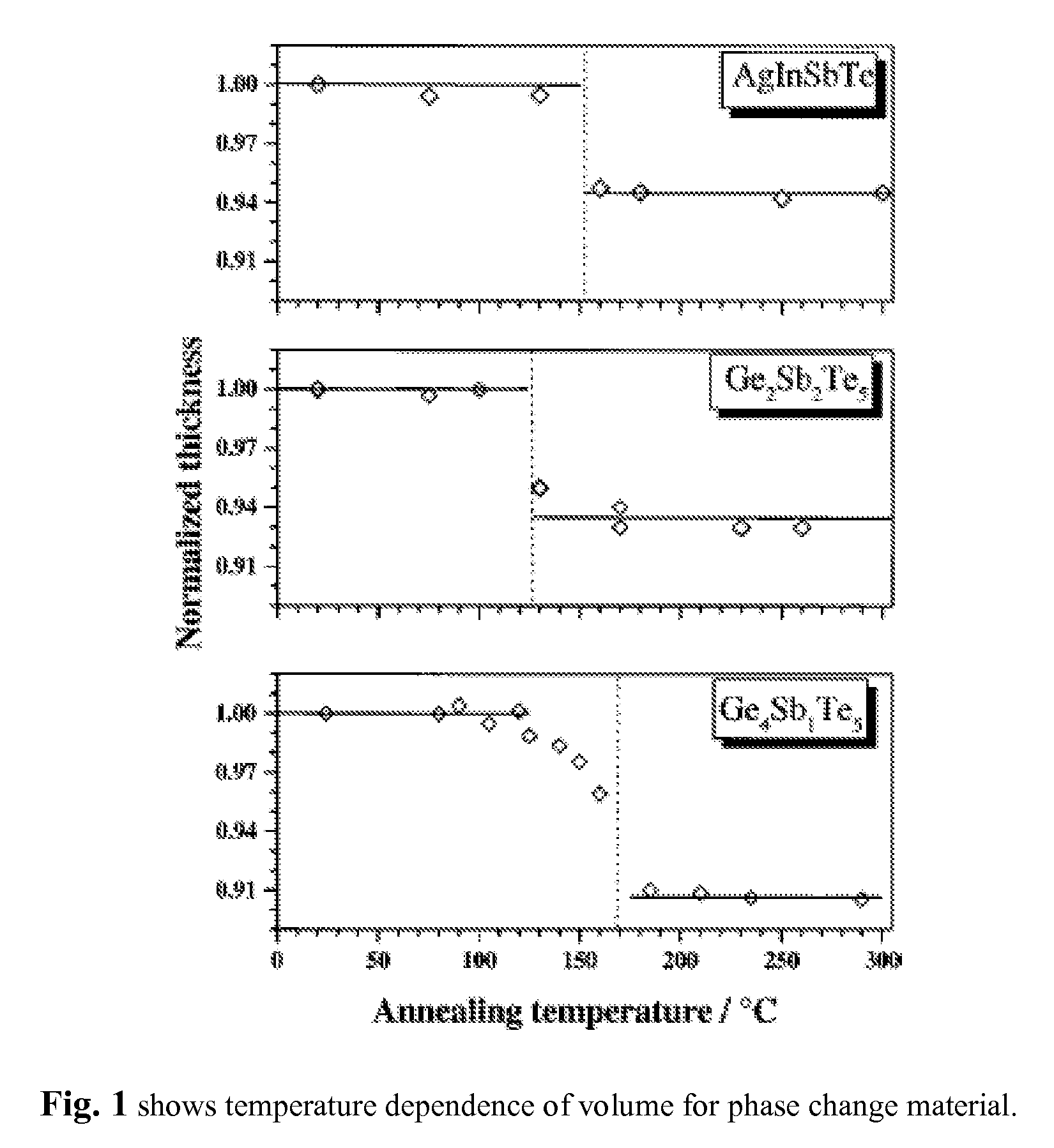
semiconductor device, wherein the phase change material comprises a Group V and Group VI element, preferably a composition comprising Sb-M, wherein M being one or more elements selected from the group of Ge, In, Ag, Ga, Te, Zn, Sn, for instance; Ag5.5In6.5Sb59Te29, Ge0.08-0.4Sb0.1-0.33Te0.5-0.66, Ge2Sb2Te5, Ge1Sb2Te4, Ge1Sb4Te7 and Ge4SbiTe5, and combinations thereof. These materials have a large
volume change, such as more than 5%, which volume change is achieved at relatively low temperatures, e.g. around 150° C. Furthermore, the
phase transition of these materials is well controlled, e.g. by applying an
electrical current which current forms heat. It is envisaged that also any phase change material, which can provide a high volume change at a temperature being close enough to
room temperature, such as organic or
polymer material, may be used, as well as combinations thereof.



 Login to View More
  Login to View More