
Functionalized cyanine dyes (PEG)
a technology of cyanine dyes and fluorescent compounds, applied in the field of fluorescent compound synthesis, can solve the problems of insufficient hydrophilicity, insufficient brightness, and inability to emit steady, and achieve the effect of enhancing assay performance and versatile assay design
- Summary
- Abstract
- Description
- Claims
- Application Information
AI Technical Summary
Benefits of technology
Problems solved by technology
Method used
Image

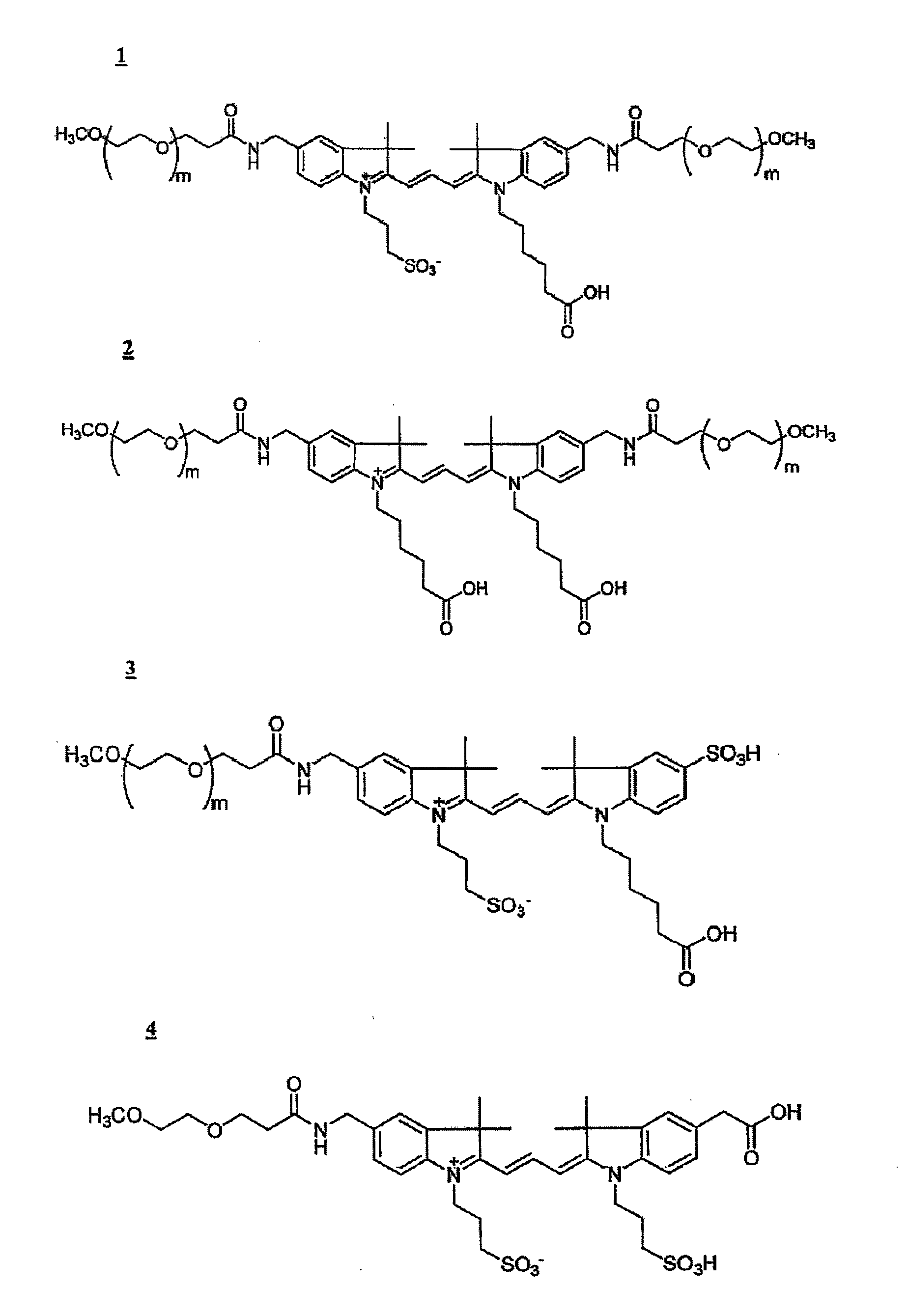
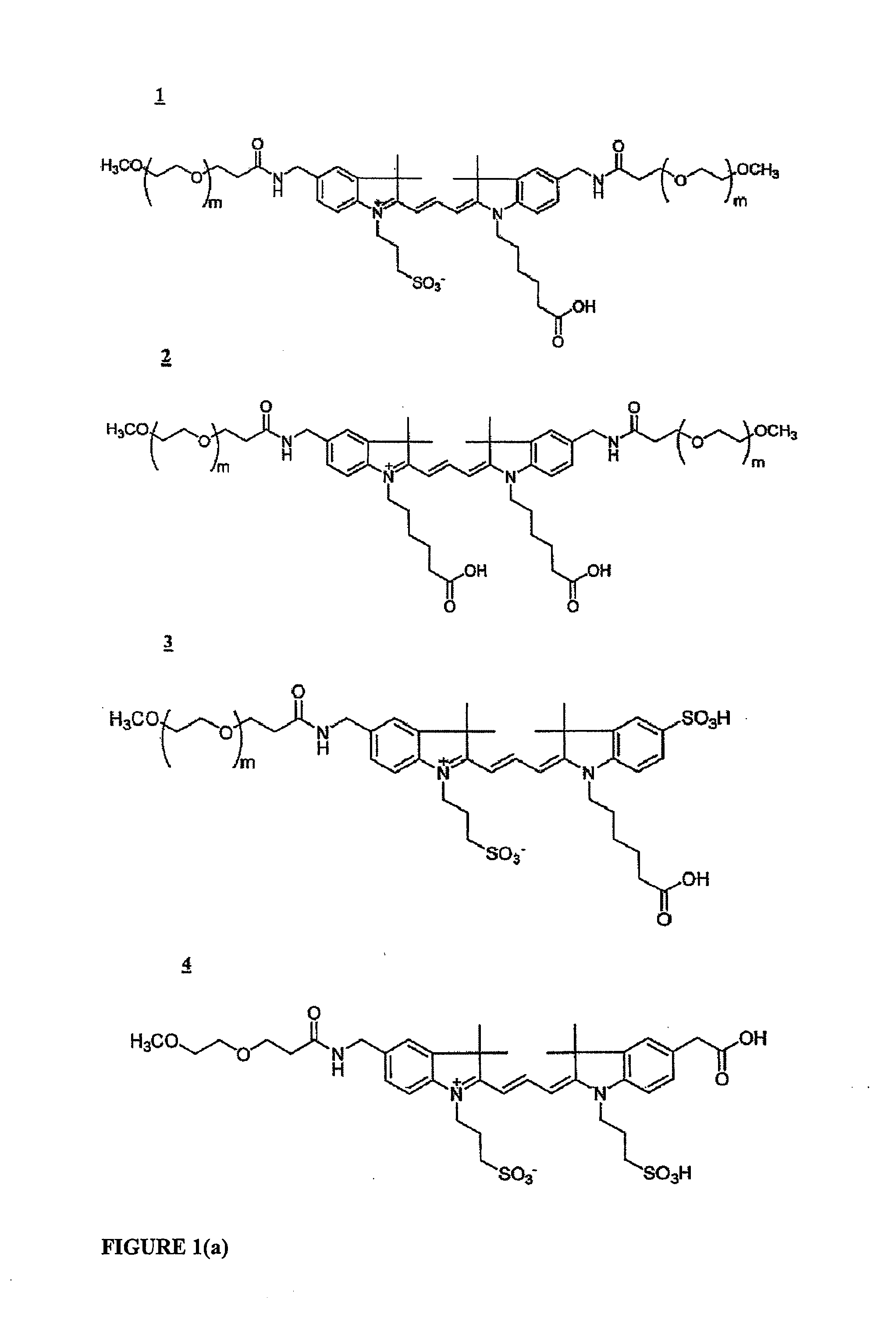
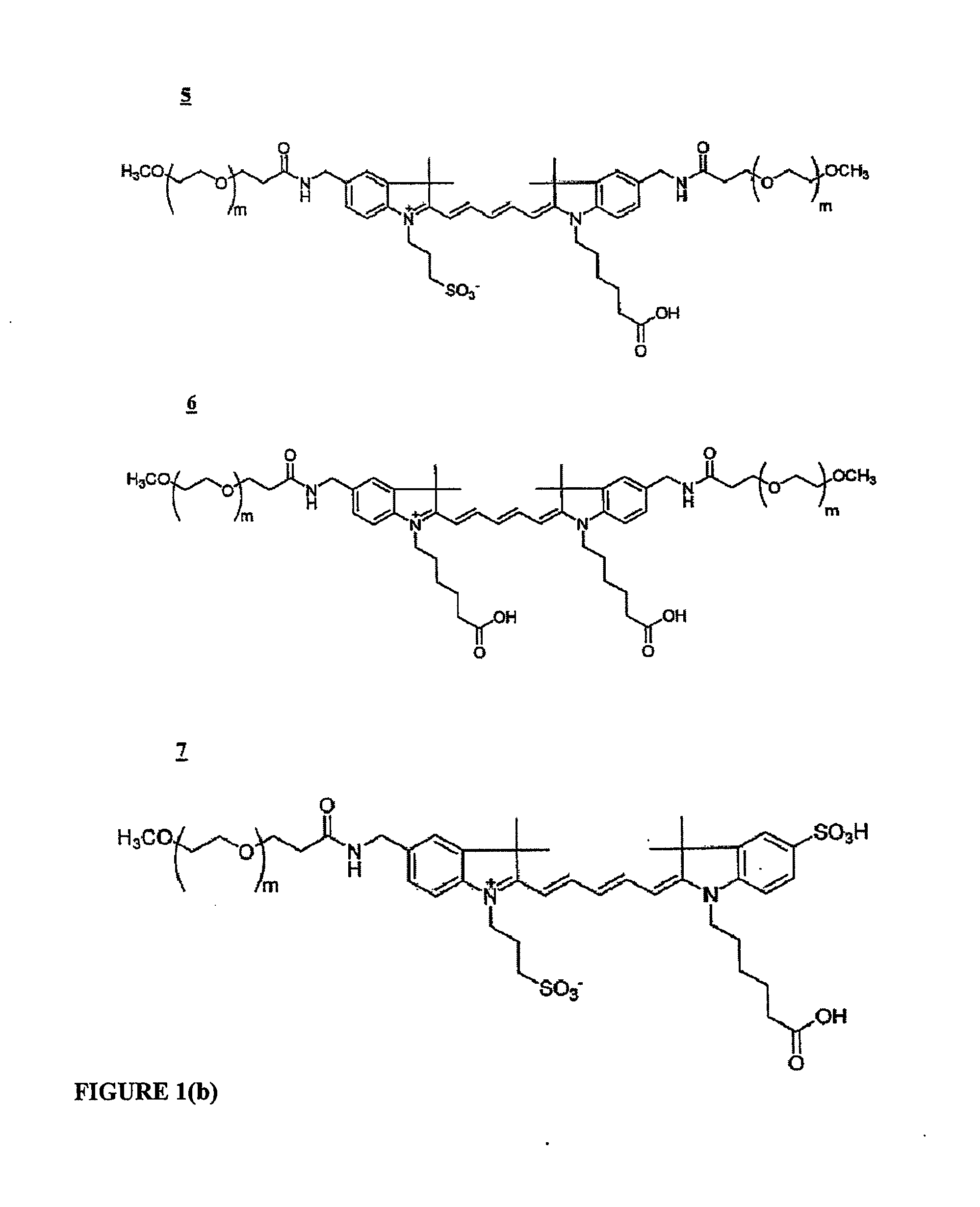
Examples
example 1
[0216]
[0217]1.1 2,3,3-Trimethyl-5-carboxy-3H-indole. A solution of 4-hydrazinobenzoic acid (10.0 g, 65.7 mmol), isopropylmethylketone (21.1 mL, 197 mmol) in acetic acid (35 mL) was heated under reflux in an oil bath for 20 h. After cooling to ambient temperature the solvent was evaporated off under reduced pressure and to it was added a saturated aqueous solution of NaHCO3 (50 mL) and washed with CH2Cl2 (3×40 mL). The pH of the aqueous solution was adjusted with 1 M aqueous HCl to ca. 2, and then extracted with CH2Cl2 (3×50 mL). The combined organic solution was then dried with Na2SO4, filtered and concentrated to dryness under reduced pressure to yield the desired product (10.7 g, 80%) as a brownish solid.
[0218]1.2 2,3,3-Trimethyl-4-carboxy-3H-indole. A solution of 3-hydrazinobenzoic acid (30.0 g, 197 mmol), isopropylmethylketone (31.7 mL, 296 mmol) in ethanol (500 mL) and sulfuric acid (5 mL) was heated under reflux in an oil bath for 20 h. After cooling to ambient temperature the...
example 2
[0267]
[0268]2.1 Synthesis of 2b TSTU (3.76 g, 12.54 mmole), in 4 portions, was added to a solution of 4-bromo-2,6-pyridinedicarboxylic acid (2a, 1.03 g, 4.12 mmole) and diisopropylethylamine (1.68 g, 13.0 mmole) in 20 mL DMF at 4° C. over 3 min. The reaction was stirred for 10 min, the cooling bath was removed, and stirred for another 1 hr. This DMF solution was added to a solution of taurine (12.0 g, 95.8 mmole) and Na2CO3 (16.2 g, 152.8 mmole) in 300 mL of DMF / H2O (1:10) over 20 min at room temperature. The reaction was stirred for another 30 min after the addition was completed. The product was purified by reverse phase HPLC eluted with a gradient of CH3CN over 0.1 N triethylammonium bicarbonate (TEAB) buffer (pH 7). The yield of the desired product (2b) was 1.09 g, also isolated was the mono-taurine amide 0.58 g.
[0269]2.2 Synthesis of 2d. A solution of Na2CO3 (214 mg, 2 mmole) in 2.5 mL H2O was added dropwise to a solution of 2b (270 mg, 0.40 mmole) and 2c (100 mg, 0.43 mmole) i...
example 3
[0290]
[0291]3.1 Synthesis of 3b, 3b′, and 3b″. 3a (1.25 g, triethylammonium salt) was stirred with 5 mL of POCl3 at room temperature for 18 hr. POCl3 was removed by rotavap and pumped under vacuum for 15 hr. The residue was dissolved in 10 mL DMF and added dropwise to a solution of taurine (5.5 g, 44 mmole) and Na2CO3 (14.0 g, 132 mmole) in 250 mL DMF / H2O (1:9) over 10 min at room temperature. The stirred for 30 min after the addition was completed. The products were purified by reverse phase HPLC eluted with a gradient of CH3CN over 0.1 N TEAB buffer. The yield of the product 3b was 530 mg, 3b′ was 260 mg, and 3b″ was 303 mg.
[0292]3.2 Synthesis of 3c. 3b (67 mg, 0.1 mmole) dissolved in 0.8 mL of sulfolane at 80° C. was added 1,3 propanesultone (87 mg, 0.7 mmole) with stirring. The reaction was heated to 120° C. for 1.2 hr. After cooling down the reaction was diluted with 10 mL 0.1 N TEAB, filtered, and purified by reverse phase HPLC eluted with a gradient of CH3CN over 0.1 N TEAB b...
PUM
 Login to View More
 Abstract
Description
Claims
Application Information
 Login to View More