
Tetrahydro-azacarboline mch-1 antagonists, methods of making, and uses thereof
a technology of azacarboline and mch-1, which is applied in the field of tetrahydroazacarboline derivatives, can solve the problems of limited efficacy, current available pharmaceutical therapies for the treatment of obesity, and limit their use, and achieves the effects of increasing body mass index, increasing waist circumference, and high affinity
- Summary
- Abstract
- Description
- Claims
- Application Information
AI Technical Summary
Benefits of technology
Problems solved by technology
Method used
Image

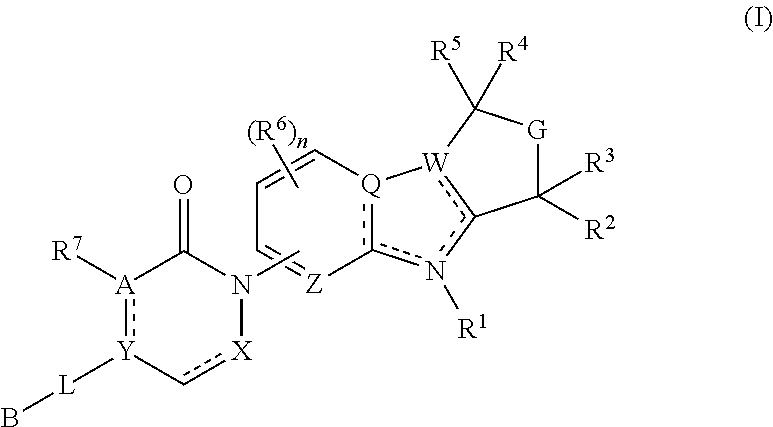
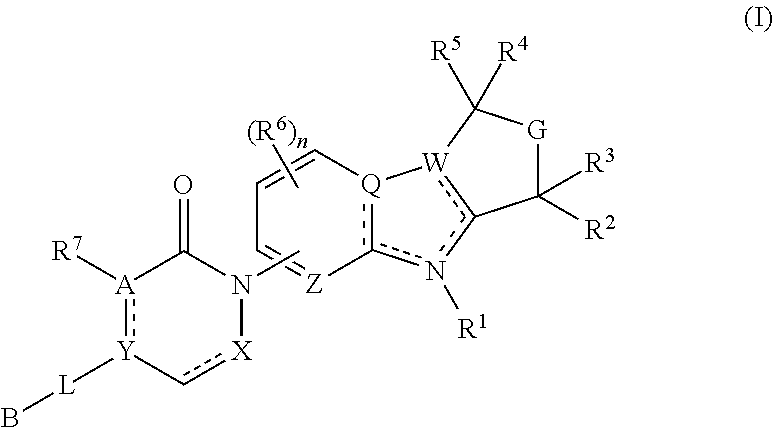
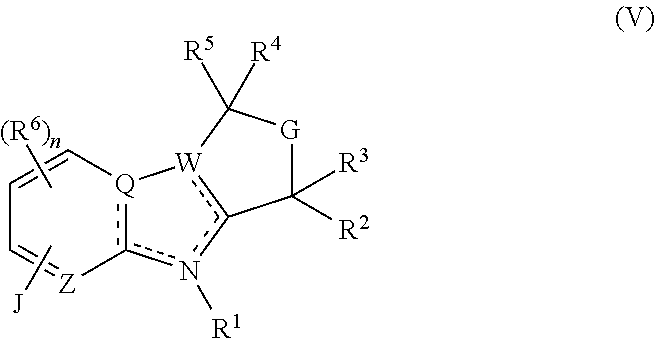
Examples
example 1
Analytical Methods and Materials
[0146]Unless otherwise noted, reagents and solvents were used as received from commercial suppliers. Proton nuclear magnetic resonance (NMR) spectra were obtained on Bruker spectrometers at 300, 400 or 500 MHz. Spectra are given in ppm (δ) and coupling constants, J, are reported in Hertz. Tetramethylsilane (TMS) was used as an internal standard. Mass spectra were collected using either a Finnigan LCQ Duo LCMS ion trap electrospray ionization (ESI) or a mass Varian 1200L single quadrapole mass spectrometer (ESI). High performance liquid chromatograph (HPLC) analyses were obtained using a Luna C18(2) column (250×4.6 mm, Phenomenex) or a Gemini C18 column (250×4.6 mm, Phenomenex) with UV detection at 254 nm or 223 nm using a standard solvent gradient program (Method A, Method B or Method C).
Method A:
[0147]
TimeFlow(min)(mL / min)% A% B0.01.090.010.0201.010.090.0301.010.090.0A = Water with 0.05% Trifluoroacetic AcidB = Acetonitrile with 0.05% Trifluoroacetic...
example 2
Preparation of 4-(Benzyloxy)-1-(9-methyl-5,7,8,9-tetrahydro-6H-pyrido[3′,4′:4,5]pyrrolo[2,3-b]pyridin-2-yl)pyridin-2(1H)-one dihydrochloride
a) 2-Bromo-6-hydrazinylpyridine
[0150]
[0151]Hydrazine (27 mL, 83 mmol) was added to 2,6-dibromopyridine (20 g, 84 mmol), and the resulting suspension was heated at 70° C. for 30 min. The solution was cooled to 50° C. and diluted with H2O (150 mL). The resulting solids were stirred for 2 h, collected by filtration, and washed with H2O (350 mL) to provide the title compound (13 g, 83%) as a white solid: 1H NMR (300 MHz, DMSO-d6) δ 7.87 (s, 1H), 7.34 (overlapping dd, J=7.8 Hz, 1H), 6.68 (d, J=7.8 Hz, 1H), 6.65 (d, J=7.8 Hz, 1H), 4.19 (s, 2H).
b) tert-Butyl 4-(2-(6-bromopyridin-2-yl)hydrazono)piperidine-1-carboxylate
[0152]
[0153]N-Boc piperidinone (13.8 g, 69.1 mmol) was added to a solution of 2-bromo-6-hydrazinylpyridine (13.0 g, 69.1 mmol) in MeOH (240 mL). The resulting solution was stirred at ambient temperature for 2 h. The solution was concentrat...
example 3
Preparation of 1-(9-Methyl-5,7,8,9-tetrahydro-6H-pyrido[3′,4′:4,5]pyrrolo[2,3-b]pyridin-2-yl)-4-phenethylpiperazin-2-one dihydrochloride
a) 4-Phenethylpiperazin-2-one (CAS Registry Number 23099-72-1) (JP 43017188 to Irikura et al., which is Hereby Incorporated by Reference in its Entirety)
[0164]
[0165]A suspension of (2-bromoethyl)benzene (4.10 mL, 30.0 mmol), piperazin-2-one (3.00 g, 30.0 mmol) and K2CO3 (4.90 g, 36.0 mmol) in DMSO (60.0 mL) was stirred at 80° C. for 5 h. The reaction mixture was cooled to room temperature and filtered. The filtrate was then washed with water (200 mL) and extracted with methylene chloride (2×). The combined organic layers were washed with brine, dried over MgSO4, filtered, and concentrated. The result yellow solid was then dissolved in 1 N HCl (120 mL) and washed with methylene chloride. The aqueous layer was separated, basified with 6 N NaOH, and extracted with methylene chloride (3×). The combined organic layers were dried over MgSO4, filtered, and...
PUM
| Property | Measurement | Unit |
|---|---|---|
| temperature | aaaaa | aaaaa |
| temperature | aaaaa | aaaaa |
| volume | aaaaa | aaaaa |
Abstract
Description
Claims
Application Information
 Login to View More