[0009]According to one aspect of the present invention, an illuminator is disclosed which utilizes solid state light sources to produce a bright, color balanced, broad-spectrum, visible light output.
[0014]According to one advantageous feature of the invention, the LED light sources may be mounted on a
heat sink in good
thermal contact with a single
heat spreader plate. The spreader plate may be a
metal having high
thermal conductivity, such as
copper, aluminum, iron,
diamond, gold or silver and the like. The spreader plate may be mounted on—or integral with—a
passive cooling system, such as a finned
heat sink or a
heat pipe, or an
active cooling system, such as a thermoelectric cooler (TEC) or liquid cooler.
Thermal contact between the LEDs and the plate may be provided by, for example,
soldering or with the application of a thermally conductive compound, such as Type 120
Silicon Thermal
Joint Compound (Wakefield Thermal Solutions, New Hampshire). This mounting arrangement and cooling structure optimizes both cost / complexity of the
assembly and
cooling efficiency and therefore also the lifetime / reliability of the solid state source.
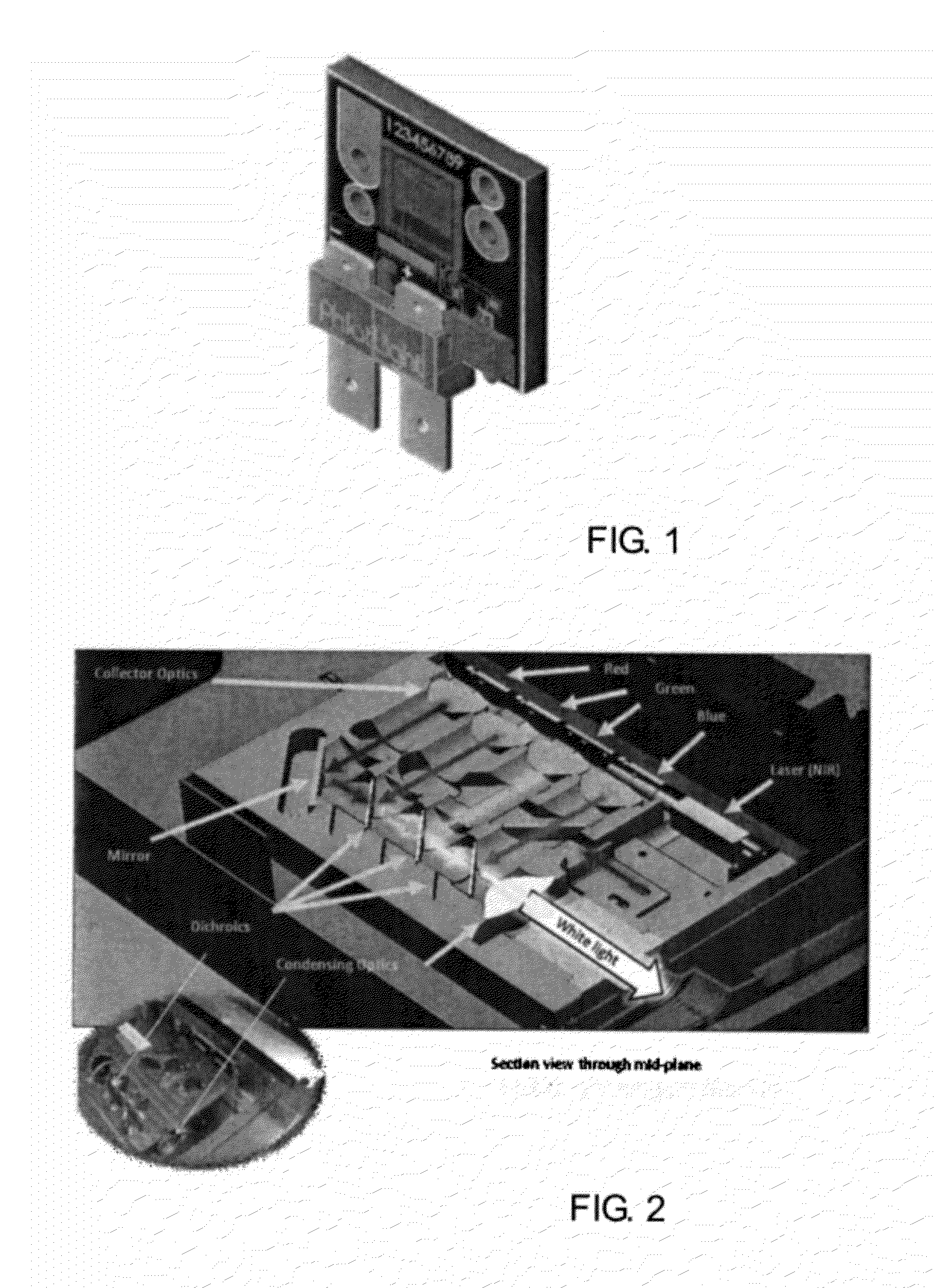
[0015]According to one advantageous feature of the invention, the LED light sources may be mounted on a plane which is common to the planar surface of the heat sink on the single
heat spreader plate, with the
optical path length increasing with
wavelength, e.g. the red LED has longest
optical path, the blue LED has shortest optical path. LED
light source is positioned at or near the focal point of a compound collector group consisting of an
aspheric lens (e.g., Newport KPA040-C, Irvine, Calif.), which collects the light from each LED
light source. The collection efficiency of the
aspheric lens may be enhanced by a field lens mounted between the LED and the
aspheric lens. The aspheric lens projects a nearly
collimated light beam from the LED onto a mirror or a
dichroic filter (e.g. Semrock FF670-SDi01-25x36, Rochester, N.Y.) positioned to reflect light at a right angle relative to the light projected by the aspheric lens into the combined
light beam path. The
dichroic filter is designed to reflect substantially all light at or above the wavelength of the LED emission and transmits the light of all shorter wavelengths. The power and position of each aspheric lens and the power and position of any field lens is adjusted as required for each LED to accommodate the differences in optical path lengths. In this way, the etendue constraints with a linear arrangement of light sources can be managed and the capacity of the high NA lens in
coupling the combined beam of light into an optical
light guide can be maximized.
[0016]According to one advantageous feature of the invention,
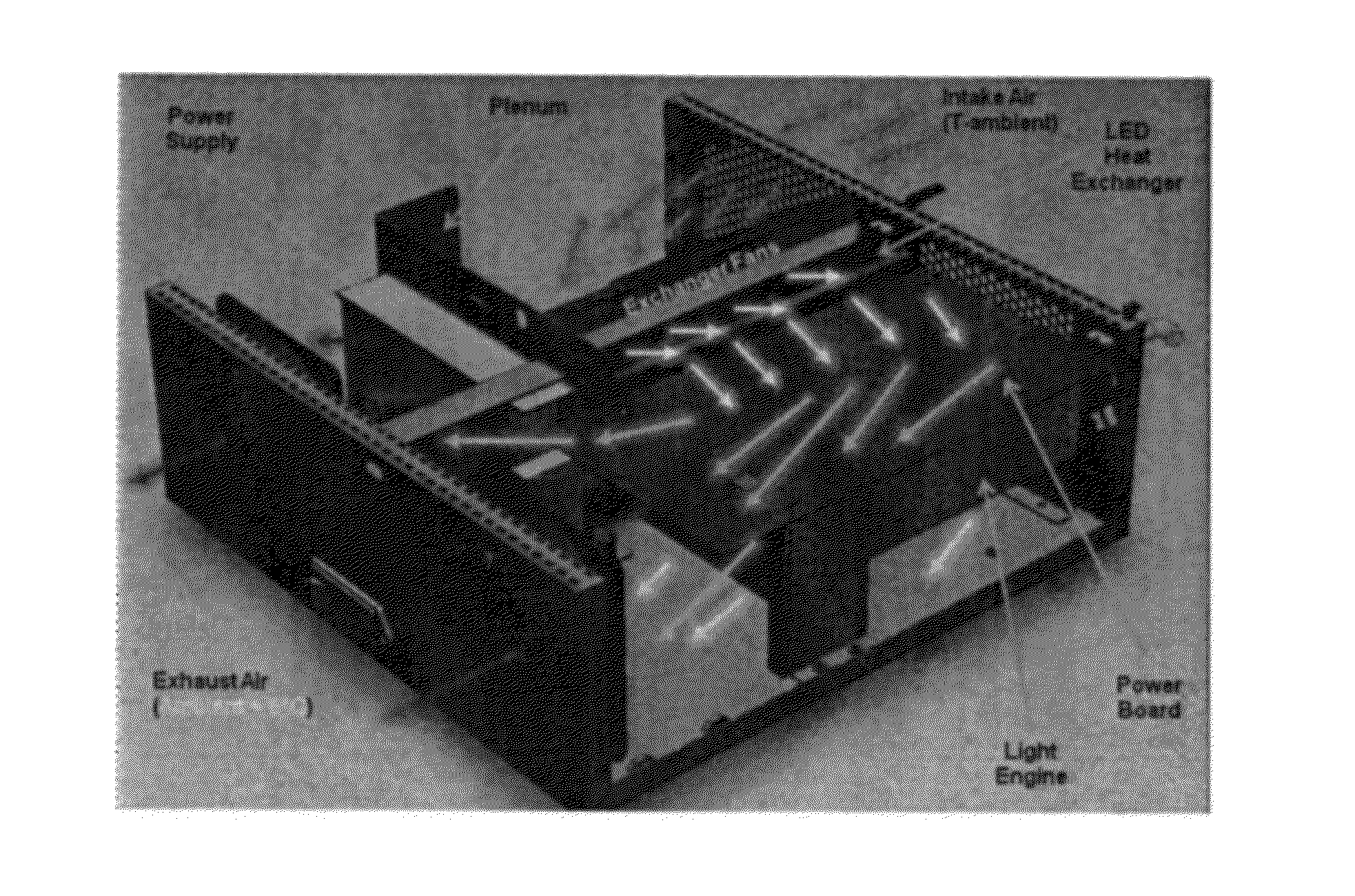
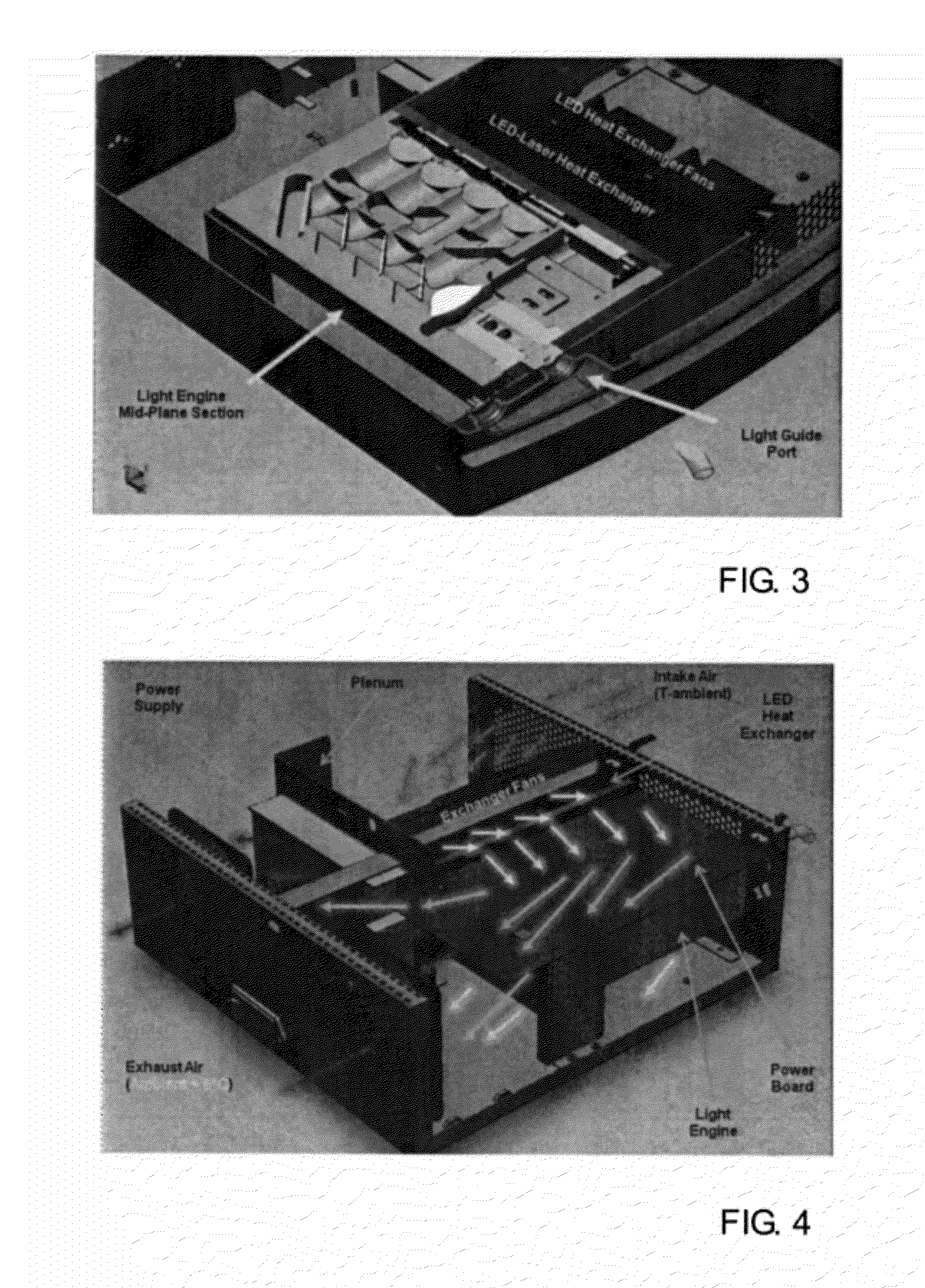
all optical elements not directly attached to the LED light sources (including all remaining collector lenses, reflective and dichroic mirrors, and collimating / condensing lenses) may be mounted in a
mating mechanical
enclosure. The
enclosure may be fabricated from a single block of material such as aluminum, or similar material and may be machined or may be cast and machined as a
single element. The mechanical
enclosure may also be composed of multiple elements individually fabricated (e.g. machined) and assembled. The enclosure has a
linear array of input ports matching the linear pattern of LED sources on the
heat spreader plate˜e.g., one input port for each LED light source˜and a single output port. Once
all optical components are mounted in the enclosure, the plate with the LED light sources is assembled to the enclosure input ports and a
shutter that seals the exit aperture in the absence of a
light guide is mounted placed on the output port. The enclosure is consequently fully sealed and the optical elements are protected against the ingress of dust and other contaminants.


 Login to View More
  Login to View More