

Negative-swelling and exceptionally robust adhesive hydrogels
a technology of adhesive hydrogels and negative swelling, applied in the direction of impression caps, dental prosthetics, surgery, etc., can solve the problems of poor mechanical properties, limited internal use, and the possibility of disease transmission, and achieve the effects of good adhesion to soft tissue, controlled swelling, and high mechanical robustness
- Summary
- Abstract
- Description
- Claims
- Application Information
AI Technical Summary
Benefits of technology
Problems solved by technology
Method used
Image

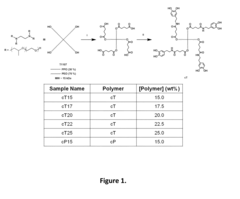
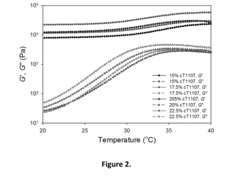
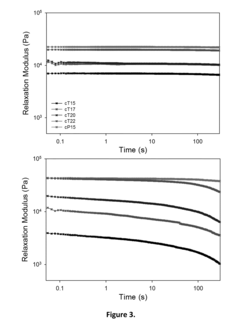
Examples
example 1
[0078]Materials:
[0079]Tetronic® 1107 (T1107, MW≈15 kDa; 30 wt % PPO, 70 wt % PEO) was a generous gift from BASF (Florham Park, N.J.). PEO (4-arm, MW≈10 kDa) was purchased from JenKem Technology USA, Inc. (Allen, Tex.). 2-(1H-benzotriazole-1-yl)-1,1,3,3-tetramethyluronium hexafluorophosphate (HBTU) was purchased from Chem-Impex International (Wood Dale, Ill.). Sodium meta-periodate (NaIO4) and glutaric anhydride (GA) were purchased from Sigma-Aldrich (Milwaukee, Wis.). Dopamine hydrochloride (DA), triethylamine (TEA), 4-nitrophenyl chloroformate (4NPC), dichloromethane (DCM), dimethylformamide (DMF), tetrahydrofuran (THF), and methanol (MeOH) were purchased from Fisher Scientific (Philadelphia, Pa.). All chemicals were used without further purification. Dehydrated and decellularized porcine dermis was a gift from Kensey Nash Corporation (Exton, Pa.).
[0080]Synthesis of Catechol-Tetronic® (cT):
[0081]T1107 (10 g) and glutaric anhydride (5× mol. equiv. relative to —OH) were added to a tw...
PUM
| Property | Measurement | Unit |
|---|---|---|
| Temperature | aaaaa | aaaaa |
| Temperature | aaaaa | aaaaa |
| Temperature | aaaaa | aaaaa |
Abstract
Description
Claims
Application Information
 Login to View More