Check patentability & draft patents in minutes with Patsnap Eureka AI!

Process for the preparation of polyamides

a polyamide and polyamide technology, applied in the field of polyamide production methods, can solve the problems of large amount of water, and use of aqueous nylon salt solutions

Inactive Publication Date: 2014-10-02
INVISTA NORTH AMERICA R L
View PDF3 Cites 10 Cited by
  • Summary
  • Abstract
  • Description
  • Claims
  • Application Information

AI Technical Summary

Benefits of technology

The patent text describes a process for producing polyamides by combining solidified components of diacids and diamines. The process involves contacting the components in a specific ratio and in a specific state (molten or solution) to create a composition with a specific molar ratio of dicarboxylic acid to diamine. The resulting composition has a unique composition and properties that make it useful in various applications. The process can be carried out with or without heat and pressure, and the resulting polyamide can be formed into various forms such as granules or fibers.

Problems solved by technology

There are several disadvantages to the use of aqueous nylon salt solutions.
Reducing the amount of water therefore creates a trade-off with the cost and instability of managing a higher temperature and pressure storage process.
Another disadvantage is the cost associated with handling large amounts of water.
Holding the solutions at high temperatures during storage and concentration also increases the risk of thermal degradation.
Finally, the diamines used frequently have vapor pressures such that a portion of the diamine is lost to vaporization during the removal of water.
This process, however, does not address the problem of diamine volatility.
Restricting compositions to higher boiling diamines such as m-xylylenediamine makes this process uneconomical when compared to much less expensive but more volatile diamines.
It would also be uneconomical to construct a condenser large enough to meet the reflux volume required for a system based on higher amounts of more volatile diamines such as hexamethylenediamine.
As the temperature is raised during the synthesis, the residence time of free diamine in the liquid phase becomes continually shorter and this leads to disadvantageously long cycle times for completing the polyamidation.
Throughout these refinements, however, the restriction to the use of high-boiling diamines and the use of the diamine reflux column persist.
The possibility of process upsets and difficulties in maintaining steady-state in such a system suggests limitations to general utility of the process.
In addition, only molten processing is disclosed: the problem of starting with solid acid-rich mixtures is not addressed.
Much of the energy costs of conventional processes arise ahead of the final reactor, however, as the initial salt solution is concentrated prior to reactor charge.
This process does reduce the amount of water added, but significant amounts of water are still required for removal.
This process also adds two layers of complexity to existing polyamidation operations.
There are therefore several disadvantages inherent in this approach.
This process achieves higher starting salt concentrations but is still limited to water contents of between about 24.5 and 35.6% by weight.
In addition, no method for controlling the stoichiometric balance of the final polymer is proposed.
As a result, the need for balanced salt at start-up is disadvantageous.

Method used

the structure of the environmentally friendly knitted fabric provided by the present invention; figure 2 Flow chart of the yarn wrapping machine for environmentally friendly knitted fabrics and storage devices; image 3 Is the parameter map of the yarn covering machine
View more

Image

Smart Image Click on the blue labels to locate them in the text.
Viewing Examples
Smart Image
  • Process for the preparation of polyamides
  • Process for the preparation of polyamides
  • Process for the preparation of polyamides

Examples

Experimental program
Comparison scheme
Effect test

example 1

Preparation of Pelletized Acid-Rich Solids

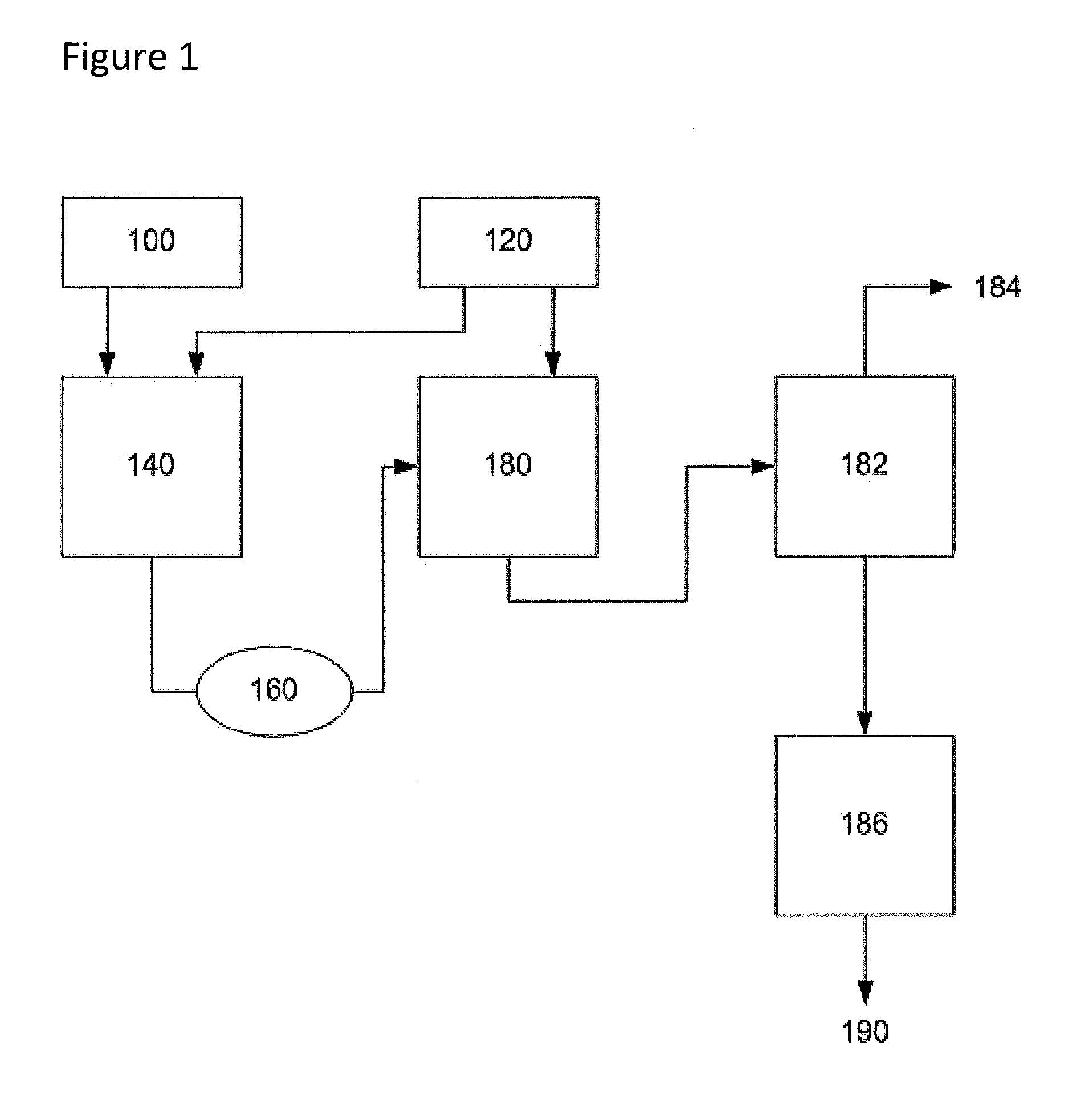
[0068]The description of this example may be better understood by reference to FIG. 1. Under an inert atmosphere and without the presence of oxygen, wet adipic acid (100 in FIG. 1) is fed at 100 kg / min into a continuous stirred tank reactor (140) used as the primary mix vessel. This adipic acid feed (100) contains 10% water by weight but the moisture content can be varied. It is understood that the real limit of incoming moisture content is economically sizing the mix vessels and distillation column. Anhydrous adipic acid also functions well. The primary mix vessel (140) is well stirred and the anhydrous hexamethylenediamine (120) is fed into the vessel (140) under agitation at a rate of 22.5 kg / min. Aqueous solutions of hexamethylenediamine can also be used. It is understood that the molar ratio of diacid to diamine can be varied above 1 without departing from this invention so long as other process conditions are selected to achieve an ade...

example 2

Preparation of Pelletized Amine-Rich Solids

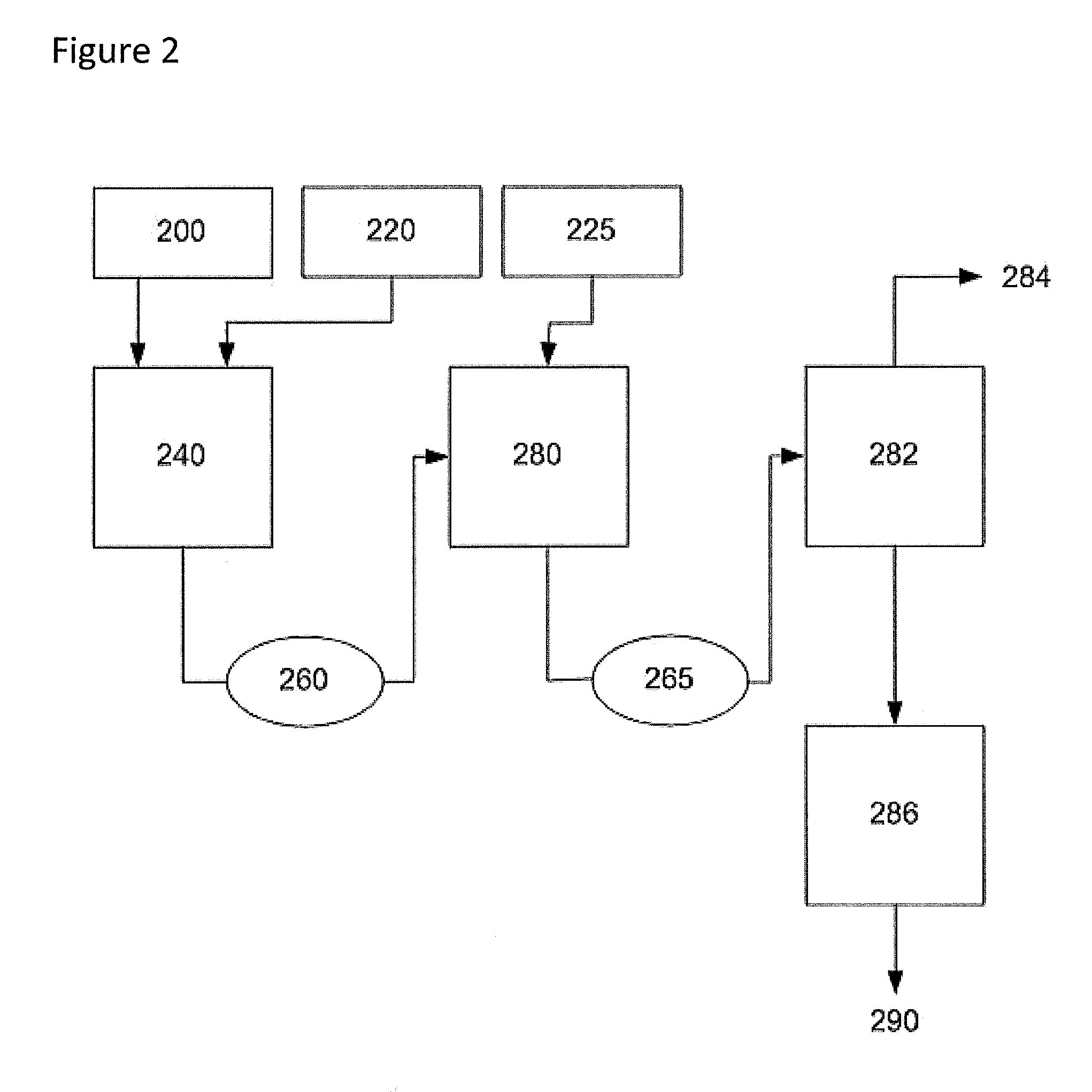
[0072]The description of this example may be better understood by reference to FIG. 2. In the manner of Example 1, wet adipic acid (200) is fed at 26.8 kg / min into the primary mix vessel (240). Anhydrous hexamethylenediamine (220) is added under agitation at a rate of 6.1 kg / min. This process is controlled via feedback from the online NIR instrument (260). The vessel (240) is maintained at 125° C. and atmospheric pressure under nitrogen blanketing to maintaining an inert atmosphere. It is understood that the molar ratio of diacid to diamine can be varied below 1 without departing from this invention so long as other process conditions are selected to achieve an adequate melt. Other moisture contents of the diacid and diamine feeds can be selected without departing from this invention.

[0073]The molten acid-rich mixture is fed into the secondary mix vessel (280) to which anhydrous hexamethylenediamine (225) is added under agitation at a rate ...

example 3

Preparation of Salt Solutions from Pelletized Acid-Rich Solids

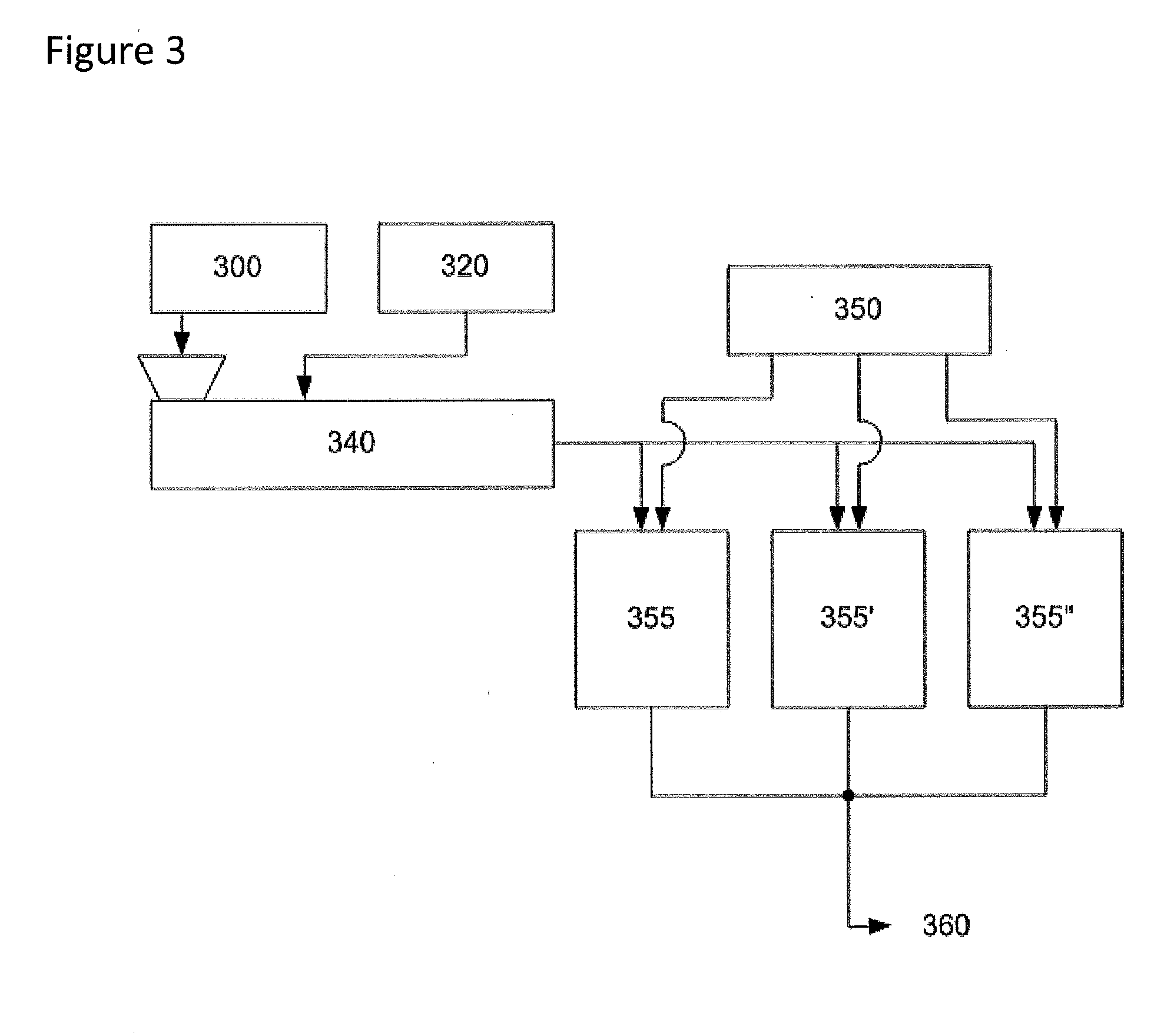
[0076]The description of this example may be better understood by reference to FIG. 3. The apparatus includes a single screw extruder (340) constructed of corrosion-resistant alloys utilizing a screw that is designed to promote mixing such that additives can be injected along the barrel as desired. It also includes three mix vessels (355, 355′, 355″) that are similar to those of Example 1. Twin screw extruders are also suitable for this use. The vessels (355, 355′, 355″) are sequenced through three stages to maintain uninterrupted input and output. The vessels (355, 355′, 355″) are maintained under agitation at 140° C. and about 43 psig or higher under inert atmosphere.

[0077]The acid-rich pellets (300) of Example 1 are conveyed by known means at a rate of 20.0 kg / min to a single screw extruder (340) under inert atmosphere. The extruder is operated to melt the pellets smoothly at 125° C. Water (320) is injected in this exa...

the structure of the environmentally friendly knitted fabric provided by the present invention; figure 2 Flow chart of the yarn wrapping machine for environmentally friendly knitted fabrics and storage devices; image 3 Is the parameter map of the yarn covering machine
Login to View More

PUM

PropertyMeasurementUnit
mole ratioaaaaaaaaaa
mol %aaaaaaaaaa
melt temperatureaaaaaaaaaa
Login to View More

Abstract

The disclosures herein relate to a process for making polyamides from stoichiometrically imbalanced mixtures. This process includes the production and subsequent use of solidified stoichiometrically imbalanced components comprising mixtures of diacids and diamines. This stoichiometric imbalance is defined by a component molar ratio equal to moles of dicarboxylic acid units divided by moles of diamine units; and wherein this molar ratio is different from unity. This process comprises steps of: a) forming an acid-rich solidified first component in a dry or moisture containing state by; b) contacting at least a dicarboxylic acid with at least a diamine in a molar ratio of greater than 1:1; c) forming an amine-rich solidified second component in a dry or moisture containing state by; d) contacting at least a dicarboxylic acid with at least a diamine in a molar ratio of less than 1:1; e) contacting the acid-rich first component with the amine-rich second component in a molten state or a solution state and f) forming a first composition having a composition molar ratio g) such that a total dicarboxylic acid content and a total diamine content, supplied by said first and second components, is from about 0.95 to about 1.05; h) heating the first composition with agitation in the molten state and under pressure to a sufficiently high temperature for a polyamidation reaction to and subsequently, i) forming a second composition comprising a polyamide.

Description

RELATED APPLICATION[0001]This application claims benefit to Provisional Application No. 61 / 566,886 filed Dec. 5, 2011 which is herein incorporated by reference in its entirety.FIELD OF THE INVENTION[0002]The disclosures herein relate to a method for the production of polyamides having the benefit of lower energy requirements, lower thermal degradation, and greater compositional flexibility. More particularly these disclosures relate to processes of mixing and staging dicarboxylic acids with diamines and ultimately to the preparation of high molecular weight polyamides. In addition, these disclosures relate to the preparation of solid intermediate products of diamine and diacid blends adapted for storage and subsequent polyamidation at later times.BACKGROUND OF THE INVENTION[0003]There are several disadvantages to the use of aqueous nylon salt solutions. The first is that the temperature and pressure required to stabilize the salt solutions increases exponentially with concentration....

Claims

the structure of the environmentally friendly knitted fabric provided by the present invention; figure 2 Flow chart of the yarn wrapping machine for environmentally friendly knitted fabrics and storage devices; image 3 Is the parameter map of the yarn covering machine
Login to View More

Application Information

Patent Timeline
no application Login to View More
Patent Type & Authority Applications(United States)
IPC IPC(8): C08G69/04
CPCC08G69/04C08G69/28C08L77/06
Inventor KAUSHIVA, BRYAN DINESH
Owner INVISTA NORTH AMERICA R L
Features
  • R&D
  • Intellectual Property
  • Life Sciences
  • Materials
  • Tech Scout
Why Patsnap Eureka
  • Unparalleled Data Quality
  • Higher Quality Content
  • 60% Fewer Hallucinations
Social media
Patsnap Eureka Blog
Learn More