Unlock instant, AI-driven research and patent intelligence for your innovation.

Halogen free ionic liquids as lubricant or lubricant additives and a process for the preparation thereof

a technology of ionic liquids and additives, which is applied in the direction of additives, lubricant compositions, petroleum industry, etc., can solve the problems of corroding the tribo-surface but also polluting the environment, damage to the contact surfaces in the mechanical system, etc., to minimize the hazardous and corrosion effect on the environment and engineering surfaces, and improve the combination of friction, wear and heat transfer properties. , the effect of improving the effect of friction

Inactive Publication Date: 2017-04-06
COUNCIL OF SCI & IND RES
View PDF1 Cites 5 Cited by
  • Summary
  • Abstract
  • Description
  • Claims
  • Application Information

AI Technical Summary

Benefits of technology

The present invention provides lubricants or lubricant additives made of halogen-free, phosphorus-free, and sulphur-free ionic liquids containing fatty acids anions. These lubricants have superior friction-reducing and anti-wear properties, and minimize hazardous and corrosion effects on the environment and engineering surfaces. The composition also has high friction reducing and anti-wearing properties.

Problems solved by technology

The drawbacks are the use of halogenated ionic liquids, which not only corrodes the tribo-surfaces but also pollute the environment.
Eventually, the interactions of these ionic liquids with metallic surfaces under tribological conditions (high temperature and pressure) cause corrosion, which damages the contact surfaces in the mechanical system.
Addition to that halogenated ionic liquids releases toxic and corrosive hydrogen halides to the surrounding environment.
Therefore, the use of these ionic liquids as lubricant additives with various lube base stocks is a great challenge owing to their hazardous, toxic and corrosive nature to the environment and engineering surfaces.
The drawbacks are (a) no significant improvement in tribological properties and (b) use of halogenated ionic liquids, which pollute the environment by halogen exposure.
Herein, all claimed ionic liquids exhibit halogen (fluorine) content, which not only corrodes the contact surfaces of metals but also pollute the environment by halogen exposure.
The addressed ionic liquids contains phosphorus and sulphur elements as main constituents, which are not only hazardous and toxic to environment, but also corrodes the engineering surfaces of metals.
Theses ionic liquids exhibit no significant reduction in both friction and wear by adding to 5W30 oil as lubricant additives and possesses halogen contents, which not only corrodes the contact surfaces made of metals but also pollute the environment.
The drawback is that ionic liquids have not been explored for friction and wear reduction.
Additionally, the addressed ionic liquids were based on halogen content, which not only corrodes the contact surfaces made of metals but also pollute the environment by halogen exposure.
However, so far no attempt was made on development of halogen-, phosphorus- and sulphur-free ionic liquids composed of fatty acids anions as lubricant or lubricant additives to improve the lubricating properties by reducing friction coefficient and wear between two or more contact surfaces and to minimize the hazardous and corrosive effects to the environment and engineering surfaces, which are emergent call of the hours owing to strict government regulations and policies on environment and energy efficient processes development.

Method used

the structure of the environmentally friendly knitted fabric provided by the present invention; figure 2 Flow chart of the yarn wrapping machine for environmentally friendly knitted fabrics and storage devices; image 3 Is the parameter map of the yarn covering machine
View more

Image

Smart Image Click on the blue labels to locate them in the text.
Viewing Examples
Smart Image
  • Halogen free ionic liquids as lubricant or lubricant additives and a process for the preparation thereof
  • Halogen free ionic liquids as lubricant or lubricant additives and a process for the preparation thereof
  • Halogen free ionic liquids as lubricant or lubricant additives and a process for the preparation thereof

Examples

Experimental program
Comparison scheme
Effect test

example 1

[0045]Preparation of Halogen-, Phosphorus- and Sulphur-Free Ionic Liquids Containing Fatty Acid Anions

(a) Tetrabutylammonium oleate (TBA-OL)

[0046]

[0047]TBA-OL ionic liquid may be represented by general formula TBA-OL was prepared by mixing sodium salt of oleic acid (0.05 mol) in an aqueous solution of tetrabutylammonium bromide (0.05 mol) at 45° C. for 4 hours under continuous stirring. This led to the formation of an organic layer in the reaction product, which was extracted using dichloromethane This was followed by washing of organic content composed of TBA-OL ionic liquid with pure water until no more bromide ions were detected in the water. Finally, dichloromethane was removed under reduced pressure and the extracted product was dried in a vacuum oven at 80° C. under reduced pressure for 48 hours. The synthesized ionic liquid was characterized by 1t1 NMR and FTIR spectroscopy. The characterization detail is as follows:

[0048]1H NMR (ppm): 0.88-1.1 (t, 15Hg,k CH3), 1.2-1.4 (m12Hc...

example 2

[0057]Friction-reducing and Anti-Wear Properties of Fatty Acids Ionic liquids as Lubricants

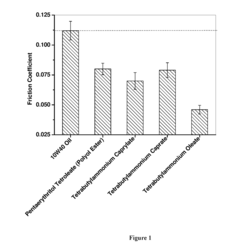
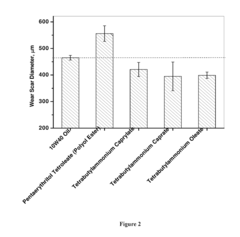
[0058]Lubricating properties in terms of friction coefficient and wear scar diameter (hereon it will be known as WSD) for the fatty acid ionic liquids as lubricants were evaluated on a four-ball test machine as per the ASTM D4172 standard test method For comparison purpose, two conventional lube oils (fully formulated 10W40 lube oil and pentaerythritol tetraoleate, polyol ester) were also evaluated under similar test conditions. In a typical experiment, a 12.7 mm steel ball under the 392 N load is rotated (rotating speed: 1200 rpm) against three stationary steel balls clamped in the holder at temperature of 75° C. for a test duration of 60 minutes. During the experiments, the four balls were fully flooded with a test lube sample, which was used for the friction and WSD evaluation. The friction force was measured during the tribo-test and WSD on the lubricated steel balls was examined by the mi...

example 3

[0059]Effect of Fatty Acid Ionic Liquid Concentration as Lubricant Additive on their Lubrication Properties

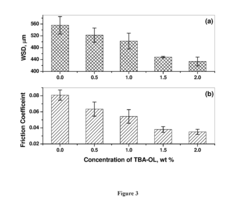
[0060]In order to improve the lubrication properties, variable concentrations (wt. %) of fatty acid ionic liquid are mixed with the conventional polyol ester (pentaerythrito) tetraoleate) lube base and then evaluated their friction coefficient and WSD on a four-ball test machine as per the ASTM D4172 standard test method. TBA-OL was selected as representative fatty acid ionic liquid for this study. In atypical experiment, a 12.7 mm steel ball under the 392 N load is rotated (rotating speed: 1200 rpm) against three stationary steel balls clamped in the holder at temperature of 75° C. for a test duration of 60 minutes. During the experiments, the four balls were fully flooded with a test lube sample. The friction force was measured during the tribo-test and WSD on the lubricated steel balls was examined by microscopic measurements. FIG. 3 shows the changes in friction coefficient...

the structure of the environmentally friendly knitted fabric provided by the present invention; figure 2 Flow chart of the yarn wrapping machine for environmentally friendly knitted fabrics and storage devices; image 3 Is the parameter map of the yarn covering machine
Login to View More

PUM

PropertyMeasurementUnit
temperatureaaaaaaaaaa
friction reducingaaaaaaaaaa
Login to View More

Abstract

A lubricant or lubricant additive composed of halogen-, phosphorus- and sulphur-free ionic liquids containing fatty acid anions exhibit superior friction-reducing and anti-wear properties. Preferably, the lubricant composition comprises a base oil and an ionic liquid or mixed of two or more ionic liquids having concentration of 0.5 wt. % or more. These halogen-, phosphorus- and sulphur-free ionic liquids as lubricant or lubricant additive have minimal hazardous and corrosion effect to the environment and engineering surfaces, respectively. General chemical formula of fatty acid anion is represented as RCOO−; whereas R may be C4 to C30 straight chain alkyl, branched alkyl, cycloalkyl, alkyl substituted cycloalkyl, cycloalkyl substituted alkyl, alkenyl (single or more double bonds) includes with or without branched structure and may contain heteroatom.

Description

FIELD OF THE INVENTION[0001]The present invention relates to halogen free ionic liquids based lubricant or lubricant additives and a process for the preparation thereof Particularly, the present invention provides lubricant or lubricant additives composed of halogen-, phosphorus, and sulphur-free ionic liquids containing fatty acid anions. More particularly, the invention relates to the reduction of friction and wears using these ionic liquids as lubricants or lubricant additives mixed with mineral, synthetic, native lube oils.BACKGROUND AND PRIOR ART OF THE INVENTION[0002]Need to conserve energy and the environment has catalyzed an interest to develop a new generation green lubricants or lubricant additives, which can improve the efficiency of engineering system, where two or more surfaces are in contact and moving relative to each other. The energy and material loss in such engineering system (pistons, pumps, clutches, bearing, turbines, cutting tools, MEMS and so on) can be reduc...

Claims

the structure of the environmentally friendly knitted fabric provided by the present invention; figure 2 Flow chart of the yarn wrapping machine for environmentally friendly knitted fabrics and storage devices; image 3 Is the parameter map of the yarn covering machine
Login to View More

Application Information

Patent Timeline
no application Login to View More
Patent Type & Authority Applications(United States)
IPC IPC(8): C10M141/06
CPCC10M141/06C10M2207/126C10M2215/04C10N2230/02C10N2220/022C10N2220/04C10M2215/224C10M129/32C10M129/38C10M2203/1006C10M2207/2835C10N2020/02C10N2030/02C10N2030/06C10N2020/077
Inventor KHATRI, OM PRAKASHGUSAIN, RASHI
Owner COUNCIL OF SCI & IND RES