Redox active colloidal particles for flow batteries

a technology of flow batteries and colloidal particles, which is applied in the direction of indirect fuel cells, cell components, electrochemical generators, etc., can solve the problems of 20% of the battery cost, high cost of iems, and large-scale development of nrfbs

Active Publication Date: 2017-05-11
THE BOARD OF TRUSTEES OF THE UNIV OF ILLINOIS
View PDF0 Cites 15 Cited by
  • Summary
  • Abstract
  • Description
  • Claims
  • Application Information

AI Technical Summary

Benefits of technology

[0006]The invention provides a redox flow battery comprising a first and a second chamber separated by a microporous or nanoporous size-exclusion membrane, wherein the first and second chambers each contain a non-aqueous solvent, a charge balancing ion, and an electrode; and wherein the first chamber contains one or more colloi

Problems solved by technology

Despite these exciting prospects, the lower ionic conductivity observed in non-aqueous electrolytes has prevented the wide-scale development of NRFBs.
Moreover, IEMs are expensive and they contribute to ˜20% of the battery cost.
A strong emphasis is placed on the complex design of these membranes so they can adjust their sterics and electrostatics to effectively discriminate the redox active species, however this adds to the cost and complexity of the device.

Method used

the structure of the environmentally friendly knitted fabric provided by the present invention; figure 2 Flow chart of the yarn wrapping machine for environmentally friendly knitted fabrics and storage devices; image 3 Is the parameter map of the yarn covering machine
View more

Image

Smart Image Click on the blue labels to locate them in the text.
Viewing Examples
Smart Image
  • Redox active colloidal particles for flow batteries
  • Redox active colloidal particles for flow batteries
  • Redox active colloidal particles for flow batteries

Examples

Experimental program
Comparison scheme
Effect test

example 1

on of Polyvinylbenzyl Chloride Particles

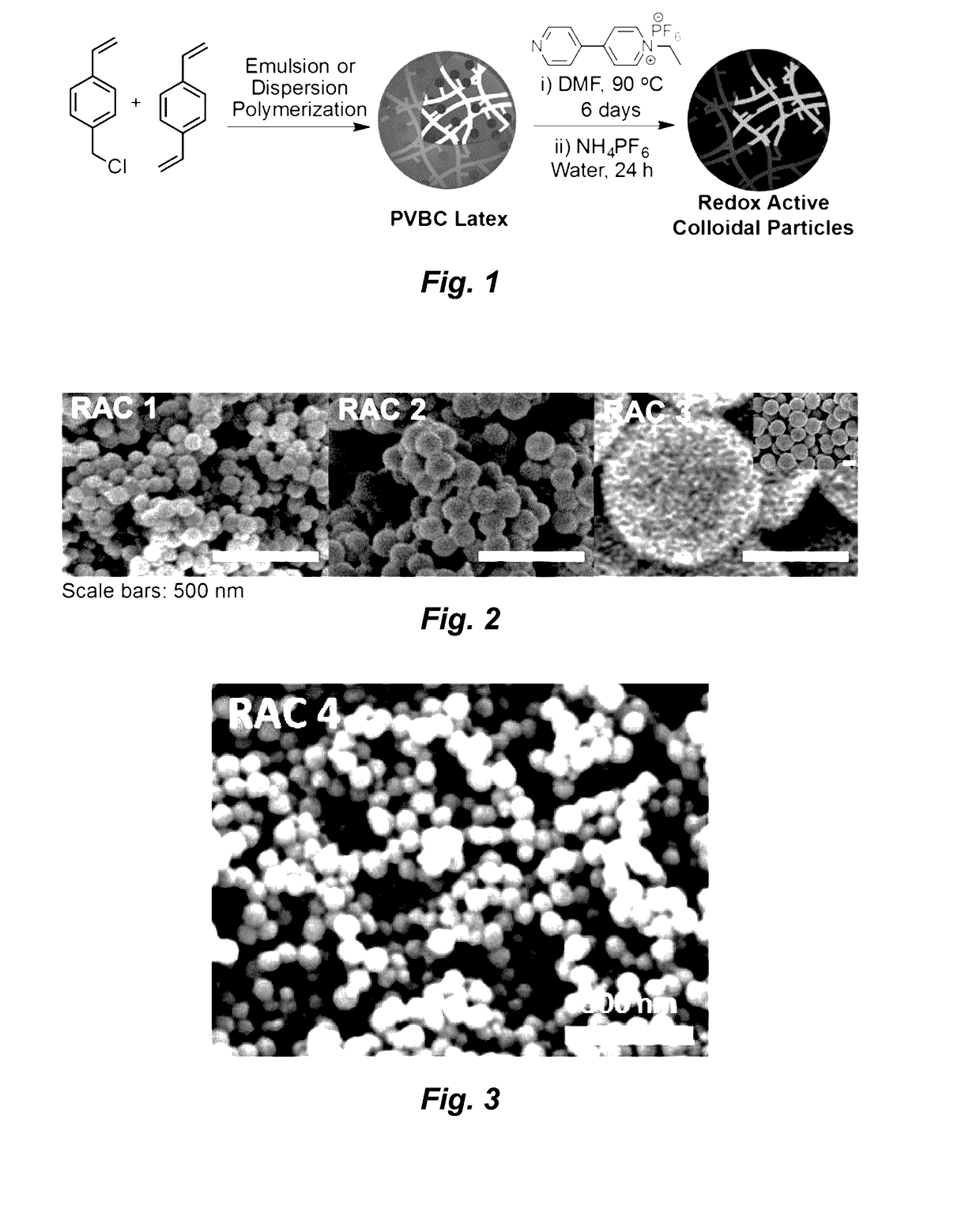
[0137]Redox-active colloidal particles were prepared and evaluated as redox species for non-aqueous redox flow batteries (NRFBs). A schematic of the colloidal particles prepared from a polyvinylbenzyl chloride latex is shown in FIG. 1.

[0138]Polyvinylbenzyl Chloride Particles (60 nm and 90 nm).

[0139]The redox-initiated emulsion polymerization of 4-vinylbenzyl chloride reported by Chonde and coworkers (J. Appl. Polym. Sci. 1980, 25, 2407) was modified to synthesize poly(4-vinylbenzyl chloride) (PVBC) particles 60±10 and 90±10 nm in diameter. Reagent quantities are listed in Table 1-1.

TABLE 1-1Recipes for 60-nm and 90-nm PCMS particles.Reagent60-nm Recipe90-nm RecipeWater (mL)21.014.010% (w / w) Triton X-100 (mL)16.016.01.0% (w / w) Sodium dodecyl sulfate (mL)16.016.00.1 N KOH (mL)12.012.00.01% (w / w) FeSO4•7H2O (mL)1.02.04-Vinylbenzyl chloride, 90% (mL)15.030.0Divinylbenzene, 80% (mL)0.300.601.0% (w / w) NaHSO3 (mL)4.08.03.0% (w / w) K2S2O8 (mL)2.04.0Nit...

example 2

on of Viologen Redox-Active Colloidal Particles (RACs 1-3)

[0143]

[0144]Viologen Redox-Active Colloidal Particles (RACs 1-3) can be prepared as illustrated above. Similar techniques can be used to prepare redox active colloidal particles based on polyacrylate, polymethacrylate, polystyrene, polynorbornene, and polyacrylamide polymer backbones.

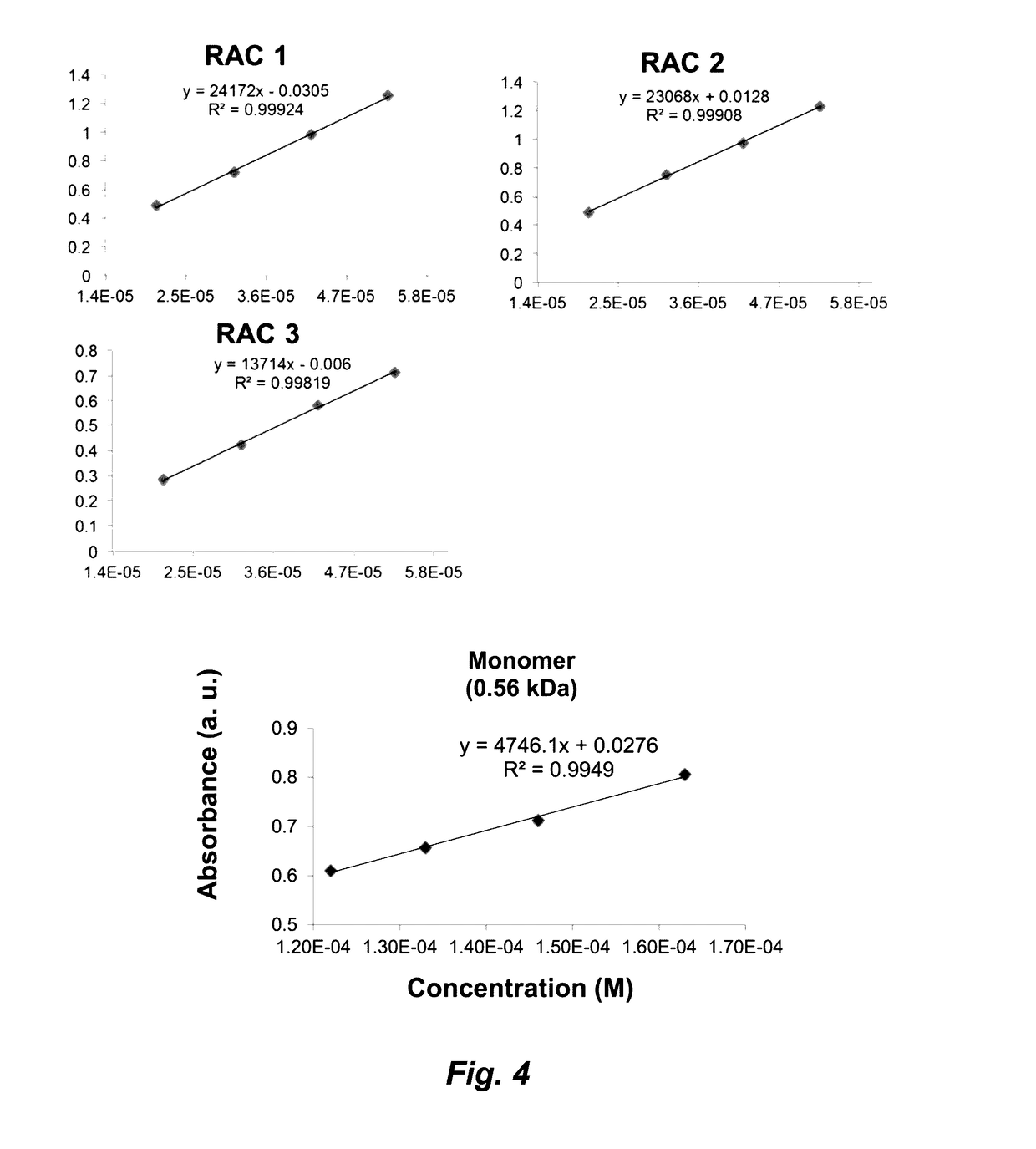
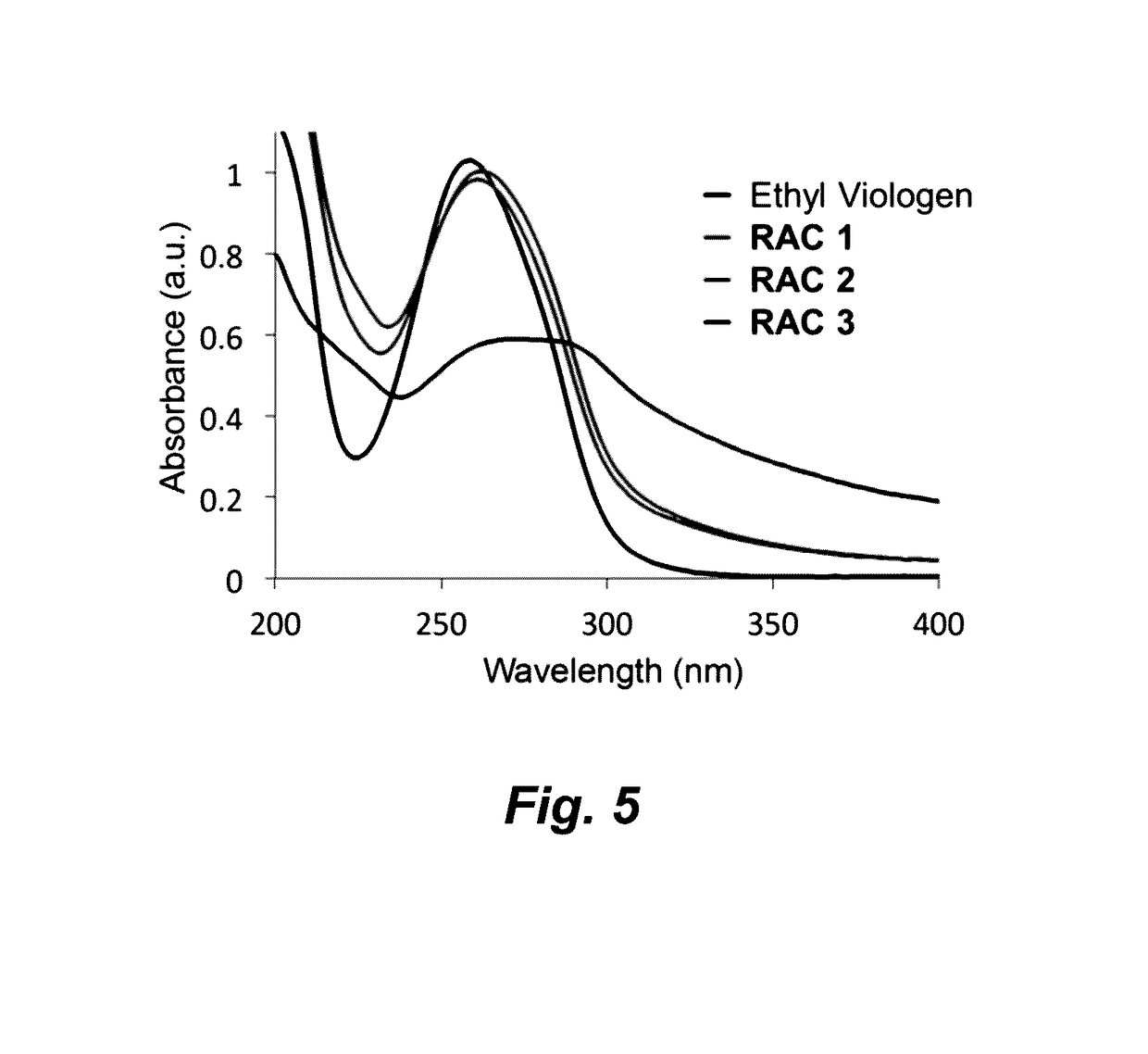
[0145]Dry DMF (45 mL) and dry THF (45 mL) were added to a flask containing polyvinylbenzyl chloride colloidal particles (1.5 g, 9.83 mmol) and the resultant mixture was sonicated in a bath sonicator until a homogeneous dispersion was obtained (˜1-2 h). To the above dispersion ethyl viologen (15 g, 45.4 mmol) was added and reflux condenser was attached. Reflux condenser was sealed with rubber septa at the top. The dispersion was subjected to 3 vacuum / nitrogen cycles followed by purging with nitrogen for about 15 min. The round-bottom flask was then immersed in an oil bath, preheated to 90° C., for 7 days. A concentrated solution of ammonium hexafl...

example 3

on of Ferrocene Redox-Active Colloidal Particles

[0146]

[0147]Ferrocene Redox Active Colloidal Particles (RAC 4):

[0148]Dry DMF (50 mL) and dry THF (50 mL) were added to a flask containing crosslinked polyvinylbenzyl chloride colloidal particles (1.0 g) and the resultant mixture was sonicated in bath sonicator until a homogeneous dispersion was obtained (˜1-2 h). To the above dispersion (dimethylaminomethyl)ferrocene (12 mL) was added and the flask was sealed with rubber septa. The dispersion was subjected to 3 vacuum / nitrogen cycles followed by purging with nitrogen for about 15 min. The flask was immersed in oil bath preheated to 50° C. and stirred for 4 days. The reaction mixture was precipitated in diethyl ether and colloidal particles were separated by centrifugation. The colloidal particles were redispersed in DMF (˜200 mL). A concentrated solution of ammonium hexafluorophosphate (12 g in 30 mL water) was prepared in water and added to the colloidal particle dispersion and stirre...

the structure of the environmentally friendly knitted fabric provided by the present invention; figure 2 Flow chart of the yarn wrapping machine for environmentally friendly knitted fabrics and storage devices; image 3 Is the parameter map of the yarn covering machine
Login to View More

PUM

PropertyMeasurementUnit
Fractionaaaaaaaaaa
Fractionaaaaaaaaaa
Fractionaaaaaaaaaa
Login to View More

Abstract

The invention provides a redox flow battery comprising a microporous or nanoporous size-exclusion membrane, wherein one cell of the battery contains a redox-active colloidal particle dispersed in a non-aqueous solvent. The redox flow battery provides enhanced ionic conductivity across the electrolyte separator and reduced redox-active species crossover, thereby improving the performance and enabling widespread utilization of the battery. Redox active colloidal particles (RACs) were prepared, analyzed, and were found to be highly effective redox species for use in redox flow batteries.

Description

RELATED APPLICATIONS[0001]This application is a continuation-in-part of U.S. patent application Ser. No. 15 / 000,910, filed Jan. 19, 2016, which claims priority under 35 U.S.C. §119(e) to U.S. Provisional Patent Application No. 62 / 104,329, filed Jan. 16, 2015, which applications are incorporated herein by reference.GOVERNMENT SUPPORT[0002]This invention was made with government support under contract number DE-AC02-06CH11357 awarded by the Department of Energy. The government has certain rights in the invention.BACKGROUND OF THE INVENTION[0003]Redox flow battery technology offers many advantages for grid energy storage such as load-leveling, long durability, flexible operation, easy scalability, high-efficiency and low cost. In this technology, electrochemical energy is stored in highly concentrated solutions of reversible redox active molecules, and separated in compartments for the low and high electrochemical potential species. Non-aqueous redox flow batteries (NRFBs) are a potent...

Claims

the structure of the environmentally friendly knitted fabric provided by the present invention; figure 2 Flow chart of the yarn wrapping machine for environmentally friendly knitted fabrics and storage devices; image 3 Is the parameter map of the yarn covering machine
Login to View More

Application Information

Patent Timeline
no application Login to View More
IPC IPC(8): H01M4/90C08F214/14H01M8/18
CPCH01M4/9008C08F214/14H01M4/9091H01M8/188C08F8/30H01M8/20H01M8/02H01M2300/0025H01M2300/0028C08F212/26C08F212/32C08F212/18Y02E60/50C08F212/36C08F12/26C08F12/32C08F12/18
InventorMOORE, JEFFREY S.RODRIGUEZ-LOPEZ, JOAQUINGAVVALAPALLI, NAGARJUNAMONTOTO, ELENAHUI, JINGSHU
OwnerTHE BOARD OF TRUSTEES OF THE UNIV OF ILLINOIS