

Polymer alcoholysis
a polymer alcohol and alcohol technology, applied in the field of polymer alcoholysis, can solve the problems of thermal degradation of pla, inability to readily reprocess pla, and inability to meet the demand for post-consumer pla, and achieve the effects of enhancing or accelerating the partial or complete degradation of polymers, reducing the molecular weight of polymer segments, and improving the recyclability of materials
- Summary
- Abstract
- Description
- Claims
- Application Information
AI Technical Summary
Benefits of technology
Problems solved by technology
Method used
Image

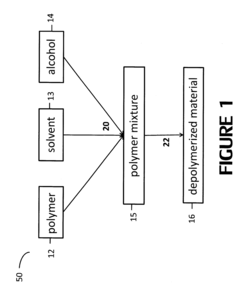
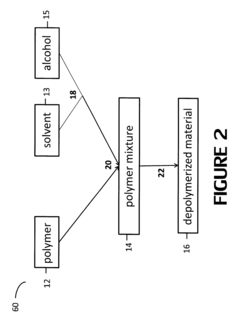
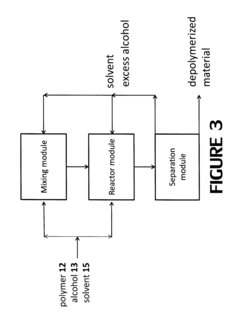
Examples
example 1
[0053]Solution A, consisting of PLA, methanol (MeOH), and chloroform (CHCl3) (4 / 25 / 71 w / w / w) was prepared and left at 57° C. overnight. After this time, it was noted that the solution exhibited lower viscosity than previously, and the molecular weight of the sample was evaluated.
[0054]Two additional, similar solutions were prepared using the same PLA but with PLA / methanol / chloroform ratios of 11 / 25 / 64 w / w / w (Solution B) and 7.5 / 25 / 67.5 w / w / w (Solution C). Solutions A, B, and C were maintained at 57° C. for 7 days, air-dried to evaporate residual methanol and chloroform, and then further dried in a vacuum oven for 7 days. The inherent viscosities of these solutions were measured and compared with a control (“Control”) prepared by evaporating a 10% solution (w / w) of the same PLA in chloroform only. The results are provided below in Table 1.
TABLE 1Data for Depolymerized ProductsSample (PLA / MeOH / CHCl3) wt. / wt. / wt.10 / 0 / 904 / 25 / 717.5 / 25 / 67.511 / 25 / 64(Control)(Solution A)(Solution B)(Solutio...
example 2
[0056]To study the kinetics of the degradation (methanolysis) reaction, a ternary solution was made up in a glass jar at room temperature at the following loading: PL49 / MeOH / CHCl3, 11.1 / 26.0 / 62.9 (w / w / w). PL49 is a commercially available PLLA from Corbion Purac (Amsterdam, the Netherlands), sold under the tradename PURASORB® PL49 (inherent viscosity=4.9 dL / g).
[0057]The mixture was a gel at room temperature and was placed on a shaker table at 100 RPM to homogenize for 66 hours. The kinetic study was begun when a portion of the ternary mixture was placed in an incubator set at 57° C. The opaque gel turned into a clear solution after several minutes at this temperature. Samples were withdrawn at various time points as indicated in the table below. Samples were prepared as described previously and submitted for IV testing.
TABLE 2Data on Kinetics of Depolymerization AnalysisDescriptionTime at Time at Sample (PL49 / MeOH / CHCl3)23° C.57° C.Mean IV, IDwt. / wt. / wt.(hours)(hours)dL / gPLA-111.1 / 26...
example 3
[0059]In order to evaluate the change in molecular weight distribution (MWD) resulting from the depolymerization methods, selected samples were sent out for gel permeation chromatography (GPC), as outlined below in Table 3. The samples were prepared and air-dried for 21 days before evaluation, and not vacuum-dried, which can pull off the lactate monomer. Results from the GPC analysis are tabulated below in Table 4.
TABLE 3Samples Studied in Depolymerization MWD AnalysisSample IDDescription (PL49 / MeOH / CHCl3)PLA-6PL49 polymer control, cast from a 10%solution with CHCl3PLA-7Cast from solution PLA-4 (see Table 2,i.e., 75 h at 57° C.)PLA-8Cast from solution PLA-5 (see Table 2,i.e., 75 h at room temperature)PLA-9Methyl lactate monomer controlPLA-10PL49 polymer control (resin pellets)
TABLE 4GPC studies of Depolymerization ProductsMolar Mass Average (g / mol)Mw / MnSample IDInjectionMnMwMz(PDI)PLA-61179,400413,200866,5002.302170,400417,300942,4002.45Average174,900415,250904,4502.38Std. Dev.6,364...
PUM
| Property | Measurement | Unit |
|---|---|---|
| boiling point | aaaaa | aaaaa |
| boiling point | aaaaa | aaaaa |
| temperature | aaaaa | aaaaa |
Abstract
Description
Claims
Application Information
 Login to View More