Mass spectrometer
a mass spectrometer and mass technology, applied in the field of mass spectrometers, can solve the problems of deterioration in mass-resolving power or mass accuracy, quantitative accuracy decline, reproducibility of peak shapes, etc., and achieve high dimensional accuracy, accurate mass spectrum, and suppressed increase in cost
- Summary
- Abstract
- Description
- Claims
- Application Information
AI Technical Summary
Benefits of technology
Problems solved by technology
Method used
Image



Examples
first embodiment
[0048]A Q-TOF mass spectrometer as the first embodiment of the present invention is hereinafter described with reference to the attached drawings.
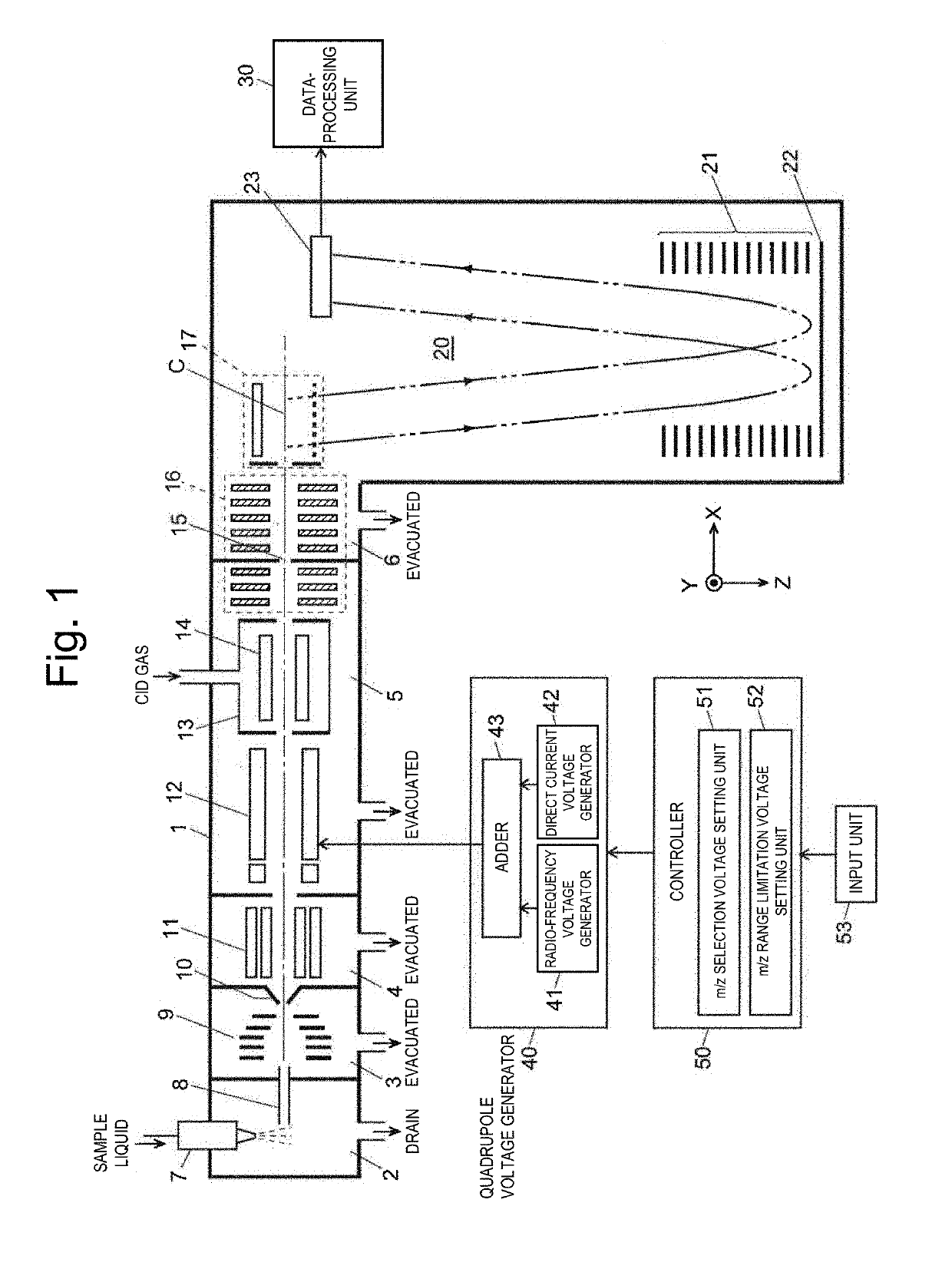
[0049]FIG. 1 is an overall configuration diagram of the Q-TOF mass spectrometer according to the first embodiment.
[0050]The Q-TOF mass spectrometer in the present embodiment has the configuration of a multistage pumping system, including an ionization chamber 2 maintained at substantially atmospheric pressure and a high vacuum chamber 6 with the highest degree of vacuum, with three (first through third) intermediate vacuum chambers 3, 4 and 5 between the two aforementioned chambers 2 and 6 located within a chamber 1.
[0051]The ionization chamber 2 is equipped with an ESI spray 7 for electrospray ionization (ESI). When a sample liquid containing a target compound is supplied to the ESI spray 7, ions originating from the target compound are generated from liquid droplets imparted with uneven charge at the tip of the spray 7 and sprayed. It sh...
second embodiment
[0071]In the first embodiment described above, since the parameters (a and q) are always constant, control is easy. On the other hand, when the amplitude value V of the radio-frequency voltage applied to the quadrupole mass filter 12 is small, an ion having a mass-to-charge ratio that does not become period delay originally are also blocked, hence the measurable mass-to-charge-ratio range becomes narrow. This is as presented in FIG. 4. Accordingly, a Q-TOF mass spectrometer of the second embodiment employs a control method different from that of the first embodiment in order to avoid excessive ion blockage and broaden the mass-to-charge-ratio range of the measurement target as much as possible. Since the configuration of the Q-TOF mass spectrometer of the second embodiment is basically the same as that of the Q-TOF mass spectrometer of the first embodiment described above, FIG. 1 is used as a configuration diagram in the description below.
[0072]FIG. 5 is a Mathieu diagram for illust...
PUM
 Login to View More
 Abstract
Description
Claims
Application Information
 Login to View More