Unlock instant, AI-driven research and patent intelligence for your innovation.

Cooling Plate for ICP-MS

Active Publication Date: 2020-06-18
THERMO FISHER SCI BREMEN
View PDF0 Cites 1 Cited by
  • Summary
  • Abstract
  • Description
  • Claims
  • Application Information

AI Technical Summary

Benefits of technology

[0032]Increased resistance to corrosion of a bronze cooling plate as compared with currently used nickel-coated copper plates represents one major advantage of the invention. As a result of the corrosion resistance, the cooling plate does not need to be coated with a corrosion-resistant coating. Thus, the cooling plate in accordance with the invention preferably does not contain a coating.
[0033]An added advantage of the use of bronze in the cooling plate is that bronze has a lower thermal conductivity than copper. As a result, the operating temperature at the tip of the sampler cone is expected to be higher when using the bronze cooling plate as compared with prior art copper plates. A higher operating temperature, which is still low enough so that the sampler is not damaged by the hot plasma, is expected to result in less interference from potentially interfering components in the sample being analysed. This is especially important for certain high-matrix samples, where it is known that matrix components can lead to matrix redeposits onto the sampler cone which in turn can lead to signal artefacts such as drifts and poorer stability during analysis of such samples.
[0034]The sampler is mounted on the cooling plate, over an entry opening in the plate, so that ions from plasma that enter the sampling interface do so through an opening in the sampler. Typically, this interface is provided by an orifice at the tip of a conical structure, the sampler cone. Thus, during use the sampler, and by extension the cooling plate on which the sampler is mounted, face the ICP source.
[0035]The ICP source is typically placed very close to the sampler, or at a distance of about 1 cm. As a consequence, the conditions at the sampler and the cooling plate on which the sampler is mounted are quite extreme, in part due to the high temperature of the plasma (5000-10,000 K) and in part due to sample and / or matrix chemical components that are generated by the plasma and that can be corrosive.
[0036]The sampler can typically be in the form of a circular structure, for example a circular structure having a cone at its center, having a small diameter orifice at the tip of the cone, the orifice thereby defining a sampling orifice through which ions from plasma enter the sampling interface. The sampler can be mounted on the cooling plate, so that the cooling plate surrounds at least an outer portion of the sampler. Thus, the sampler can be mounted in a recession on the cooling plate that is complementary in shape to the sampler, e.g. in the form of a recession or lip that surrounds the opening (entry opening) in the plate.
[0037]The sampler can comprise a flange that extends radially away from the conical structure. The flange can be adapted to meet an outer surface of the cooling plate that surrounds the entry opening. There can be a securing mechanism provided to secure the sampler to the cooling plate via the flange.

Problems solved by technology

The sampling interface is sensitive to deposits forming on the sampler cone, resulting in optical defects, noise or other artefacts in the obtained mass spectrum.
Conditions at the sample interface in ICP-MS are harsh.
The inventors have however found that the nickel plating on the cooling plate is susceptible to corrosion by aggressive chemicals.
With time, corrosion of the coating is followed by blistering in the coating, which finally requires exchange of the cooling plate.
However, degradation of the nickel plating can result in optical defects, particle deposition at the sampler cone and / or contamination by nickel isotopes in the analytical signal.
A related problem stems from matrix deposition onto the sampler cone that causes signal drift during analysis of high matrix samples.

Method used

the structure of the environmentally friendly knitted fabric provided by the present invention; figure 2 Flow chart of the yarn wrapping machine for environmentally friendly knitted fabrics and storage devices; image 3 Is the parameter map of the yarn covering machine
View more

Image

Smart Image Click on the blue labels to locate them in the text.
Viewing Examples
Smart Image
  • Cooling Plate for ICP-MS
  • Cooling Plate for ICP-MS
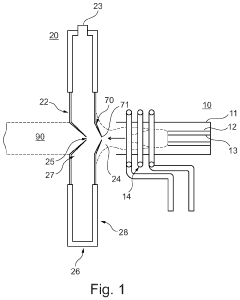
  • Cooling Plate for ICP-MS

Examples

Experimental program
Comparison scheme
Effect test

example 1

[0086]The stability of a water-cooled cooling plate made from bronze over time was tested by allowing the cooling plate to experience prolonged exposure conditions of an ICP source.

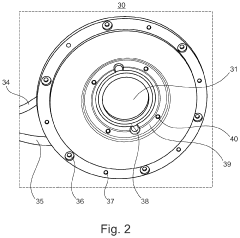
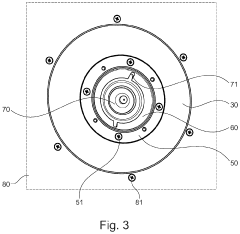
[0087]The cooling plate (as illustrated in FIG. 2) was prepared from solid bronze (88% Cu, 12% Sn) and mounted on a sample interface, to provide the front face of the interface that faces the ICP source when in use. A sampler cone, made from solid Pt, was mounted on the plate, as illustrated in FIG. 3.

[0088]The interface, comprising the water-cooled bronze plate was subjected to a treatment of continuous exposure to plasma at a power of 1250 watts for 14 days, with a stream of isopropanol being injected into the plasma during this time.

[0089]At the end of the treatment period, the cooling plate and the sampler cone were inspected for deterioration by optical microscopy. No visual change in the orifice size of the sampler cone was observed, indicating that the cooling plate maintained its chemical integrit...

the structure of the environmentally friendly knitted fabric provided by the present invention; figure 2 Flow chart of the yarn wrapping machine for environmentally friendly knitted fabrics and storage devices; image 3 Is the parameter map of the yarn covering machine
Login to View More

PUM

No PUM Login to View More

Abstract

Disclosed is a plasma sampling interface for an inductively coupled mass spectrometer, comprising a housing having entry and exit openings for respectively introducing and releasing ions from the chamber, and a sampler mounted on the housing so as to be disposed adjacent to plasma generated by an inductively coupled plasma source, wherein the entry opening is provided in a cooling plate that is integral to the housing and that is formed from bronze. Also disclosed is a bronze cooling plate for receiving and cooling a plasma sampler in an inductively coupled mass spectrometer, and a mass spectrometer that comprises a plasma sampling interface as disclosed.

Description

CROSS-REFERENCE TO RELATED APPLICATIONS[0001]This application claims the priority to GB Patent Application No. 1820201.0, filed on Dec. 12, 2018, which application is hereby incorporated herein by references in its entirety.FIELD OF THE INVENTION[0002]The invention relates to an interface for an inductively coupled plasma mass spectrometer (ICP-MS). The invention further relates to a cooling plate for use in inductively coupled plasma mass spectrometers.BACKGROUND OF THE INVENTION[0003]Inductively coupled plasma mass spectrometry (ICP-MS) is an analytical method that is capable of detecting metals and certain non-metals at very low concentration, as low as one part in 1015 (part per quadrillion, ppq) on non-interfered low-background isotopes. The method involves ionizing the sample to be analysed with an inductively coupled plasma and then using a mass spectrometer to separate and quantify the thus generated ions.[0004]The sample is typically a liquid solution or suspension, supplie...

Claims

the structure of the environmentally friendly knitted fabric provided by the present invention; figure 2 Flow chart of the yarn wrapping machine for environmentally friendly knitted fabrics and storage devices; image 3 Is the parameter map of the yarn covering machine
Login to View More

Application Information

Patent Timeline
no application Login to View More
IPC IPC(8): H01J49/10H01J49/06
CPCH01J49/105H01J49/067G01N27/62H05K7/20254H05K7/20272H01J49/0027H01J49/06H01J49/068
Inventor HINRICHS, JOACHIM
Owner THERMO FISHER SCI BREMEN