Unlock instant, AI-driven research and patent intelligence for your innovation.

Method for precisely analyzing degree of impregnation of electrolyte of electrode in cell

Active Publication Date: 2021-06-03
LG ENERGY SOLUTION LTD
View PDF0 Cites 1 Cited by
  • Summary
  • Abstract
  • Description
  • Claims
  • Application Information

AI Technical Summary

Benefits of technology

The present invention describes a method for evaluating the degree of impregnation of an electrode in a battery cell. This is done by creating a battery cell with an electrode and observing how much the electrode can hold lithium during charging and discharging. By analyzing the difference in capacity between the charge / discharge profile, the method can determine when the electrolyte is fully impregnated with lithium. This method can help improve the performance of batteries by ensuring optimal electrolyte impregnation.

Problems solved by technology

In this case, since the amount of the electrolyte solution is not sufficient inside the secondary battery, the performance of the secondary battery may be degraded and the safety of the battery may be lowered.
Such poor impregnation of the electrolyte may cause a problem of shortening the life of the battery by accelerating the deterioration of the electrode despite the good state of the other electrode.
As a method for analyzing the degree of impregnation of the electrode, a method of measuring the AC impedance hourly after the electrolyte injection into the cell has been widely applied, but there is a limit that it is difficult to precisely analyze.

Method used

the structure of the environmentally friendly knitted fabric provided by the present invention; figure 2 Flow chart of the yarn wrapping machine for environmentally friendly knitted fabrics and storage devices; image 3 Is the parameter map of the yarn covering machine
View more

Image

Smart Image Click on the blue labels to locate them in the text.
Viewing Examples
Smart Image
  • Method for precisely analyzing degree of impregnation of electrolyte of electrode in cell
  • Method for precisely analyzing degree of impregnation of electrolyte of electrode in cell
  • Method for precisely analyzing degree of impregnation of electrolyte of electrode in cell

Examples

Experimental program
Comparison scheme
Effect test

example 2

[0097]96% by weight of Li (Ni0.8Co0.01Mn0.1)O2, 2% by weight of Denka black (conductor) and 2% by weight of PVdF (Polyvinylidene fluoride, binder) were added to N-Methyl-2-pyrrolidone (NMP) to thereby prepare an electrode mixture slurry. The positive electrode mixture slurry prepared above was coated on one surface of the aluminum current collector, dried and rolled, and punched to a predetermined size to prepare a positive electrode.

[0098]A membrane of porous polyethylene was interposed between the positive electrode and the negative electrode of the preparation example, and 0.5 wt % vinylene carbonate and 1 M LiPF6 dissolved electrolyte were injected into a mixed solution of ethyl methyl carbonate (EMC) and ethylene carbonate (EC) with a volume ratio of 7:3, to thereby prepare a full cell. Thereafter, the full cell was stored at room temperature for 3 hours to wet the electrolyte solution.

[0099]Thereafter, charging and discharging were performed in the same manner as in Example 1,...

the structure of the environmentally friendly knitted fabric provided by the present invention; figure 2 Flow chart of the yarn wrapping machine for environmentally friendly knitted fabrics and storage devices; image 3 Is the parameter map of the yarn covering machine
Login to View More

PUM

No PUM Login to View More

Abstract

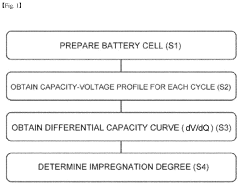
The present invention relates to a method for analyzing a degree of impregnation of an electrolyte of an electrode in a battery cell, the method comprising: a battery cell manufacturing step (S1) of preparing a battery cell by injecting an electrolyte into a battery cell including an electrode to be evaluated; a step of charging / discharging the battery cell several times and obtaining a capacity-voltage profile for each cycle (S2); a step of obtaining a differential capacity (dV / dQ) curve obtained by differentiating the capacitance-voltage profile for each cycle with respect to the capacity (S3); and a step of, in the differential capacity curve, determining a cycle at which behavior becomes the same as a time point when impregnation is sufficiently performed (S4).

Description

TECHNICAL FIELD[0001]This application claims the benefit of priority based on Korean Patent Application No. 10-2018-0092997, filed on Aug. 9, 2018, and the entire contents of the Korean patent application are incorporated herein by reference.[0002]The present invention relates to a method for precisely analyzing the degree of electrolyte impregnation of an electrode in a cell to determine at which cycle the electrolyte is sufficiently impregnated through a differential capacity curve which is obtained by differentiating a capacity-voltage profile with respect to the capacity for each charge / discharge cycle.BACKGROUND ART[0003]Recently, secondary batteries capable of charging and discharging have been widely used as energy sources of wireless mobile devices. In addition, the secondary battery has attracted attention as an energy source of an electric vehicle, a hybrid electric vehicle, etc., which are proposed as a solution for air pollution of existing gasoline vehicles and diesel v...

Claims

the structure of the environmentally friendly knitted fabric provided by the present invention; figure 2 Flow chart of the yarn wrapping machine for environmentally friendly knitted fabrics and storage devices; image 3 Is the parameter map of the yarn covering machine
Login to View More

Application Information

Patent Timeline
no application Login to View More
IPC IPC(8): H01M10/44H01M10/0567H01M10/0569H01M50/609H01M4/133H01M4/505H01M4/525H01M4/62G01R31/36G01R31/385
CPCH01M10/446H01M10/0567H01M10/0569H01M50/609H01M4/133H01M10/0525H01M4/525H01M4/623G01R31/3648G01R31/385H01M4/505H01M10/0564Y02E60/10Y02P70/50H01M10/4285H01M10/44G01R31/3842G01R31/3865H01M2004/027H01M2004/028
Inventor HAN, SONG YIKIM, YOUNG DEOKKIM, DAE SOO
Owner LG ENERGY SOLUTION LTD