

Cellulosic complex and applications thereof
a technology of tetranbutyl ammonium fluoride and cellulosic complex, which is applied in the field of polysaccharide supported tetranbutyl ammonium fluoride complex, can solve the problems of introducing fluorine atoms into the organic backbone, affecting the stability of the organic backbone,
- Summary
- Abstract
- Description
- Claims
- Application Information
AI Technical Summary
Benefits of technology
Problems solved by technology
Method used
Image

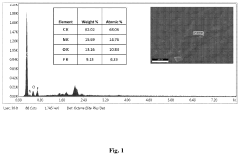
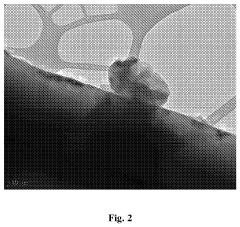
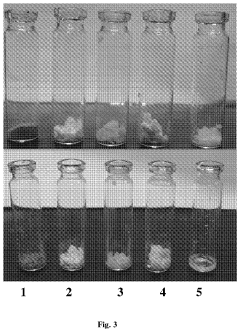
Examples
example 1
rocedure for the Synthesis of Non-Hygroscopic and Thermally Stable Polysaccharide Supported TBAF Complex
[0045]For the reaction pectin, starch and plant cellulose were procured from Sigma Chemicals Co., USA. Bacterial cellulose was synthesized in lab using indigenous bacteria which inventors have isolated as described in RSC Advances, 2018, 8, 29797-29805, DOI: 10.1039 / c8ra05295f.
[0046]To a flame-dried round bottom flask equipped with cooling condenser, tetra-n-butyl ammonium fluoride hydrate and polysaccharide support (pectin / starch / plant cellulose / bacterial cellulose) was added in their respective equivalent amount (w / w) in 100 ml of hexane. This mixture was refluxed in nitrogen atmosphere at 80° C. for 1.5 h with vigorous stirring. During the reaction, complex shows the water droplets on sidewall of the condenser, which indicates the completion of the reaction and complex formed. The solution was allowed to cool to 25-30° C., filtered, washed with hexane and dried under high vacuu...
example 6
ntative Fluorination Procedure: Synthesis of 4-(3-fluoropropoxy)-1,2-dimethoxybenzene
[0052]In a flame dried round bottom flask, substrate compound (maybe a range should be given 0.290 mg, 1 mmol) and NBu4(Bac-cell-OH)F.1 (0.3915 mg, 1.5 eq) in dry acetonitrile were taken and the reaction vial was flushed with N2 and stirred at a temperature in the range of 50-100° C. for a time period in the range of 1-3 h. The reaction mixture was cooled to a temperature in the range of 25-35° C. and the reaction mixture was filtered using sintered funnel. The reaction mixture was washed with ethyl acetate and evaporated under reduced pressure. The crude product was purified by flash column chromatography using (20% EtOAc / hexane) to give corresponding fluorinated compound.
[0053]4-(3-fluoropropoxy)-1,2-dimethoxybenzene: 1H NMR (400 MHz, CDCl3) δ 6.10 (s, 3H), 4.71 (t, J=5.8 Hz, 1H), 4.59 (t, J=5.8 Hz, 1H), 4.07 (t, J=6.1 Hz, 2H), 3.78 (s, 6H), 2.25-2.08 (m, 2H). 13C NMR (101 MHz, CDCl3) δ 161.5, 160...
example 7
rocess for the Recovery of the Polysaccharide Support from Used Cellulosic Supported TBAF Complex
[0066]After completion of the reaction as disclosed in scheme 1, the reaction mixture was cooled to 25-35° C. Bacterial cellulose was filtered, washed with ethyl acetate and dried under high-vacuum (2 mbar) to re-use for further loading with TBAF.
Advantages of the Invention
[0067]The present invention provides a new thermally stable, non hygroscopic polysaccharide supported TBAF complex as a fluorinating agent.[0068]The polysaccharide component of disclosed complex is recyclable[0069]The complex provides broad substrate scope, good selectivity and excellent yields of fluorinated products
PUM
| Property | Measurement | Unit |
|---|---|---|
| temperature | aaaaa | aaaaa |
| temperature | aaaaa | aaaaa |
| time duration | aaaaa | aaaaa |
Abstract
Description
Claims
Application Information
 Login to View More