
7-(2-imidazolinylamino) quinoline compounds useful as alpha-2 adrenoceptor agonists
a technology of quinoline compounds and alpha-2 adrenoceptors, which is applied in the field of 7(2imidazolinylamino) quinoline compounds useful as alpha-2 adrenoceptor agonists, can solve the problems of high specificity, many compounds found to be effective nasal decongestants are often found to have undesirable side effects, and achieve good activity
- Summary
- Abstract
- Description
- Claims
- Application Information
AI Technical Summary
Benefits of technology
Problems solved by technology
Method used
Image

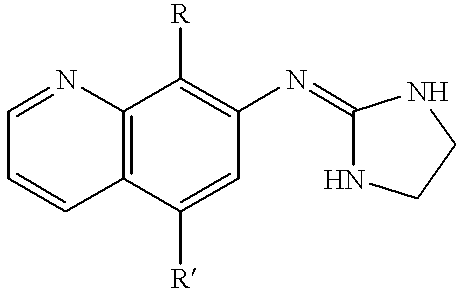
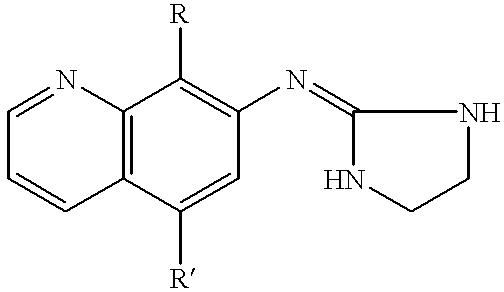
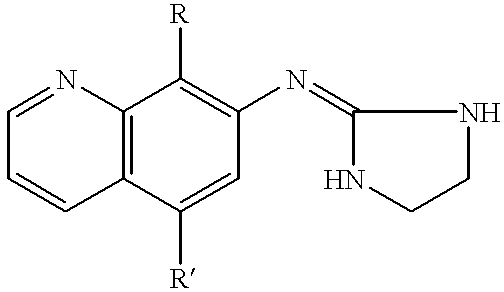
Examples
example 1
Synthesis of 7-(2-imidazolinylamino)-8-methylquinoline
##STR6##
A. 8-Methyl-7-nitroquinoline. A mixture of 2-methyl-3-nitroaniline (10 g), glycerin (20.57 g) and arsenic pentoxide hydrate (As.sub.2 O.sub.5.xH.sub.2 O, Baker, 88% As.sub.2 O.sub.5, 8.5 g) in concentrated sulfuric acid (9.75 mL) is heated slowly to 150.degree. C. in an open round-bottom flask, then stirred for 6 hours at 150.degree. C. The resulting mixture is cooled to room temperature and diluted with water (200 mL), then basified with ammonium hydroxide (28-30%, 100 mL). After about 10 minutes, the solution is acidified to pH=5 with glacial acetic acid and extracted with methylene chloride (3.times.200 mL). The combined extracts are washed with water (200 mL) and saturated sodium bicarbonate (200 mL), then dried over magnesium sulfate and rotary evaporated. The crude quinoline is filtered through a short pad of silica gel, using methylene chloride as solvent. The filtrate is rotary evaporated and the residue recrystal...
example 2
Synthesis of 5-cyano-7-(2-imidazolinylamino)-8-methylquinoline
##STR7##
A. 4-Cyano-2,6-dinitrotoluene. A solution of 4-cyanotoluene (10.3 g) in tetramethylene sulfone (65 mL) is added dropwise to a solution of nitronium tetrafluoroborate (14.6 g) in tetramethylene sulfone (130 mL). The reaction is stirred for 1 hour at 95.degree. C. Additional nitronium tetrafluoroborate (15.58 g) is added slowly to the reaction mixture, which is then allowed to stir for another 2 hours. The mixture is poured into ice and diluted further with water (500 mL). The products are extracted with ethyl acetate (4.times.500 mL). The combined extracts are dried over magnesium sulfate and rotary evaporated. The crude orange oil is filtred through a short pad of silica gel, using 10% ethyl acetate / hexanes as solvent. The filtrate is rotary evaporated and the residue recrystallized from hot methylene chloride to afford 4-cyano-2,6dinitrotoluene as a white solid.
B. 4-Cyano-2,6-diaminotoluene. A solution of 4-cyano...
example 3
Synthesis of 5-Fluoro-7-(2-imidazolinylamino)-8-methylquinoline
##STR8##
A. 2,6-Dinitro-4-fluorotoluene. Fuming sulfuric acid (180 mL) is added dropwise to 4-fluoro-2-nitrotoluene (50.21 g) under an argon atmosphere. The internal temperature of the mixture is maintained at 0-5.degree. C. using an ice / sodium chloride bath. A preformed (ice bath) mixture of fuming nitric acid (30 mL) and fuming sulfuric acid (90 mL) is added dropwise to the previous solution over three hours. The reaction is then allowed to warm to room temperature. After stirring at room temperature for 2 hours, the mixture is poured slowly into ice and the products are extracted with methylene chloride (4.times.500 mL). The combined extracts are dried over magnesium sulfate, filtered and rotary evaporated. The crude mixture is filtered through a short pad of silica gel, using 10% ethyl acetate / hexanes as solvent, then recrystallized from ethyl acetatelhexanes to afford 2,6-dinitro-4-fluorotoluene as a pale yellow soli...
PUM
| Property | Measurement | Unit |
|---|---|---|
| temperature | aaaaa | aaaaa |
| temperature | aaaaa | aaaaa |
| temperature | aaaaa | aaaaa |
Abstract
Description
Claims
Application Information
 Login to View More