

High lubricity, multi-layer polyolefin laminate
a polyolefin laminate and high lubricity technology, applied in the direction of synthetic resin layered products, mechanical equipment, transportation and packaging, etc., can solve the problems of glass run channel, skin layer liable to peel off from the substrate, complex process, etc., to achieve excellent sliding properties of window glass, excellent abrasion resistance, and favorable use
- Summary
- Abstract
- Description
- Claims
- Application Information
AI Technical Summary
Benefits of technology
Problems solved by technology
Method used
Image

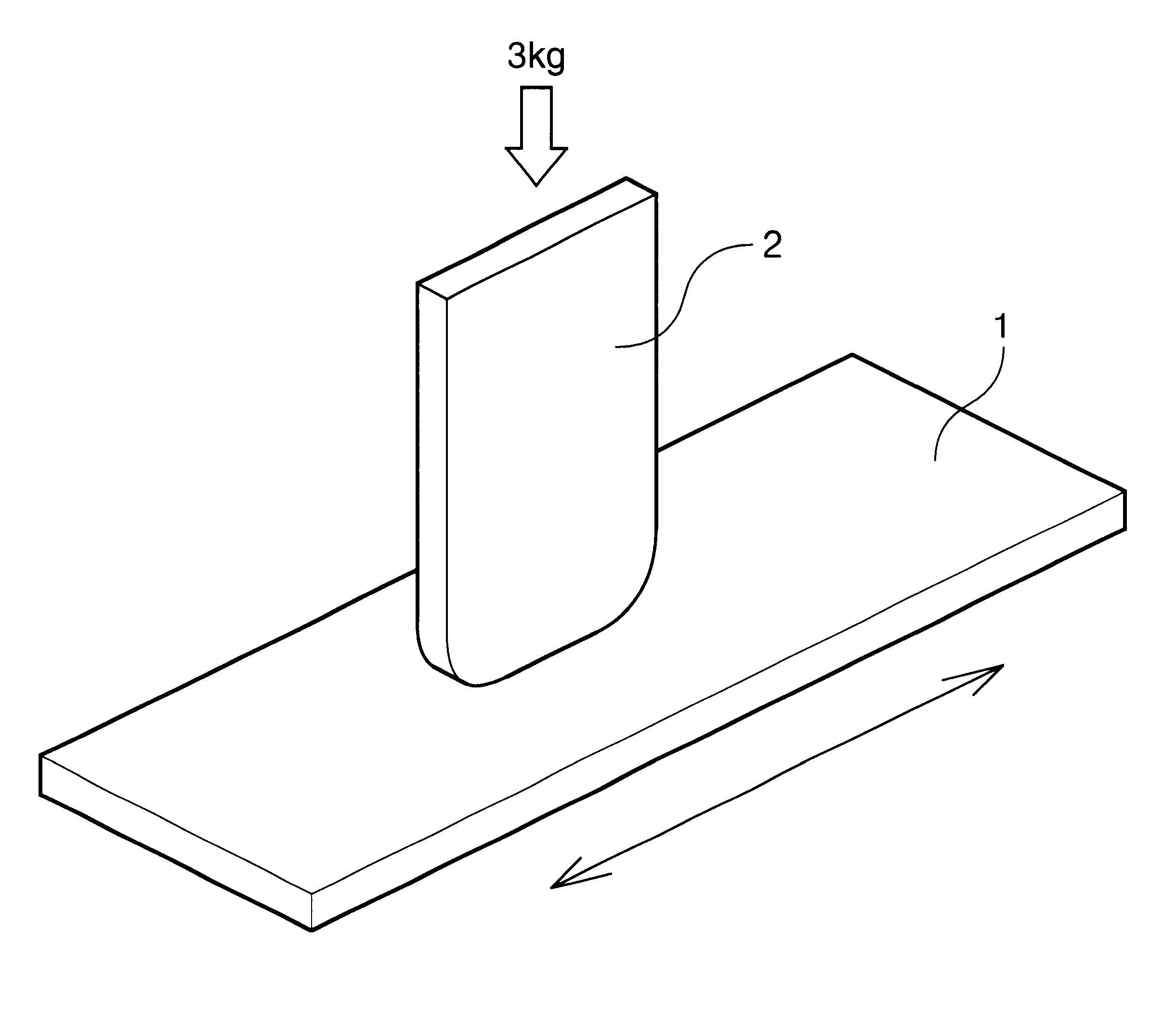
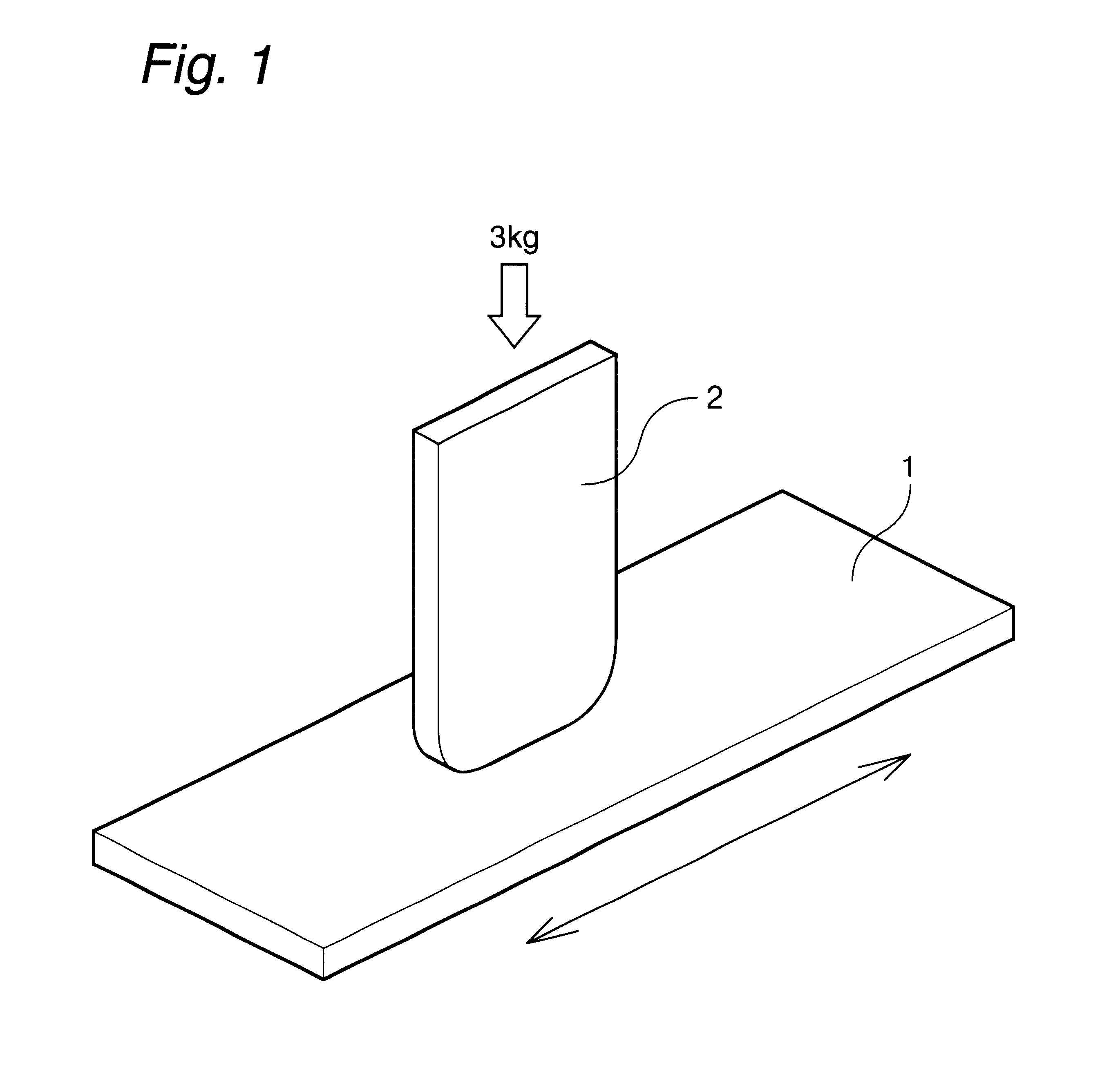
Examples
examples 1-6
, Comparative Examples 1-4
Preparation of Thermoplastic Olefin Elastomer
60 Parts by weight of an ethylene / propylene / 5-ethylidene-2-norbornene copolymer rubber (ethylene content: 70% by mol, iodine value: 12, Mooney viscosity ML.sub.1+4 (100.degree. C.): 120) and 40 parts by weight of polypropylene (MFR (ASTM D 1238-65T, 230.degree. C.): 13 g / 10 min, density: 0.91 g / cm.sup.3) were kneaded by a Banbury mixer at 180.degree. C. for 5 minutes in an atmosphere of nitrogen, and the kneadate was passed through rolls to prepare a sheet. The sheet was cut by a sheet cutter to give square pellets.
Then, the square pellets, 0.2 part by weight of 1,3-bis(tert-butylperoxyisopropyl)benzene and 0.2 part by weight of divinylbenzene were mixed and stirred by a Henschel mixer.
The resulting mixture was extruded by a twin-screw extruder (L / D: 40, screw diameter: 50 mm) at 220.degree. C. in an atmosphere of nitrogen to obtain a thermoplastic olefin elastomer (referred to as "TPO").
The gel content in the th...
PUM
| Property | Measurement | Unit |
|---|---|---|
| particle diameter | aaaaa | aaaaa |
| particle diameter | aaaaa | aaaaa |
| temperature | aaaaa | aaaaa |
Abstract
Description
Claims
Application Information
 Login to View More