Check patentability & draft patents in minutes with Patsnap Eureka AI!

Detection of Streptococcus pneumoniae and immunization against Streptococcus pneumoniae infection

Inactive Publication Date: 2005-03-22
GOVERNMENT OF THE UNITED STATES OF AMERICA AS REPRSENTED BY THE SEC DEPT OF HEALTH & HUMAN SERVICES THE
View PDF9 Cites 6 Cited by
  • Summary
  • Abstract
  • Description
  • Claims
  • Application Information

AI Technical Summary

Benefits of technology

In yet another aspect, the invention discloses a method of stimulating an immune response against a serotype of Streptococcus pneumoniae in a mammal including administering to the mammal an amount of a polypeptide effective to stimulate the immune response, wherein the polypeptide includes an amino acid sequence encoded by a nucleic acid amplicon including at least a portion of the psaA gene obtained when nucleic acid from a serotype of Streptococcus pneumoniae is contacted with a pair of oligonucleotide primers that prime the universal and specific amplification of the portion of the psaA gene of Streptococcus pneumoniae and the Streptococcus pneumoniae so primed is amplified to provide the amplicon.
In still an additional aspect, the invention discloses a method of st

Problems solved by technology

Unfortunately they are not sufficiently definitive, reliable, or sensitive to be used on a routine basis (Sampson et al.
The large number of pneumococci currently known (90 different serotypes) increases the challenge of diagnosis and further complicates assay development and vaccine development.
Such lung infections, however, progress with great rapidity and severity, despite treatment with antibiotics.
This form of pneumonia is difficult to control and may last for weeks.
Despite the many testing technologies available to physicians, it is sometimes very difficult to determine which species of bacteria is responsible for the illness; in up to half the cases no etiological agent can be identified.
This particular nucleic acid and polypeptide, therefore, are of limited value for use as diagnostic reagents, in prevention or treatment of infection, or in vaccine development.
Additionally, adverse reactions from this vaccine may occur in older persons, children under the age of two years, and those stricken with long-term illnesses.
Furthermore, it is found that the polysaccharide vaccine fails to provide protection in young children, the elderly and the immunocompromised.
However, there are indications that this protein-conjugate vaccine may not prevent replacement carriage of serotypes not contained in the vaccine (Mbelle et al.
Such diagnostic tests, however, are generally time-consuming, requiring at least overnight incubation.
Furthermore, cultures also lack the certainty of positive identification, providing positive diagnoses only 20% to 30% of the time.
Thus the current Gold Standard diagnostic assay has important deficiencies associated with it.
Because of the speed with which streptococcal pneumoniae can develop and potentially lead to death, there is a need for rapid testing resulting in earlier treatment of infection.
Conventional serologic methods lack uniform diagnostic sensitivity and specificity and are time-consuming because they require reagents in which all serotypes are represented.
1998, "Pneumolysin PCR-based diagnosis of invasive pneumococccal infection in children", J. Clin. Microbiol. 37:633-637), they have not been widely adapted for use in the clinical laboratory because they have not been shown to be consistently and uniformly sensitive.
All antibody detecting assays may miss active infection if the level of antibodies in a patient's blood is too low, as occurs with certain immunocompromised individuals, or if infection is too recent for antibodies to have been produced.

Method used

the structure of the environmentally friendly knitted fabric provided by the present invention; figure 2 Flow chart of the yarn wrapping machine for environmentally friendly knitted fabrics and storage devices; image 3 Is the parameter map of the yarn covering machine
View more

Image

Smart Image Click on the blue labels to locate them in the text.
Viewing Examples
Smart Image
  • Detection of Streptococcus pneumoniae and immunization against Streptococcus pneumoniae infection
  • Detection of Streptococcus pneumoniae and immunization against Streptococcus pneumoniae infection

Examples

Experimental program
Comparison scheme
Effect test

example 1

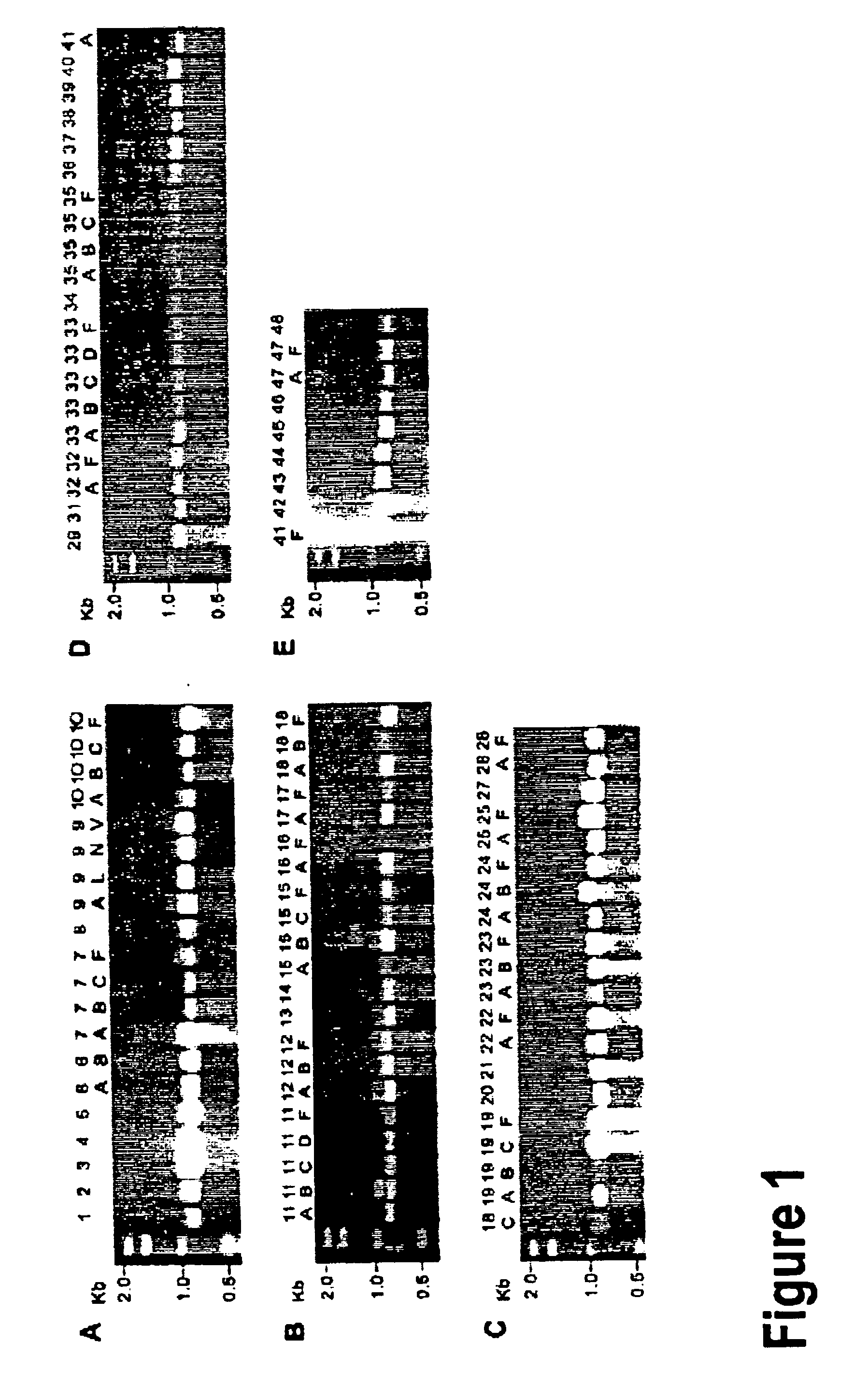
Amplification of Serotypes of Streptococcus pneumoniae Using Primers of SEQ ID NOs:1 and 2

The 90 S. pneumoniae serotypes as outlined by Henrichsen (1995, "Six newly recognized types of Streptococcus pneumoniae", J. Clin. Microbiol. 33:2759-2762) were obtained from the Statens Seruminstitut, Copenhagen, Denmark; the American Type Culture Collection (ATCC); and the Streptococcal Reference Laboratory, Centers for Disease Control and Prevention (CDC), Atlanta, Ga.

PCR.

Bacterial strains were grown for isolation on Trypticase soy agar plates supplemented with 5% defibrinated sheep blood for 12 h at 37.degree. C. in CO.sub.2. For PCR amplification, approximately 5 CFUs were placed directly into a PCR reaction mixture and allowed to lyse in the thermocycler. If this method failed to produce an amplified product, whole cells were boiled in 200 .mu.L of filtered water for 10 minutes, followed by a cooling time on ice for at least 5 minutes. An aliquot of boiled lysate was then used in the PCR ...

example 2

Amplification of Isolates of Serotype 16F of Streptococcus pneumoniae

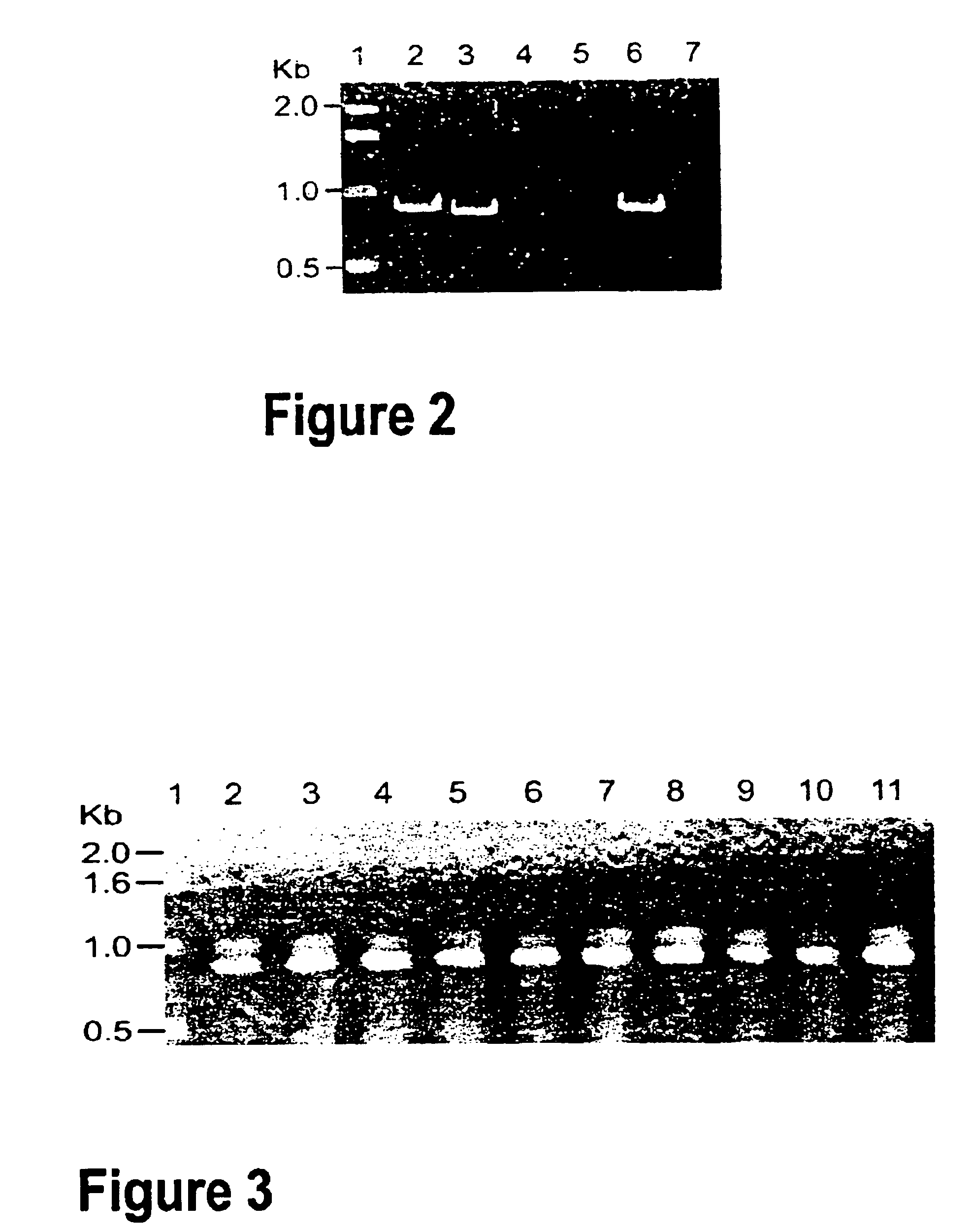
Using the assay procedure described in Example 1, amplification of the isolate of serotype 16F (ATCC# 6316) using primer pair P1 and P2 was not successful. Using the forward primer, P3, 5'AGGATCTAATGAAAAAATTAG3', with primer P2, successful amplification was observed. P3 is derived from a highly conserved region at the 5' end of the psaA gene (Russell et al. 1990). It is predicted that primers P3 and P2 yield a 867-bp amplicon. FIG. 2 shows that serotype 16F (ATCC# 6316) provides an amplicon when primed with the pair P3 / P2 (Lane 6).

To determine if the inability of P1 and P2 primers to amplify this isolate of 16F was common to all strains of serotype 16F, 10 clinical strains of serotype 16F from the United States (provided by The Streptococcal Reference Laboratory (CDC, Atlanta, Ga.)) and 10 clinical 16F isolates from Brazil (provided by Drs. Maria Christina de C Brandileone and Claudio Sacchi, Instituto Adolfo Lutz,...

example 3

Amplification of Isolates of Serotype 16F of Streptococcus pneumoniae

The specificity of the primers used in the PCR assay was tested using various bacteria, including heterologous upper respiratory bacteria. The Streptococcal Reference Laboratory (CDC, Atlanta, Ga.) provided clinical isolates of the heterologous species, Streptococcus mitis, S. oralis, S. parasanguinis, S. sanguinis, S. crista, S. gordonii, S. vestibularis, S. salivarius, various .beta.-hemolytic strains of Streptococcus pyogenes. In addition, heterologous genera, Staphylococcus aureus, Enterococcus faecalis, Corynebacterium minutissimum, Corynebacterium pseudodiphtheriticum, Corynebacterium xerosis, Corynebacterium pseudotuberculosis, Staphylococcus epidermidis, Klebsiella pneumoniae, Escherichia coli, Moraxella catarrhalis, and Haemophilus influenzae were also obtained from the Streptococcal Reference Laboratory. Eleven multidrug-resistant strains of S. pneumoniae were provided by the Pneumococcal Molecular Epidem...

the structure of the environmentally friendly knitted fabric provided by the present invention; figure 2 Flow chart of the yarn wrapping machine for environmentally friendly knitted fabrics and storage devices; image 3 Is the parameter map of the yarn covering machine
Login to View More

PUM

PropertyMeasurementUnit
Lengthaaaaaaaaaa
Immunogenicityaaaaaaaaaa
Login to View More

Abstract

The present invention relates to oligonucleotide primers, and methods of diagnosis using the primers, wherein particular primer pairs prime the universal amplification of an amplicon for specific Streptococcus pneumoniae from all 90 known serotypes. The amplicon includes at least a portion of the psaA gene of Steptococcus pneumoniae. In the methods, amplification of a biological sample using the primer pairs of the invention provide an amplicon only if the sample contains a serotype of Streptococcus pneumoniae. The invention further relates to an isolated nucleic acid including a nucleic acid amplicon obtained using a pair of oligonucleotide primers of the invention. In still a further aspect, the invention discloses a polypeptide including an amino acid sequence encoded by a nucleic acid amplicon obtained using oligonucleotide primers. Additionally, methods of stimulating an immune response against a serotype of Streptococcus pneumoniae in a mammal include either administering a polypeptide encoded by a nucleic acid amplicon obtained using the pair of oligonucleotide primers of the invention, or administering a nucleic acid containing a nucleic acid amplicon obtained using the pair of oligonucleotide primers of the invention.

Description

FIELD OF THE INVENTIONThis invention relates to the detection and treatment of Streptococcus pneumoniae infection. Specifically, the present invention relates to diagnostic assays and kits for detecting the presence of Streptococcus pneumoniae in a sample and to vaccines for use against Streptococcus pneumoniae. More specifically, the present invention relates to PCR assays for the presence of Streptococcus pneumoniae surface adhesin A protein (PsaA) and to vaccines raised against a portion of PsaA encoded by a PCR product that is provided using specific primers.BACKGROUND OF THE INVENTIONStreptococcus pneumoniae is frequently isolated from the young, the elderly, and the immunocompromised as the etiologic agent of a broad range of diseases (Centers for Disease Control and Prevention, "Prevention of pneumococcal disease: Recommendations of the Advisory Committee on Immunization Practices" (ACIP), 1997 Morbid. Mortal. Weekly Rep. (RR-8) 46:1-24). A number of diagnostic assays for the...

Claims

the structure of the environmentally friendly knitted fabric provided by the present invention; figure 2 Flow chart of the yarn wrapping machine for environmentally friendly knitted fabrics and storage devices; image 3 Is the parameter map of the yarn covering machine
Login to View More

Application Information

Patent Timeline
no application Login to View More
IPC IPC(8): C12Q1/68
CPCC12Q1/689Y10S435/975
Inventor SAMPSON, JACQUELINE S.MORRISON, KATHERINE E.WHITMON, JENNIFER CROOKADES, EDWINCARLONE, GEORGE M.
Owner GOVERNMENT OF THE UNITED STATES OF AMERICA AS REPRSENTED BY THE SEC DEPT OF HEALTH & HUMAN SERVICES THE
Features
  • R&D
  • Intellectual Property
  • Life Sciences
  • Materials
  • Tech Scout
Why Patsnap Eureka
  • Unparalleled Data Quality
  • Higher Quality Content
  • 60% Fewer Hallucinations
Social media
Patsnap Eureka Blog
Learn More