

Scalable all-polymer fuel cell
a fuel cell, all-polymer technology, applied in the field of fuel cells, can solve the problems of shrinking fossil fuel reserves, complex power source demand, and reducing the range and application of modern electronic devices, and achieve the effect of reducing the amount (and hence the weight) of fuel stock
- Summary
- Abstract
- Description
- Claims
- Application Information
AI Technical Summary
Benefits of technology
Problems solved by technology
Method used
Image

Examples
Embodiment Construction
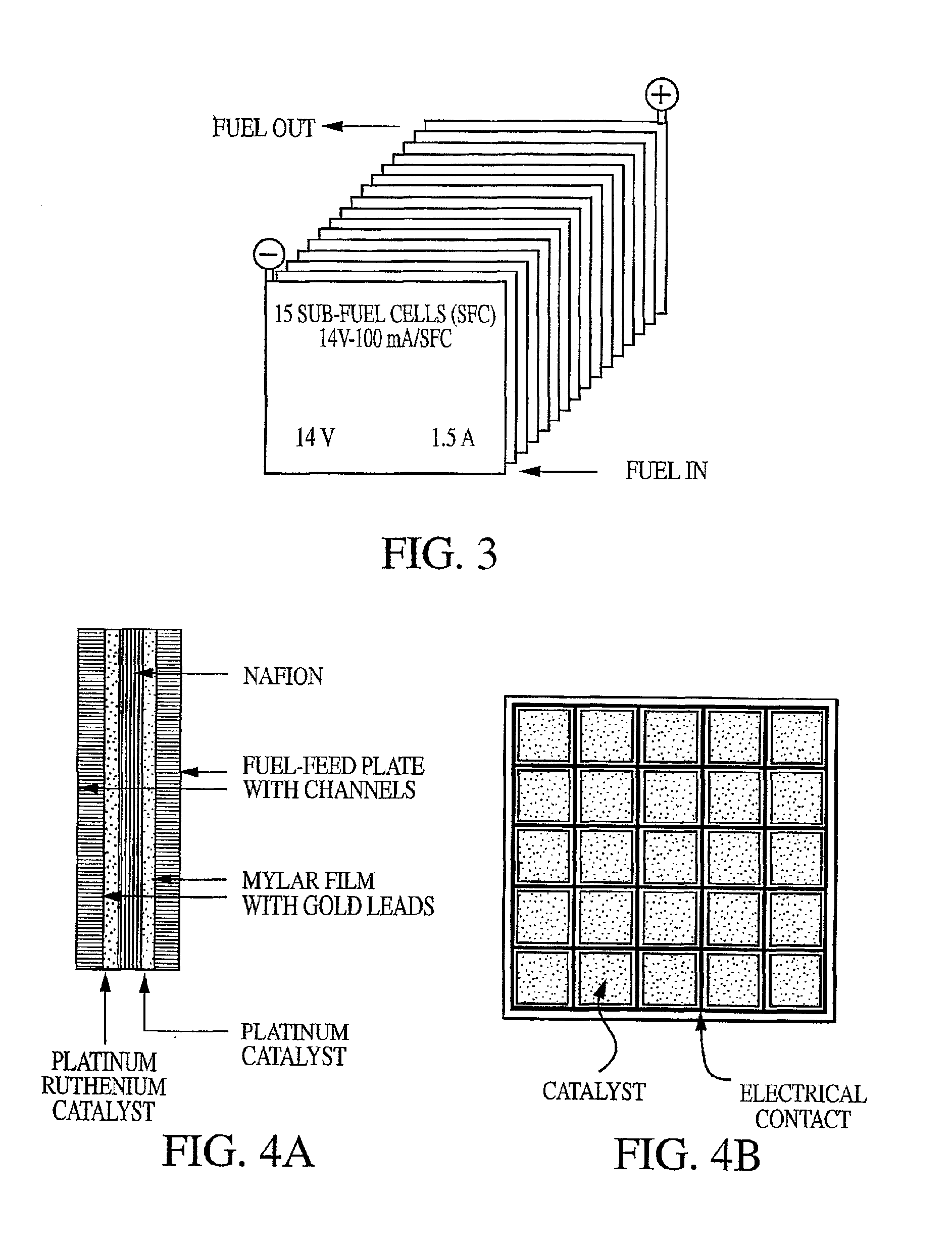
While the invention will now be described in the context of a 21 W embodiment thereof as shown in FIG. 3, the use of this embodiment is intended to be illustrative only. One of ordinary skill in the art can readily scale the described embodiment to achieve less or more power; the use of this specific 21 W embodiment is not intended in any way to limit the scope of the concept of the present invention.
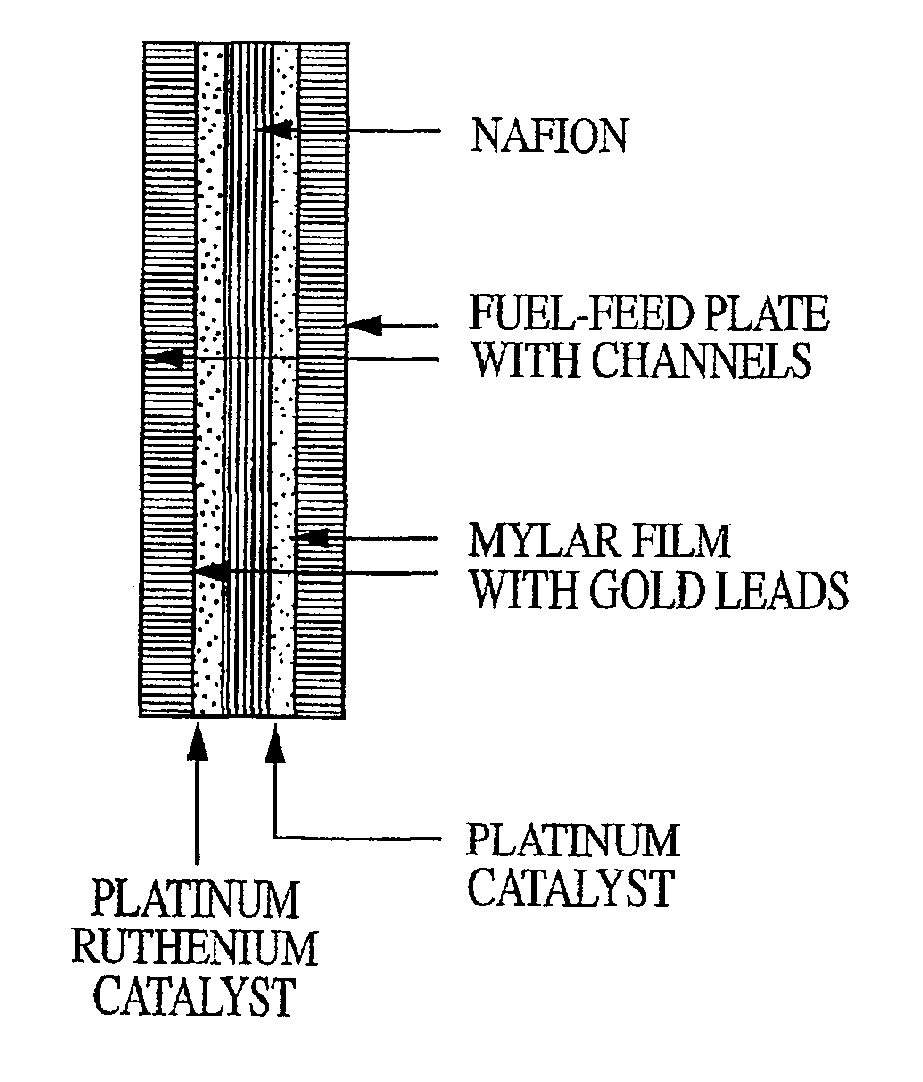
The basic operating principle of the fuel cell of the invention is to generate power with a low current and a slightly higher unit cell voltage. This is achieved by introducing a small-size building block approach to construct the fuel cell. As shown in FIG. 4A in a cross-sectional view, the building blocks are small unit cells of 1-cm2, producing 0.55 V at 100 mA. There will be 25 such unit cells in each sub-fuel cell plate, as shown in FIG. 4B, connected in series to produce 14 V at 100 mA.
As shown in FIG. 3, fifteen of these sub-fuel cell plates will operate in parallel to form the f...
PUM
| Property | Measurement | Unit |
|---|---|---|
| Percent by mass | aaaaa | aaaaa |
| Fraction | aaaaa | aaaaa |
| Thickness | aaaaa | aaaaa |
Abstract
Description
Claims
Application Information
 Login to View More