Esters, polymers, resist compositions and patterning process
a technology of resist composition and composition, applied in the direction of photosensitive materials, instruments, photomechanical equipment, etc., can solve the problems of insufficient transparency of resins, inability to use resists as base resins, and more difficulty in insuring transparency, so as to improve contrast and adhesion
- Summary
- Abstract
- Description
- Claims
- Application Information
AI Technical Summary
Benefits of technology
Problems solved by technology
Method used
Image

Examples
synthesis example 1
Monomer Synthesis Example 1
Synthesis of Monomer 1
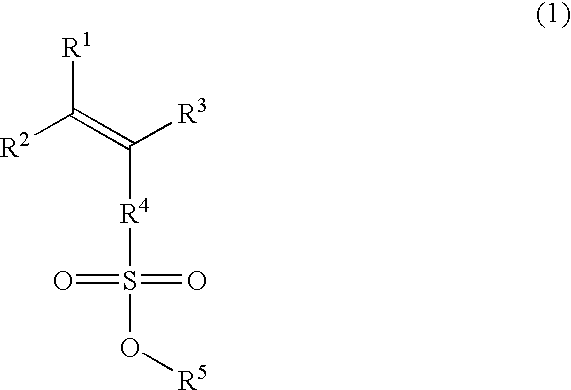
[0159]In a 1-liter four necked flask, 31.0 g of an alcohol shown below and 17.4 g of pyridine were dissolved in 100 g of dichloromethane together with a polymerization stabilizer. While the flask was immersed in an ice bath to keep the internal temperature below 10° C., 2-chloroethanesulfonyl chloride was added dropwise to the flask. Conventional post treatment was carried out. The resulting oily matter was purified by silica gel chromatography, obtaining 24.8 g of Monomer 1. The yield was 61%.
Analytical data of Monomer 1
[0160]1H-NMR (CDCl3, 270 MHz): δ 1.24-3.17 (m, 6H), 4.72 (d, 0.4H), 5.00 (d, 0.6H), 6.19 (d, 1H), 6.40-6.60 (m, 2H)
[0161]FT-IR (NaCl): 3116, 3070, 2979, 2942, 1614, 1484, 1475, 1450, 1371, 1353, 1334, 1319, 1295, 1280, 1265, 1213, 1174, 1139, 1110, 1064, 1035, 1004, 981, 964, 952, 917, 875, 846, 813, 736, 671 cm−1
polymer synthesis example 1
Copolymerization of Monomer 1 and Monomer 2 (30:70) and Protection Reaction on Hydroxyl Groups in the Polymer
[0162]A 300-ml flask was charged with 7.53 g of Monomer 1 and 12.47 g of Monomer 2, shown below, which were dissolved in 8.6 g of toluene. The system was fully purged of oxygen, charged with 0.21 g of the initiator AIBN, and heated at 60° C. at which polymerization reaction took place for 24 hours.
[0163]The polymer thus obtained was worked up by pouring the reaction mixture into hexane whereupon the polymer precipitated. The procedure of dissolving the polymer in tetrahydrofuran (THF) and pouring in 3 liters of hexane for precipitation was repeated twice, after which the polymer was separated and dried. There was obtained 14.8 g of a white polymer, which was found to have a Mw of 5,500 as measured by the light scattering method, and a dispersity (Mw / Mn) of 1.5 as determined from the GPC elution curve. On 1H-NMR analysis, the polymer was found to consist of Monomer 1 and Mono...
polymer synthesis example 2
Copolymerization of Monomer 1, Monomer 2 and Tert-Butyl α-Trifluoromethylacrylate (20:40:40)
[0166]A 300-ml flask was charged with 5.82 g of Monomer 1, 8.27 g of Monomer 2, and 5.91 g of tert-butyl α-trifluoromethylacrylate, which were dissolved in 8.6 g of toluene. The system was fully purged of oxygen, charged with 0.25 g of the initiator AIBN, and heated at 60° C. at which polymerization reaction took place for 24 hours.
[0167]The polymer thus obtained was worked up by pouring the reaction mixture into hexane whereupon the polymer precipitated. The procedure of dissolving the polymer in THF and pouring in 3 liters of hexane for precipitation was repeated twice, after which the polymer was separated and dried. There was obtained 15.1 g of a white polymer, which was found to have a Mw of 5,900 as measured by the light scattering method, and a dispersity (Mw / Mn) of 1.5 as determined from the GPC elution curve. On 1H-NMR analysis, the polymer was found to consist of Monomer 1, Monomer ...
PUM
| Property | Measurement | Unit |
|---|---|---|
| wavelength band | aaaaa | aaaaa |
| wavelength band | aaaaa | aaaaa |
| boiling point | aaaaa | aaaaa |
Abstract
Description
Claims
Application Information
 Login to View More
 - R&D
- Intellectual Property
- Life Sciences
- Materials
- Tech Scout
- Unparalleled Data Quality
- Higher Quality Content
- 60% Fewer Hallucinations
Browse by: Latest US Patents, China's latest patents, Technical Efficacy Thesaurus, Application Domain, Technology Topic, Popular Technical Reports.
© 2025 PatSnap. All rights reserved.Legal|Privacy policy|Modern Slavery Act Transparency Statement|Sitemap|About US| Contact US: help@patsnap.com