

Fuel cell
a fuel cell and cell technology, applied in the field of fuel cells, can solve the problems of reducing the characteristic of the electrode, requiring a great deal of starting time, and low heating efficiency, and achieve the effect of low heating efficiency
- Summary
- Abstract
- Description
- Claims
- Application Information
AI Technical Summary
Benefits of technology
Problems solved by technology
Method used
Image

Examples
first example
(a) Combustion Heater Plate
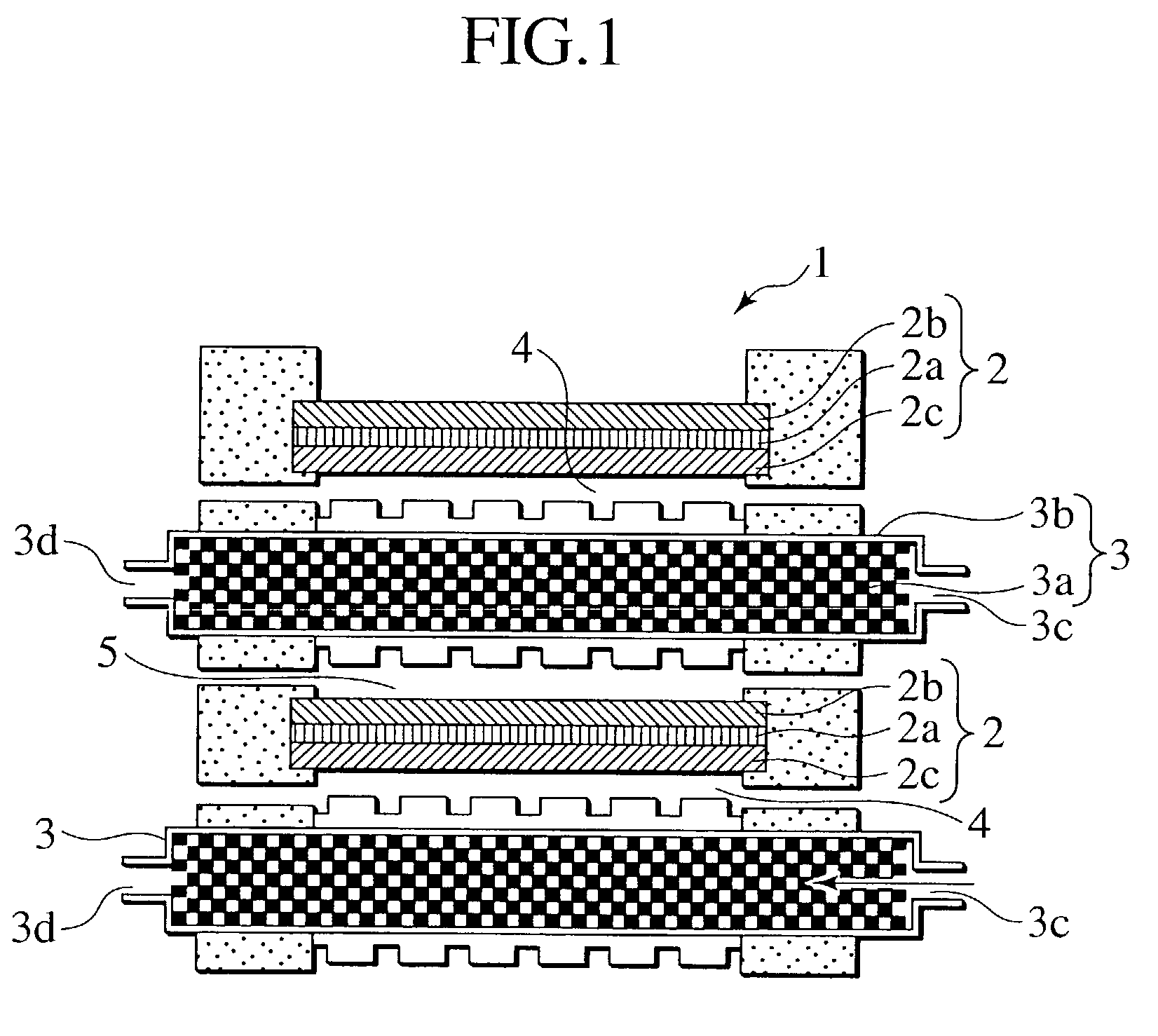
[0059]As a porous combustion support 3a, metal felt made of Fe—Cr—Al containing heat-resisting steel and having a thickness of 2 mm is used. A full surface of the combustion support 3a was covered with a thin plate (i.e., gas non-pass layer 3b) made of heat-resisting steel, and supply and exhaust ports 3c and 3e for heating gas were formed on parts of a side face. Thus, a combustion heater plate 3 as shown in FIG. 1 was obtained. In this time, as in the case of a normal separator, a material layer identical to an electrode material of an opposite cell plate can be formed on the gas non-pass layer 3b for control of a passage, and an increase of a heating area.
(b) Cell Plate (Air Electrode Supporting Type)
[0060]First, a solvent and a binder were added to lanthanum strontium manganate LaSrMnO3 (abbreviated to LSM, hereinafter) powder having a mean diameter of particles 3 to 10 μm, and mixed. This mixture was formed in a plate shape by extrusion molding. By si...
second example
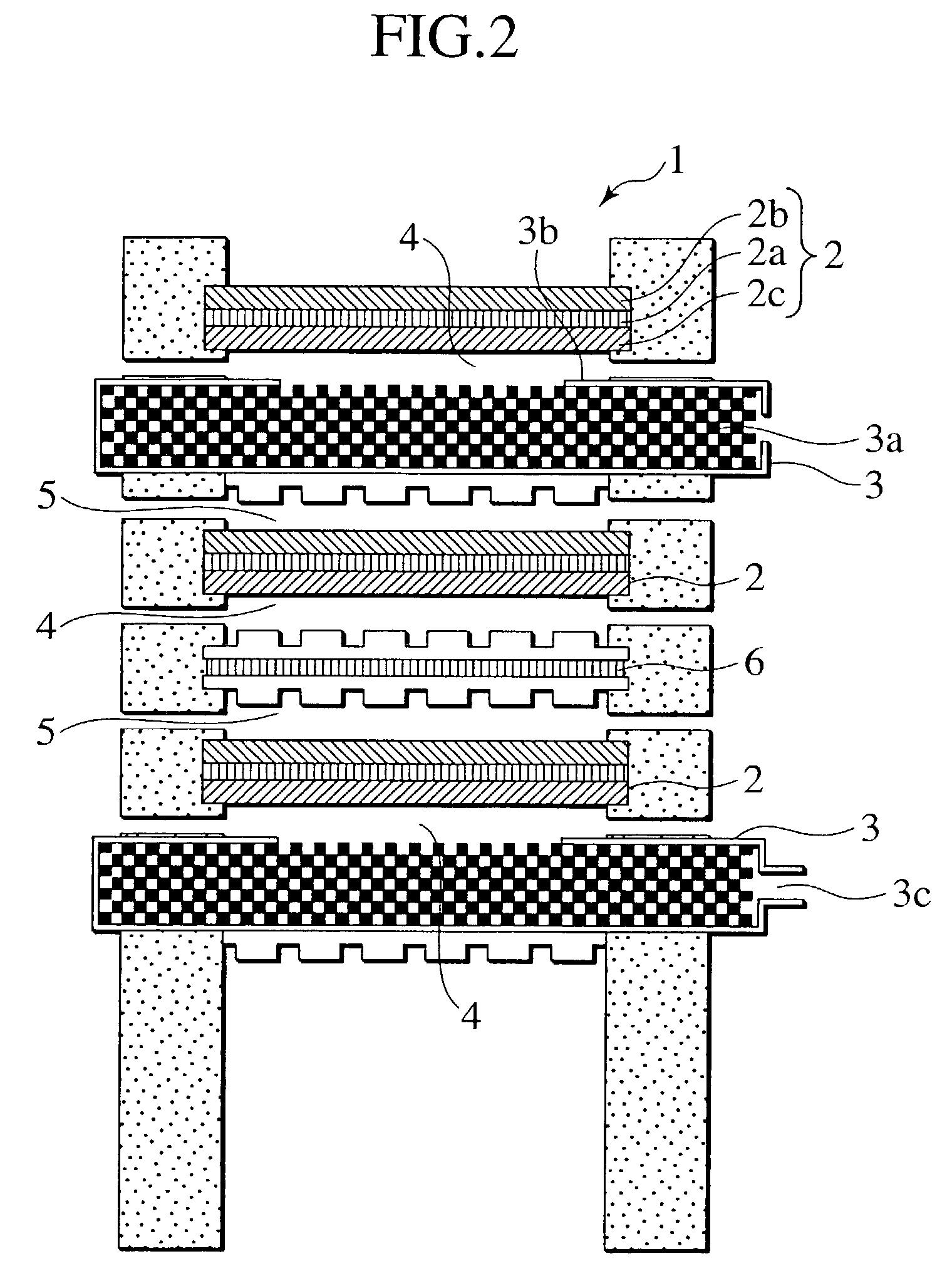
[0064]A cell plate 2 similar to that in the first example was used. Further, a combustion heater plate 3 of a type having a structure basically similar to that of the combustion heater plate 3 shown in the first example, in which no gas non-pass layers 3b are formed on a surface opposite the cell plate 2, was used. Also, a separator 6 having passages of fuel and air electrode materials formed on both surfaces of a lanthanum-chrome containing oxide plate was used. As shown in FIG. 2, one separator out of every two separators in a normal stack formed by alternately laminating cell plates and the separators was substituted with a combustion heater plate 3. Accordingly, a fuel cell stack 1 was formed by including four cell plates 2, two combustion heater plates 3, and three separators 6 (separator 6, cell plate 2, combustion heater plate 3, cell plate 2, separator 6, cell plate 2, combustion heater plate 3, cell plate 2, and separator 6). Moreover, as in the case of the first example, t...
third example
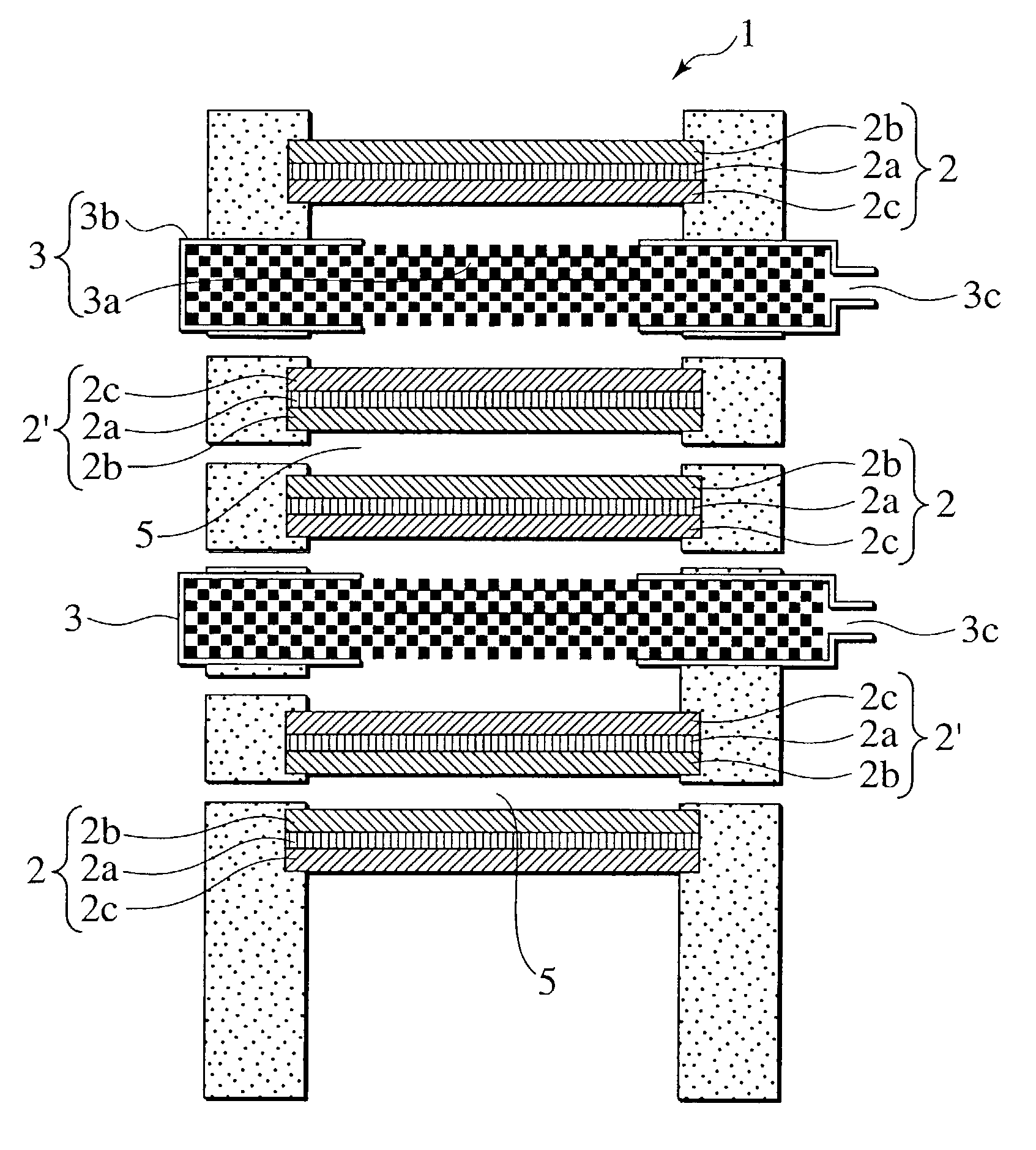
[0066]A cell plate 2 similar to that in the first example was used. For a porous combustion support 3a, as in the case of a general exhaust gas processing catalyst converter, a cordierite honeycomb supporting Pt was used as a catalyst. A combustion heater plate 3 having no gas non-pass layers 3b formed on a surface opposite the cell plate 2 in the combustion support 3a was used. Except for use of the combustion heater plate 3 having such a characteristic, a fuel cell stack 1 having a laminated structure similar to that of the first example was obtained (refer to FIG. 3).
[0067]At starting time of the fuel cell, a mixed gas of fuel (propane gas) for heating and air was introduced from a gas supply port 3c of the combustion heater plate 3, thus heating the cell plate 2. After a temperature was increased to a predetermined temperature, an air-fuel ratio was reduced, and fuel gas for power generation (hydrogen) was supplied to a fuel passage 5, thus starting power generation. In the fuel...
PUM
| Property | Measurement | Unit |
|---|---|---|
| operating temperature | aaaaa | aaaaa |
| thickness | aaaaa | aaaaa |
| mean diameter | aaaaa | aaaaa |
Abstract
Description
Claims
Application Information
 Login to View More