Positive active material for alkaline secondary battery, method for manufacturing the same and alkaline secondary battery
a secondary battery and positive active material technology, applied in the direction of sustainable manufacturing/processing, nickel compounds, lanthanide oxides/hydroxides, etc., can solve the problems of reducing the oxidation number of cobalt (co) and the electric conductivity, reducing the cycle life of the battery, and not allowing presumption as to the characteristics of other substances, etc., to achieve a small performance degradation and large discharge capacity
- Summary
- Abstract
- Description
- Claims
- Application Information
AI Technical Summary
Benefits of technology
Problems solved by technology
Method used
Image

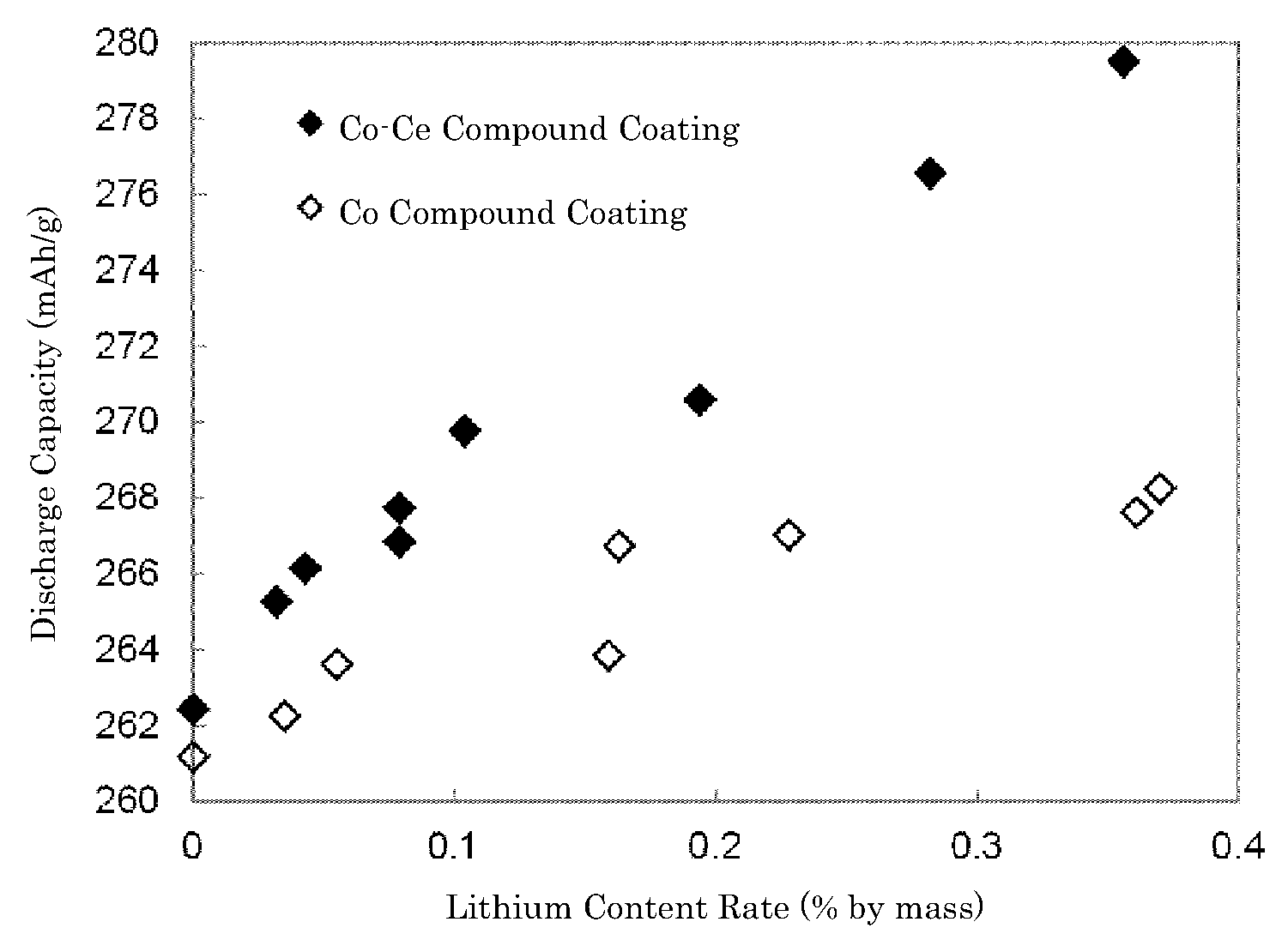
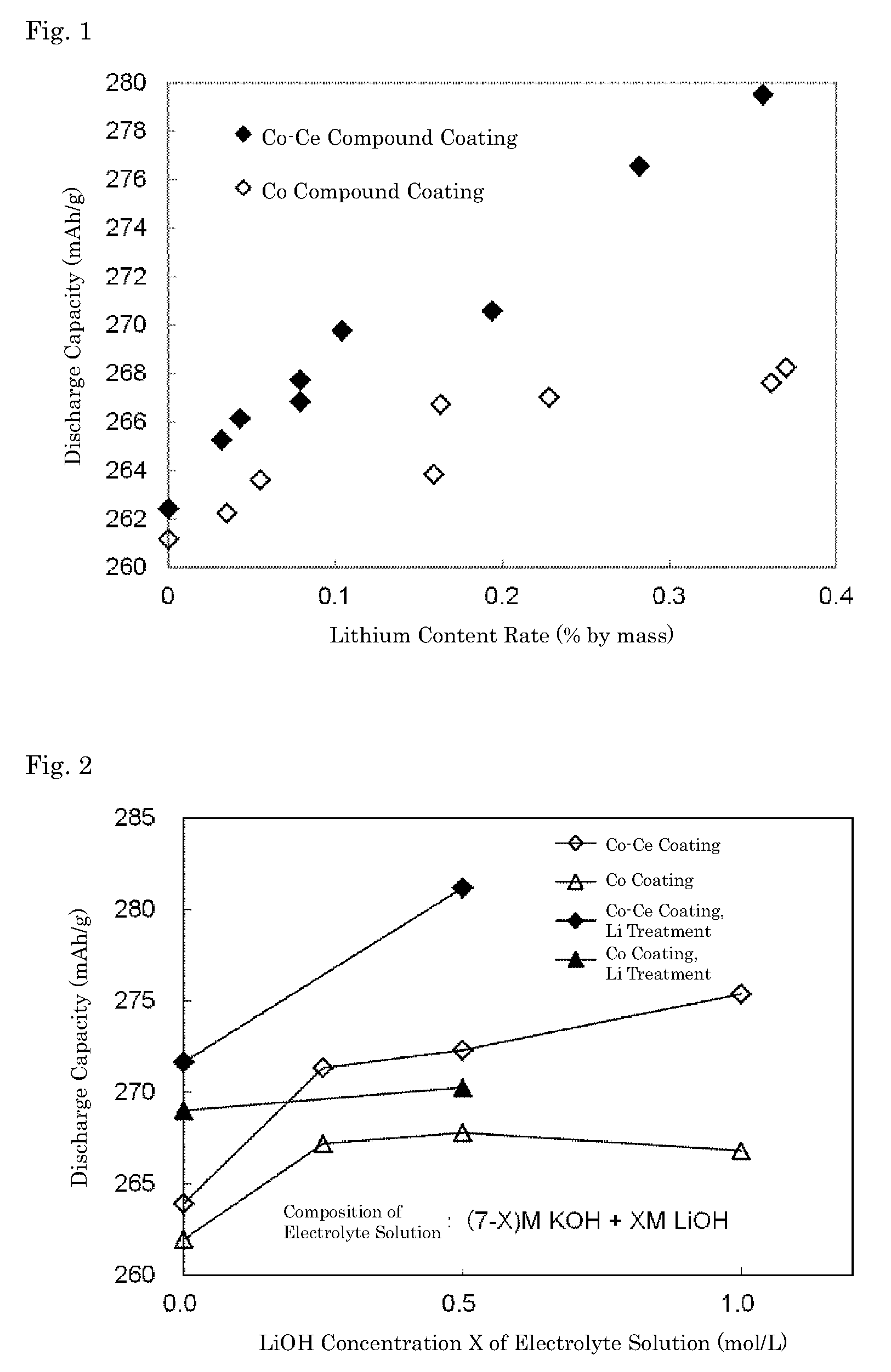
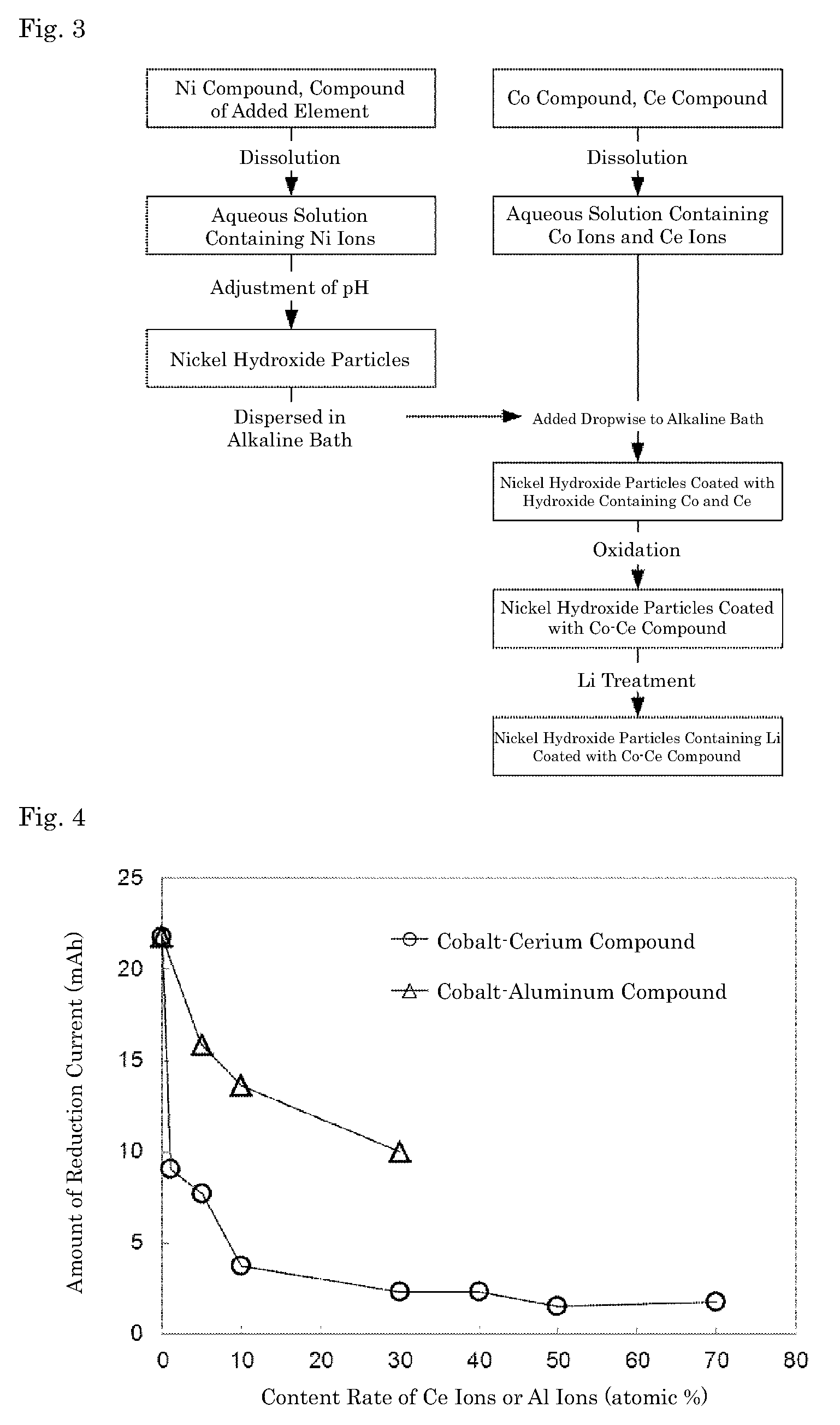
Examples
examples 1 to 7
[0118]An aqueous solution obtained by dissolving nickel sulfate, zinc sulfate and cobalt sulfate was added dropwise to a 1 mol / L aqueous ammonium sulfate solution which was controlled so as to keep a pH of 12 and a temperature of 45° C. while vigorously stirring, and thereby, spherical high density particles, having an average particle diameter of 10 μm and principally made of nickel hydroxide (hereinafter, also simply referred to as nickel hydroxide particles), were obtained. The obtained particles were separated, washed, and dried. The proportion of Ni, Zn and Co contained in the obtained particles was 91:7:2 in terms of mass ratio of elements. The pH of the aqueous ammonium sulfate solution was adjusted by using a 18% by mass aqueous NaOH solution.
[0119]The obtained nickel hydroxide particles were added to a 0.1 mol / L aqueous ammonium sulfate solution, and the resulting aqueous solution was controlled so as to keep a pH of 9 and a temperature of 45° C. and vigorously stirred. The...
examples 8 and 9
[0139]Next, each open type cell was prepared changing the composition of the electrolyte solution, and an experiment was carried out.
[0140]The cell of Example 8 was prepared by the same method as in Examples 1 to 7 except that the same active material particles (the conductive auxiliary layer contains the cerium dioxide phase and the Li content rate is 0.194% by mass) as in Example 5 were used, and the composition of the electrolyte solution was 7 mol / L KOH.
[0141]The cell of Example 9 was prepared by the same method as in Example 8 except that a 6.5 mol / L KOH and 0.5 mol / L LiOH were used as an electrolyte solution.
PUM
| Property | Measurement | Unit |
|---|---|---|
| temperature | aaaaa | aaaaa |
| temperature | aaaaa | aaaaa |
| pH | aaaaa | aaaaa |
Abstract
Description
Claims
Application Information
 Login to View More
 - R&D
- Intellectual Property
- Life Sciences
- Materials
- Tech Scout
- Unparalleled Data Quality
- Higher Quality Content
- 60% Fewer Hallucinations
Browse by: Latest US Patents, China's latest patents, Technical Efficacy Thesaurus, Application Domain, Technology Topic, Popular Technical Reports.
© 2025 PatSnap. All rights reserved.Legal|Privacy policy|Modern Slavery Act Transparency Statement|Sitemap|About US| Contact US: help@patsnap.com