Check patentability & draft patents in minutes with Patsnap Eureka AI!

Hydrolysis resisting polyester resin composition and preparation method

A polyester resin and composition technology, applied in the field of thermoplastic polyester resin compositions, can solve the problems of exudation of small molecular compounds, increase in melt viscosity, poor thermal stability, etc., achieve excellent thermal stability, and improve hydrolysis resistance. Effect

Inactive Publication Date: 2008-11-26
TORAY FIBER RES INST(CHINA) CO LTD
View PDF11 Cites 3 Cited by
  • Summary
  • Abstract
  • Description
  • Claims
  • Application Information

AI Technical Summary

Problems solved by technology

[0007] However, in all these disclosed technologies for improving the hydrolysis resistance of polyester resins, the use of carbodiimide compounds has the following disadvantages: high price, increased melt viscosity when used, poor thermal stability, and harmful effects on human health during processing. harmful smell
Epoxy organic small molecular compounds also have problems such as increased melt viscosity, volatility, poor thermal stability, and leakage of small molecular compounds during use.

Method used

the structure of the environmentally friendly knitted fabric provided by the present invention; figure 2 Flow chart of the yarn wrapping machine for environmentally friendly knitted fabrics and storage devices; image 3 Is the parameter map of the yarn covering machine
View more

Image

Smart Image Click on the blue labels to locate them in the text.
Viewing Examples
Smart Image
  • Hydrolysis resisting polyester resin composition and preparation method
  • Hydrolysis resisting polyester resin composition and preparation method
  • Hydrolysis resisting polyester resin composition and preparation method

Examples

Experimental program
Comparison scheme
Effect test

preparation example Construction

[0030] Preparation of Silica Particles Containing Epoxy Functional Groups

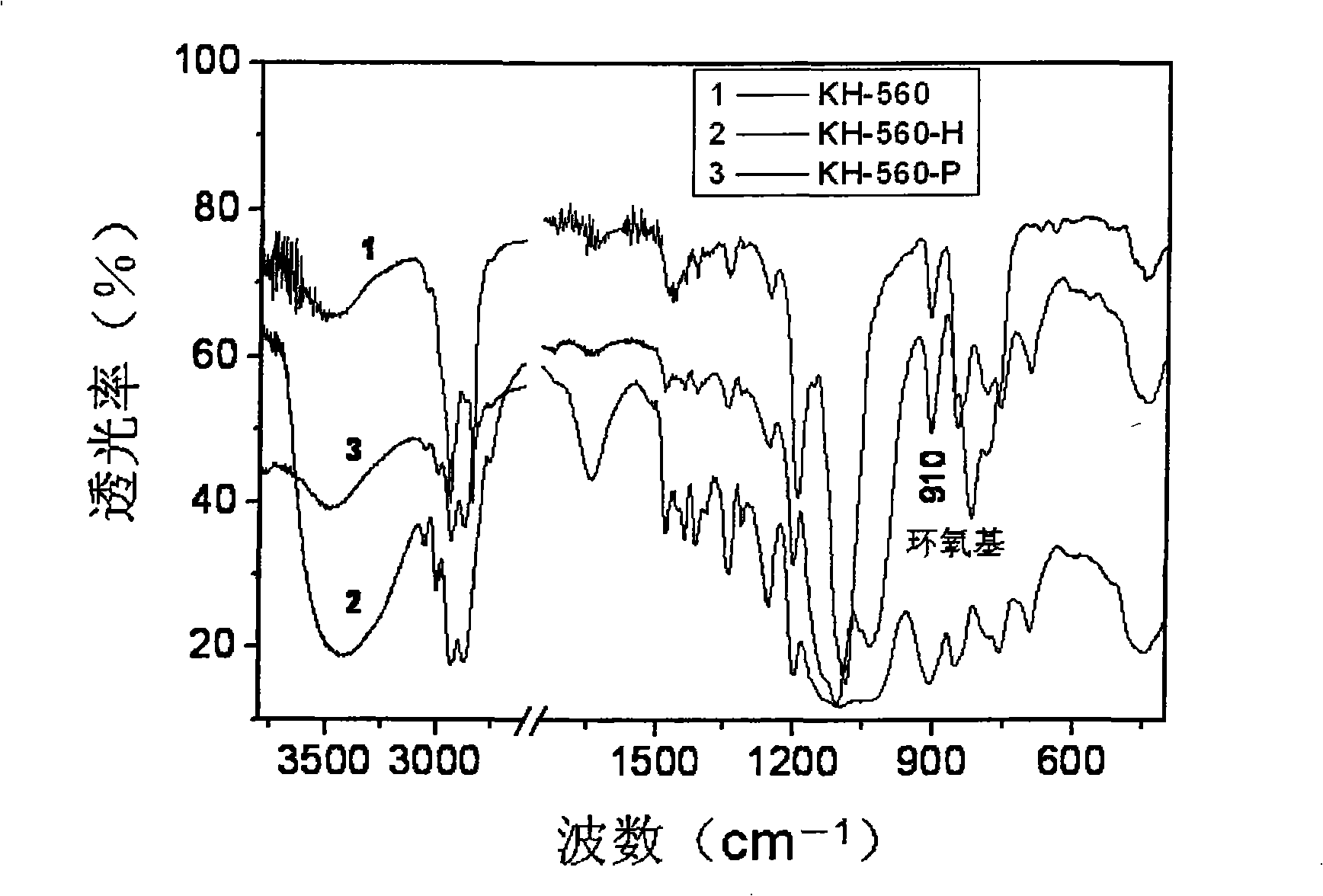
[0031]Mix 118.0g (0.5mol) of γ-(2,3-glycidyloxy)propyltrimethoxysilane (KH-560), with 27.0g (1.5mol) of deionized water, 69.0g (1.5mol) of anhydrous Ethanol was mixed, and electromagnetically stirred at room temperature for 4 hours to hydrolyze the siloxane, and then the temperature of the system was raised to 60°C and stirred for 4 hours to obtain a viscous liquid (KH-560-H). The viscous liquid was condensed in a vacuum oven at 80°C, 100°C, 120°C, and 150°C for 2 hours respectively, and finally condensed at 200°C for 1 hour to obtain a white solid. The obtained solid was pulverized by a high-speed pulverizer to obtain silica particles (KH-560-P) containing epoxy functional groups. Infrared spectrum shows that the obtained silica particles contain significant epoxy functional group absorption peaks ( figure 1 ). Thermogravimetric analysis (TGA) shows that the heat-resistant temperature of the sample...

Embodiment 1-3

[0035] After drying polyethylene terephthalate (F20S, Japan Toray Co.) in vacuum at 150°C for 6 hours, after mixing with KH-560-P obtained at a final condensation temperature of 200°C, pass it through a twin-screw extruder Extrusion yields blended chips. The temperature of the feeding section of the extruder is 230°C, the temperature of the remaining sections is 260°C, and the screw speed is 200 rpm. The intrinsic viscosity and molecular weight changes before and after the hydrolysis test of the obtained resin were analyzed, and the results are shown in Table 1.

[0036] Table 1

[0037]

Embodiment 4

[0039] PET (F20S, Japan Toray Co., Ltd.) was vacuum-dried at 150°C for 6 hours, mixed with KH-550-P obtained at a final condensation temperature of 200°C, and extruded through a twin-screw extruder (manufactured by Technovel) to obtain Blend slices. The temperature of the feeding section of the extruder is 230°C, the temperature of the remaining sections is 260°C, the screw speed is 200 rpm, and the resin stays in the extruder for 5 minutes on average. Analyze the intrinsic viscosity and molecular weight changes of the obtained resin before and after the hydrolysis test, and the results are shown in Table 2.

[0040] Table 2

[0041]

the structure of the environmentally friendly knitted fabric provided by the present invention; figure 2 Flow chart of the yarn wrapping machine for environmentally friendly knitted fabrics and storage devices; image 3 Is the parameter map of the yarn covering machine
Login to View More

PUM

No PUM Login to View More

Abstract

The invention discloses a hydrolysis resistant polyester resin composite formed by 100 weight portions of polyester resin (A) and 0.1-10 weight portions of silicon dioxide particles (B) with excellent thermal stability and a preparation method thereof. The silicon dioxide particles (B) are obtained by the hydrolysis, condensation step by step and crush of organic silicon compound with a general formula being RSiX3 under the condition of without catalyst; wherein, R is the functional group such as amino group, alkane amino, epoxy group, ethylene, cyano-group and the like with reaction activity; X is hydrolytic functional group such as alkoxy, acyloxy, halogen and the like. Compared with the unmodified polyester resin, the polyester resin provided by the invention and the finished product manufactured by the polyester resin have remarkably improved hydrolysis resistance property. In addition, as no harmful gas to human health is produced in the processing, the melt viscosity does not increase to cause processing difficulty.

Description

technical field [0001] The present invention relates to a thermoplastic polyester resin composition having excellent hydrolysis resistance and a method for preparing the same. Specifically, it relates to a thermoplastic polyester resin composition modified by functional silicon dioxide particles and having excellent hydrolysis resistance and a preparation method of the resin composition. In addition, the invention also provides a method for preparing functionalized silica particles that can be used to improve the hydrolysis resistance of thermoplastic polyester resins. Background technique [0002] Polyester resins are widely used in monofilaments, fibers, films, moldings and containers due to their excellent chemical stability, solvent resistance, abrasion resistance, gloss, gas barrier properties and electrical insulation properties. . However, most polyester materials cannot sufficiently maintain the physical properties of the material due to the hydrolytic degradation ...

Claims

the structure of the environmentally friendly knitted fabric provided by the present invention; figure 2 Flow chart of the yarn wrapping machine for environmentally friendly knitted fabrics and storage devices; image 3 Is the parameter map of the yarn covering machine
Login to View More

Application Information

Patent Timeline
no application Login to View More
IPC IPC(8): C08L67/03C08K3/36
Inventor 赖铮铮夏天徐征陈敬禄
Owner TORAY FIBER RES INST(CHINA) CO LTD
Features
  • R&D
  • Intellectual Property
  • Life Sciences
  • Materials
  • Tech Scout
Why Patsnap Eureka
  • Unparalleled Data Quality
  • Higher Quality Content
  • 60% Fewer Hallucinations
Social media
Patsnap Eureka Blog
Learn More