

Hyaluronate gel particle and preparation method thereof
A technology of hyaluronate and gel particles, applied in medical science, surgery, etc., can solve the problems of short decomposition period, complex preparation method, fast degradation and absorption, etc., to reduce production and operation costs, and to achieve high operational feasibility , the effect of easy injection into the body
- Summary
- Abstract
- Description
- Claims
- Application Information
AI Technical Summary
Problems solved by technology
Method used
Image

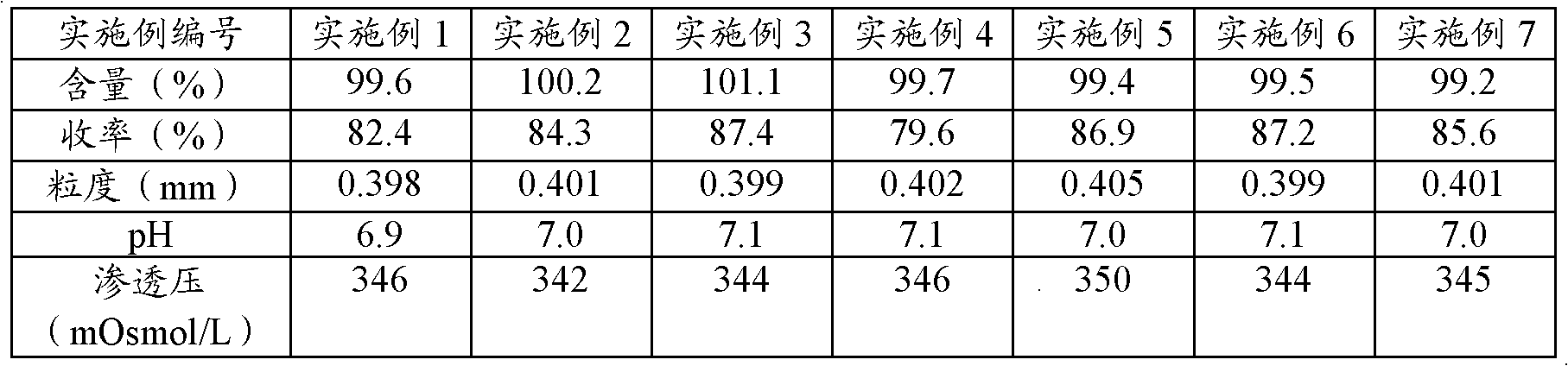
Examples
Embodiment 1
[0031] Add 1.0 g sodium hyaluronate dry powder (molecular weight 1.8 million Daltons, purchased from Shandong Freda) to 10 ml of 0.8% sodium hydroxide solution, stir until it becomes transparent and fully dissolve, and then add 80 μl of sodium hyaluronate Glycol diglycidyl ether (CA: 2425-79-8), stirred evenly, and reacted at a constant temperature of 30°C for 7 hours to obtain a transparent gel block, which was added to 500ml of deionized water, kept at a constant temperature of 70°C for 6 hours, purified Change the water once during the swelling process, filter, and wash the resulting gel piece with 500ml PBS damping fluid (the osmotic pressure is 350, and every 1000ml contains NaH 2 PO 4 2H 2 O 0.099mg, NaH 2 PO 4 2H 2 (01.123g, NaCl 10.45g) static dialysis for 12 hours, during which the PBS buffer solution was changed twice, filtered, and the gel piece was passed through an 80-mesh stainless steel sieve to obtain sodium hyaluronate gel particles.
Embodiment 2
[0033] Add 1.0 g sodium hyaluronate dry powder (molecular weight 1.8 million Daltons, purchased from Shandong Freda) to 10 ml of 0.8% sodium hydroxide solution, stir until it becomes transparent and fully dissolve, and then add 80 μl of sodium hyaluronate Diol diglycidyl ether (CA: 2425-79-8), stir well, react at 40°C for 4 hours to obtain a transparent gel block, add it to 500ml deionized water, keep at 70°C for 6 hours, purify and swell Change water once in the process, filter, with 500ml PBS damping fluid (osmotic pressure is 350, every 1000ml contains NaH 2 PO 4 2H 2 O 0.099mg, NaH 2 PO 4 2H 2 O 1.123g, NaCl 10.45g) static dialysis for 12 hours, during which the PBS buffer solution was replaced twice, filtered, and the gel piece was passed through an 80-mesh stainless steel sieve to obtain sodium hyaluronate gel particles.
Embodiment 3
[0035] Add 1.0 g sodium hyaluronate dry powder (molecular weight 1.8 million Daltons, purchased from Shandong Freda) to 10 ml of 0.8% sodium hydroxide solution, stir until it becomes transparent and fully dissolve, and then add 80 μl of sodium hyaluronate Diol diglycidyl ether (CA: 2425-79-8), stirred evenly, and reacted at a constant temperature of 50°C for 4 hours to obtain a transparent gel block, which was added to 500ml of deionized water, kept at a constant temperature of 70°C for 6 hours, and purified Change the water once during the swelling process, filter, and wash the resulting gel piece with 500ml PBS damping fluid (the osmotic pressure is 350, and every 1000ml contains NaH 2 PO 4 2H 2 O 0.099mg, NaH 2 PO 4 2H 2 (01.123g, NaCl 10.45g) static dialysis for 12 hours, during which the PBS buffer solution was changed twice, filtered, and the gel piece was passed through an 80-mesh stainless steel sieve to obtain sodium hyaluronate gel particles.
PUM
 Login to View More
 Abstract
Description
Claims
Application Information
 Login to View More