Production method of C5 enol

A production method, the technology of carbopentaenol, which is applied in the field of carbapentaenol production, can solve the problems of high production cost, achieve the effects of reducing production cost, simplifying the process, and increasing the overall reaction yield

A production method, the technology of carbopentaenol, which is applied in the field of carbapentaenol production, can solve the problems of high production cost, achieve the effects of reducing production cost, simplifying the process, and increasing the overall reaction yield

CN102381940AInactive Publication Date: 2012-03-21赵明江

Image

Smart Image Click on the blue labels to locate them in the text.
Viewing Examples
Smart Image
  • Production method of C5 enol
  • Production method of C5 enol
  • Production method of C5 enol

Examples

Experimental program
Comparison scheme
Effect test

Embodiment 1~8

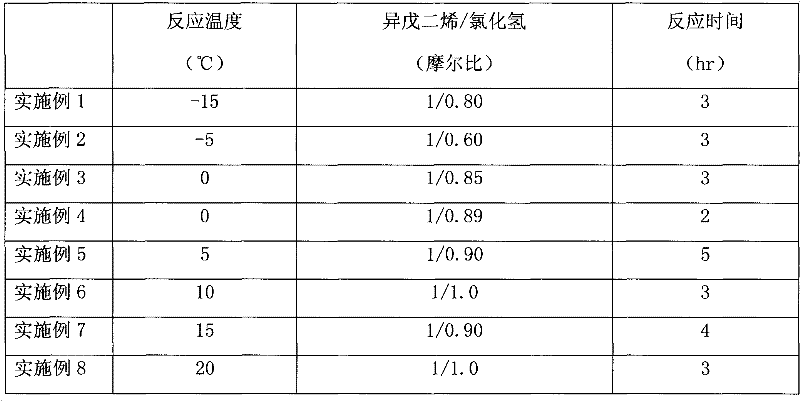
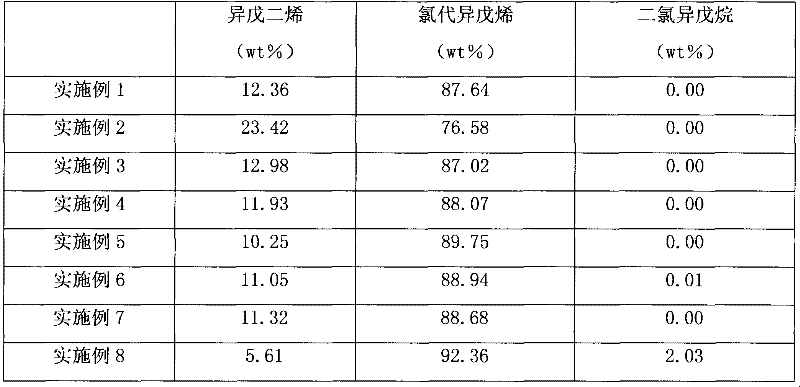
[0026] The addition reaction was carried out in a 1000 ml glass three-neck flask with mechanical stirring and cooling device. Add isoprene into the three-necked flask, start stirring and cool the reaction liquid to the required temperature, then pass the raw material anhydrous hydrogen chloride gas into the reactor from the lower part at this temperature, keep the required reaction time, and make the hydrogen chloride and Isoprene undergoes an addition reaction. Since the addition reaction is an exothermic process, the gas inlet rate of hydrogen chloride should be controlled to maintain the reaction temperature. The reaction conditions of the above embodiments are shown in Table 1, and the reaction results are shown in Table 2.

Embodiment 9~16

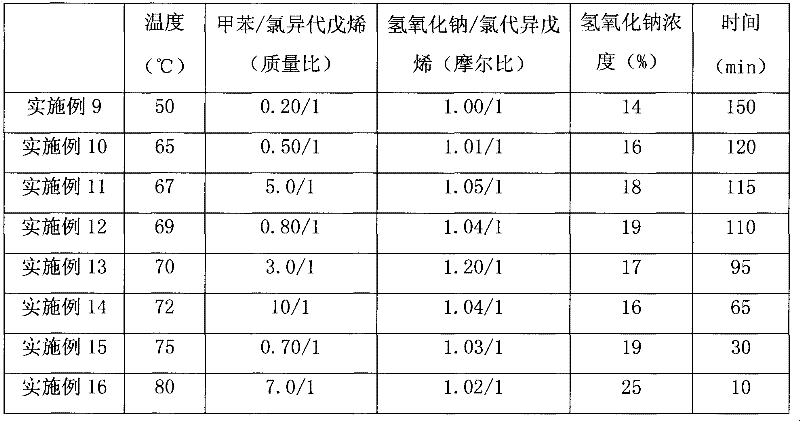
[0028] The hydrolysis reaction was carried out in a 1000 ml glass three-neck flask equipped with a mechanical stirring and heating device. Add chloroisoamylene, toluene and sodium hydroxide aqueous solution into the three-necked flask, start stirring and heat the reaction liquid to the required temperature, and keep the required reaction time. The reaction conditions of the above embodiments are shown in Table 3, and the reaction results are shown in Table 4.

[0029] When refining methyl butenol, the temperature at the top of the tower is 70-72°C, the temperature at the bottom of the tower is controlled at 80-90°C, the absolute pressure at the top of the tower is controlled at 260-270mmHg, and the reflux ratio is controlled at 1-3. When prenol is refined, the temperature at the top of the tower is 75-77°C, the temperature at the bottom of the tower is 85-95°C, the absolute pressure at the top of the tower is controlled at 60-75mmHg, and the reflux ratio is controlled at 1-3. ...

Embodiment 17~23

[0031]The hydrolysis reaction was carried out in a 1000 ml glass three-neck flask with mechanical stirring and heating device. Add chloroisoamylene, solvent and sodium hydroxide aqueous solution into a three-necked flask, start stirring and heat the reaction solution to the required temperature, and keep the required reaction time. The reaction conditions of above each embodiment see the table below:

[0032] Table 1.

[0033]

[0034] Table 2.

[0035]

[0036] table 3.

[0037]

[0038] Table 4.

[0039]

[0040] table 5:

[0041]

[0042] Table 6:

[0043]

the structure of the environmentally friendly knitted fabric provided by the present invention; figure 2 Flow chart of the yarn wrapping machine for environmentally friendly knitted fabrics and storage devices; image 3 Is the parameter map of the yarn covering machine
Login to View More

PUM

PropertyMeasurementUnit
oxygen consumptionaaaaaaaaaa
Login to View More

Abstract

The invention relates to a production method of a C5 enol. The production method uses isoprene and hydrogen chloride as raw materials and comprises the following steps: 1) performing addition reaction on isoprene and hydrogen chloride to generate a mixture of 1-chloro-isopentene and 3-chloro-isopentene; and 2) performing a hydrolysis reaction on the product of the addition reaction, adding one or more of toluene, ethylbenzene, n-hexane, cyclohexane, 2-methylpentane, 3-methylpentane, 2,2-dimethylbutane, 2,3-dimethylbutane and heptane as the solvent in the hydrolysis process, separating out the oil phase product after the hydrolysis, and rectifying to obtain products, namely methylbutenol and 3-methyl-2-buten-1-ol. Compared with the C5 enol production process of the prior art, the side reaction, in which dichloro-isopentane is generated, in the addition reaction process is effectively inhibited; after the solvent is added in the hydrolysis reaction, the yield of the hydrolysis reaction can be increased and the purification of the product can be facilitated; the yields of the addition reaction and the hydrolysis reaction are both more than 98% and are obviously increased as compared with the prior art; and the production cost is greatly reduced.

Description

technical field [0001] The present invention relates to a production method of carbopentenol, in particular to the addition reaction of isoprene and hydrogen chloride to prepare chlorinated isopentene, and the chlorinated isopentene is then directly hydrolyzed to produce isopentenol and methylbutene Alcohol method. Background technique [0002] 3-Methyl-2-buten-1-ol (prenol) and 2-methyl-3-buten-2-ol (methylbutenol) are two important fine chemical intermediates, Due to the large difference in boiling points between the two alcohols, the separation can be achieved with fewer theoretical plates in the rectification column. Isopentenol is mainly used to react with trimethyl orthoacetate or ethyl acetate to synthesize methyl or ethyl perethinate, which is the key intermediate for the preparation of pyrethroids, homo-cis permethrin (DV-chrysanthemic acid or chrysanthemic acid ester); methyl butenol is the basic raw material for the production of methyl heptenone, and then the p...

Claims

the structure of the environmentally friendly knitted fabric provided by the present invention; figure 2 Flow chart of the yarn wrapping machine for environmentally friendly knitted fabrics and storage devices; image 3 Is the parameter map of the yarn covering machine
Login to View More

Application Information

Patent Timeline
21 Mar 2012
Publication
CN102381940A
IPC
C07C33/03; C07C29/09
Inventors
赵明江; 赵明军