1,3,4-oxadizaole structure unit-containing Rhodamine B pH fluorescence probe and applications thereof
Inactive Publication Date: 2013-04-03
SHANDONG UNIV
View PDF3 Cites 17 Cited by
Summary
Abstract
Description
Claims
Application Information
AI Technical Summary
This helps you quickly interpret patents by identifying the three key elements:
Problems solved by technology
Method used
Benefits of technology
Problems solved by technology
Although some reported rhodamine B-type pH probes have been used to monitor the pH value in lysosomes, these probes tend to cause "alkaline effects", that is, after long-term incubation, they will cause pH in lysosomes The value rises, affecting the monitoring results
Method used
the structure of the environmentally friendly knitted fabric provided by the present invention; figure 2 Flow chart of the yarn wrapping machine for environmentally friendly knitted fabrics and storage devices; image 3 Is the parameter map of the yarn covering machine
View more
Image
Smart Image Click on the blue labels to locate them in the text.
Viewing Examples
Smart Image
Click on the blue label to locate the original text in one second.
Reading with bidirectional positioning of images and text.
Smart Image
Examples
Experimental program
Comparison scheme
Effect test
Embodiment 1
[0032] Synthesis of Rhodamine B pH Fluorescent Probes Containing 1,3,4-Oxadiazole Structural Units
[0033] 320 mg (0.5 mmol) of compound 1 and 80 mg (0.5 mmol) of compound 2 were dissolved in 10 mL of dry acetonitrile, 104 mg (0.75 mmol) of potassiumcarbonate was added, and the mixture was heated to reflux and reacted for 2 hours. After cooling, potassiumcarbonate was filtered off, and the filtrate was concentrated under reduced pressure to obtain a crude product. Purified by silica gelcolumn chromatography (2:1, petroleumether-ethyl acetate) to obtain 265 mg of light yellow compound 3, which is a rhodamine B-type pH fluorescent probe containing 1,3,4-oxadiazole structural units, the yield : 82.7%, melting point: 133-135°C.
[0034] Above-mentioned synthetic route reaction formula is as follows
[0035]
[0036] Infrared spectrum measurement: IR (KBr) ν: 3406 (N-H), 1615 (C=O) cm -1 .
[0037] H NMR spectrum determination: 1 HNMR(d 6 -DMSO,400MHz))δ(ppm):1.10(t,1...
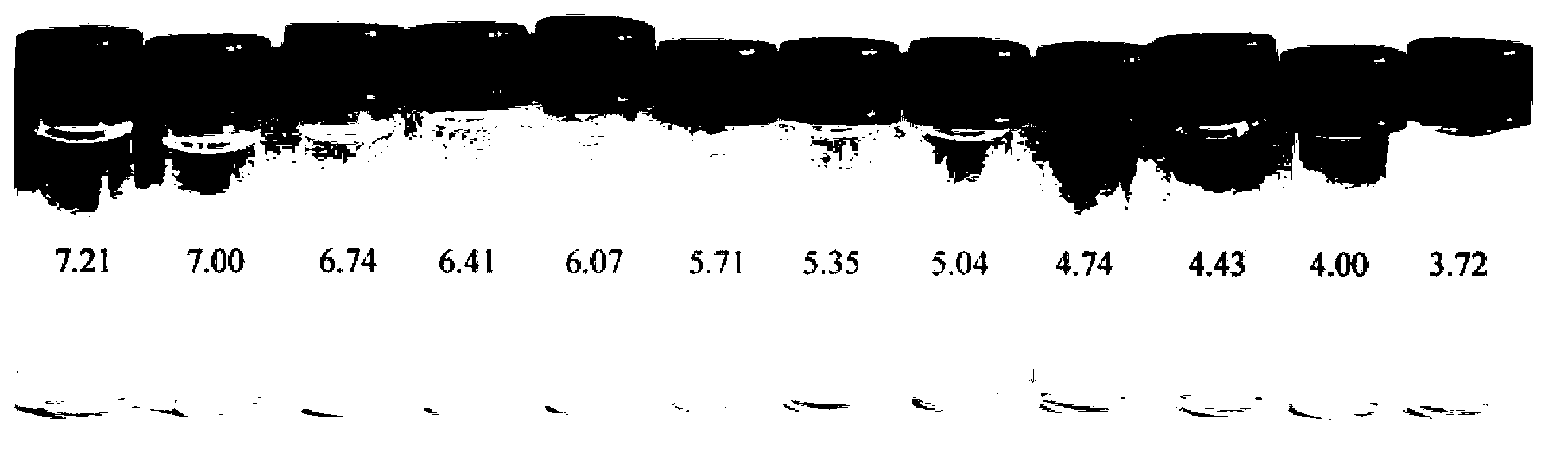
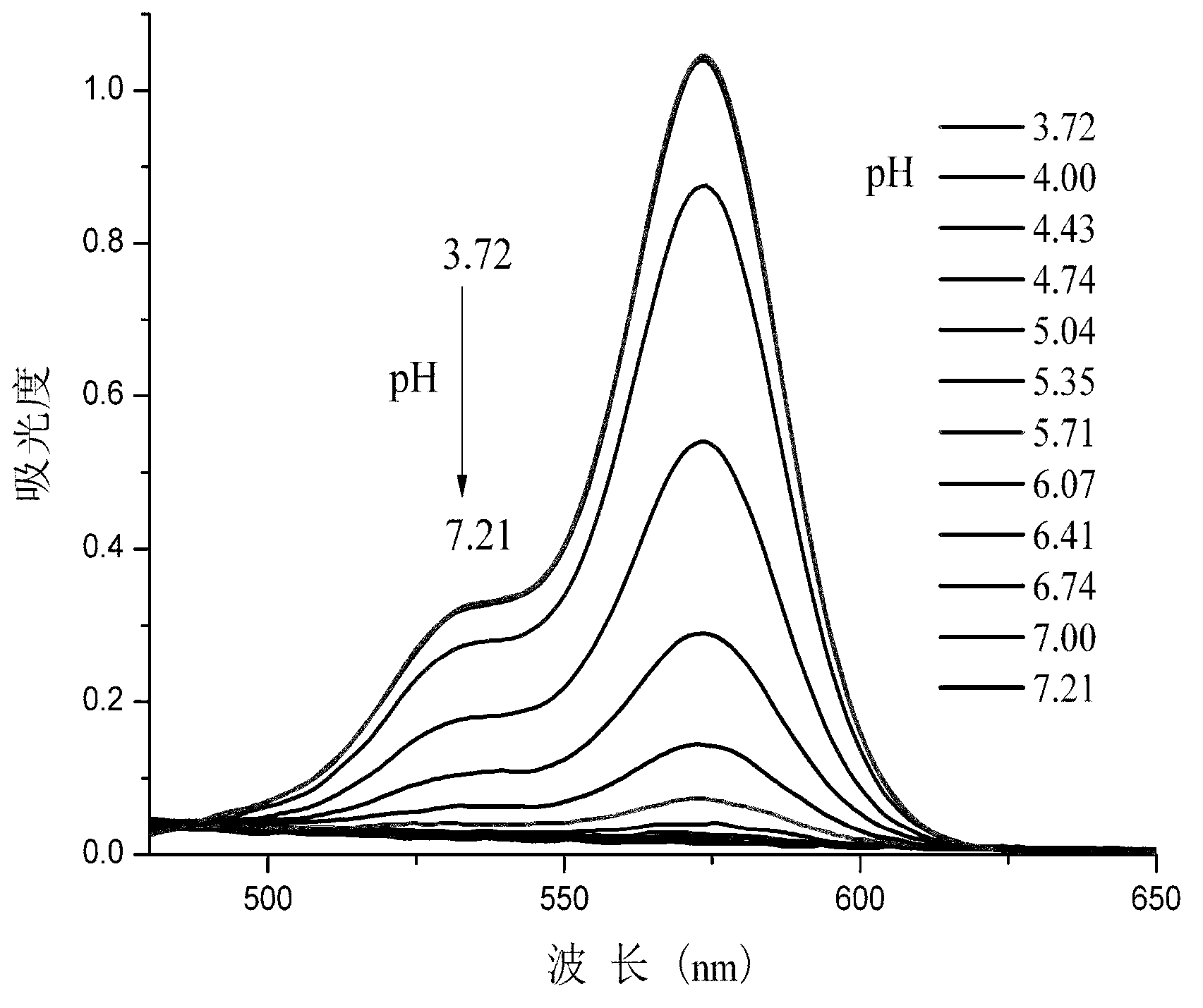
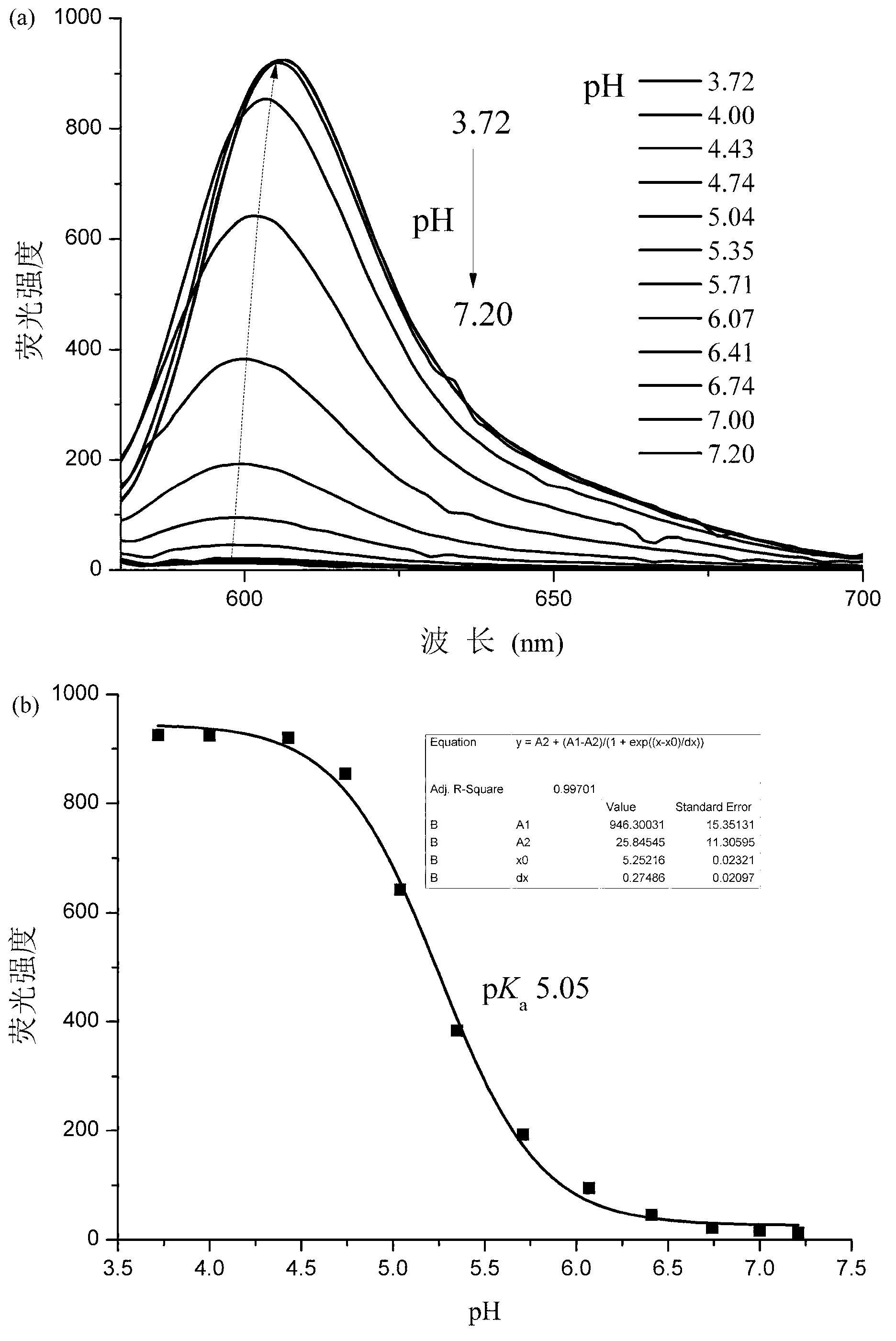
[0041] The results showed that probe 3 had a good response to the pH value. After the pH value changed from 6.7 to 4.4, its fluorescence intensity was increased by about 46 times, which had a good fluorescence enhancement effect and could improve the sensitivity and accuracy of the signal. ( figure 2 , 3 )
Embodiment 3
[0043] After adding various metal ions to the solution of probe 3 (10 μM) with a pH value of 4.74 (ethanol / Britton-Robinson buffer solution, 40 mM acetic acid, phosphoric acid, boric acid, 1:9, volume ratio, 0.1M NaCl), Test its fluorescence intensity change. (excitation wavelength (λ ex ), 565nm; Al 3+ ,Cu 2+ , Fe 3+ ,Zn 2+ ,Cd 2+ ,Hg 2+ , Ni 2+ ,Co 2+ ,Pb 2+ , Ag + The concentration is 200μM, Na + and K + Both are 10mM, Ca 2+ and Mg 2+ Both are 5mM)
[0044] After adding various metal ions to the solution of probe 3 (10 μM) with a pH value of 7.21 (ethanol / Britton-Robinson buffer solution, 40 mM acetic acid, phosphoric acid, boric acid, 1:9, volume ratio, 0.1M NaCl), Test its fluorescence intensity change. (excitation wavelength (λ ex ), 565nm; Al 3+ ,Cu 2+ , Fe 3+ ,Zn 2+ ,Cd 2+ ,Hg 2+ , Ni 2+ ,Co 2+ ,Pb 2+ , Ag + The concentration is 200μM, Na + and K + Both are 10mM, Ca 2+ and Mg 2+ Both are 5mM)
[0045] The results show that the response o...
the structure of the environmentally friendly knitted fabric provided by the present invention; figure 2 Flow chart of the yarn wrapping machine for environmentally friendly knitted fabrics and storage devices; image 3 Is the parameter map of the yarn covering machine
Login to View More
PUM
Property
Measurement
Unit
melting point
aaaaa
aaaaa
Login to View More
Abstract
The invention discloses a 1,3,4-oxadizaole structure unit-containing Rhodamine B pH fluorescence probe, the structure of which is shown as the formula (I) in the specification. The invention further discloses applications of the probe to monitoring the change of pH values and specifically marking lysocome in living cells. The probe does not emit fluoresce under the neutral and alkaline conditions; after the pH value is smaller than 7, the fluorescence intensity is fast enhanced along with the reduction of the pH value and can achieve the maximum value when the pH value is about 4.4; the pH sensitivity of the fluorescence detection ranges from 6.7 to 4.4, and the fluorescence intensity and the pH are in linear relation from pH 4.7 to 5.7; good capability of interference resistance to various metal ions can be achieved under acidity condition; and the probe is very suitable for monitoring the pH value under the complicated interior environment of the living cells in real time, especially specifically marking lysocome and monitoring the change of pH value in the lysocome.
Description
technical field [0001] The invention relates to a rhodamine B class pH fluorescent probe containing 1,3,4-oxadiazolestructural unit and its application as pH fluorescent probe in living cells. Background technique [0002] Important physiological processes in cells such as cellmetabolism, signal transduction, cell growth, apoptosis, and autophagy are closely related to pH. Small changes in the pH value of cells can lead to cell dysfunction, affecting the physiological functions of the body and leading to the occurrence of various diseases, such as cancer and Alzheimer's disease. Lysosomes in cells have a slightly acidic environment (pH4.5–5.5), which contain a large number of hydrolytic enzymes and secreted proteins, which have important functions. Therefore, monitoring pH changes in living cells is essential for studying cellular functions and physiological and pathological processes. [0003] Rhodamine B has the advantages of high quantum yield, large molarextinction ...
Claims
the structure of the environmentally friendly knitted fabric provided by the present invention; figure 2 Flow chart of the yarn wrapping machine for environmentally friendly knitted fabrics and storage devices; image 3 Is the parameter map of the yarn covering machine
Login to View More
Application Information
Patent Timeline
Application Date:The date an application was filed.
Publication Date:The date a patent or application was officially published.
First Publication Date:The earliest publication date of a patent with the same application number.
Issue Date:Publication date of the patent grant document.
PCT Entry Date:The Entry date of PCT National Phase.
Estimated Expiry Date:The statutory expiry date of a patent right according to the Patent Law, and it is the longest term of protection that the patent right can achieve without the termination of the patent right due to other reasons(Term extension factor has been taken into account ).
Invalid Date:Actual expiry date is based on effective date or publication date of legal transaction data of invalid patent.



 Login to View More