Unlock instant, AI-driven research and patent intelligence for your innovation.

A nanocomposite heterostructure electrode material for lithium-ion batteries and its preparation method

A lithium-ion battery, nanocomposite technology, applied in battery electrodes, nanotechnology for materials and surface science, nanotechnology, etc., to achieve the effects of low price, enhanced battery capacity, and a wide range of sources

Inactive Publication Date: 2016-08-17
ZHENGZHOU UNIV
View PDF3 Cites 0 Cited by
  • Summary
  • Abstract
  • Description
  • Claims
  • Application Information

AI Technical Summary

Problems solved by technology

However, by encapsulating Fe (Fe x o y ) / Fe 3 C Heterostructured nanoparticles and hollow carbon nanomaterials with interstitial gaps to enhance the performance of Li-ion batteries have not yet been reported

Method used

the structure of the environmentally friendly knitted fabric provided by the present invention; figure 2 Flow chart of the yarn wrapping machine for environmentally friendly knitted fabrics and storage devices; image 3 Is the parameter map of the yarn covering machine
View more

Image

Smart Image Click on the blue labels to locate them in the text.
Viewing Examples
Smart Image
  • A nanocomposite heterostructure electrode material for lithium-ion batteries and its preparation method
  • A nanocomposite heterostructure electrode material for lithium-ion batteries and its preparation method
  • A nanocomposite heterostructure electrode material for lithium-ion batteries and its preparation method

Examples

Experimental program
Comparison scheme
Effect test

Embodiment 1

[0026] A preparation method for a nanocomposite heterostructure electrode material for a lithium-ion battery is carried out in the following steps:

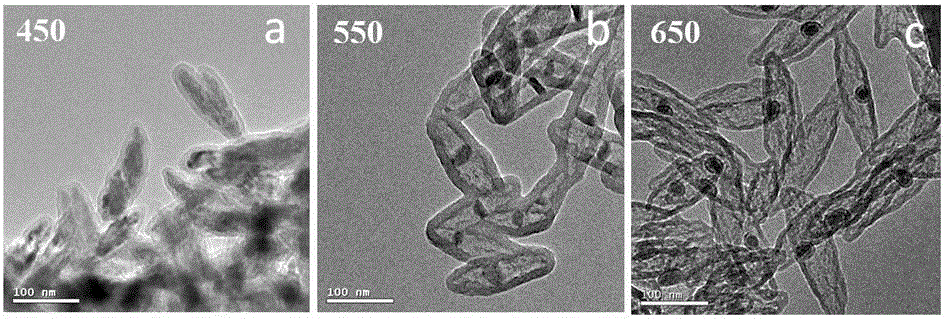
[0027] (1) Preparation of Fe 2 o 3 @RF Core-shell Nanoparticles: First, prepare NaH 2 PO 4 and FeCl 3 Mixed solutions with concentrations of 0.00045 mol / L and 0.02 mol / L were stirred and reacted at 95°C for 1 h, then left to react for 48 h under hydrothermal conditions at 105°C, and the products were separated to obtain fusiform Fe 2 o 3 nanoparticles; then, Fe 2 o 3 14.4 mg of nanoparticles were dispersed in a mixture of 2 mL of deionized water, 2 mL of absolute ethanol and 10 μL of concentrated ammonia water. After ultrasonic dispersion at room temperature, 10 mg of resorcinol and 14 μL of formaldehyde solution (37 wt %) were added successively. After ultrasonic reaction at room temperature for 30 min, the mixture was left to react for 24 h under hydrothermal conditions at 100 °C, and centrifuged (centrifugation speed wa...

Embodiment 4-5

[0035] (1) Change resorcinol to phenol and phloroglucinol, and the remaining steps are the same as step (1) in Example 1.

[0036] (2) Same as step (2) of Example 1.

Embodiment 6-9

[0038] (1) Change the amount of formaldehyde to 28 μL, 42 μL, 56 μL, and 70 μL, and the rest of the steps are the same as step (1) in Example 1.

[0039] (2) Same as step (2) of Example 1.

the structure of the environmentally friendly knitted fabric provided by the present invention; figure 2 Flow chart of the yarn wrapping machine for environmentally friendly knitted fabrics and storage devices; image 3 Is the parameter map of the yarn covering machine
Login to View More

PUM

PropertyMeasurementUnit
sizeaaaaaaaaaa
thicknessaaaaaaaaaa
Login to View More

Abstract

The invention belongs to the field of inorganic nano composite materials and electrochemical techniques and particularly discloses a preparation method of a heterogenous nano composite material for the electrodes of a lithium-ion battery. The material is in a core-shell structure and in a fusiform shape and takes C as the shell and Fe2O3 as the core, wherein the Fe2O3 core is wrapped in a Fe3C layer. A Fe2O3@RF nano material in a core-shell structure is synthesized at first, and then a Fe3C-Fe3O4 / C heterogenous nano material is obtained by adopting the one-step carbonization process. The material disclosed by the invention has high rate capability and long service life and hereby can be used for the electrodes of the lithium-ion battery. The preparation method of the material is easy to operate and is high in efficiency, the synthesizing raw materials are readily available, environment-friendly and low in cost, and the material prepared by adopting the preparation method has excellent electrochemical performance. The results show that the composite material can be widely used for the electrodes of the lithium-ion battery.

Description

technical field [0001] The invention belongs to the technical field of inorganic nanocomposite materials and electrochemistry, and specifically discloses a nanocomposite heterostructure electrode material for lithium ion batteries and a preparation method thereof. Background technique [0002] Nanoscale transition metal oxides such as iron oxide, cobalt oxide, molybdenum oxide, etc., due to their high theoretical specific capacity (~ 1000 mAh g -1 ), non-toxic, and low cost, it has been studied as an advanced lithium-ion battery anode material in the past ten years, and it is expected to bring this efficient battery technology to practical applications [Whittingham, M. S., Chem. Rev. 2004, 104, 4271−4301]. However, these promising anode materials suffer from poor rate performance due to inherently low electrical conductivity. In particular, the large volume change of the active material caused by the intercalation and deintercalation of lithium ions leads to a rapid declin...

Claims

the structure of the environmentally friendly knitted fabric provided by the present invention; figure 2 Flow chart of the yarn wrapping machine for environmentally friendly knitted fabrics and storage devices; image 3 Is the parameter map of the yarn covering machine
Login to View More

Application Information

Patent Timeline
no application Login to View More
Patent Type & Authority Patents(China)
IPC IPC(8): H01M4/36H01M4/139B82Y30/00B82Y40/00
CPCB82Y30/00B82Y40/00H01M4/139H01M4/362Y02E60/10
Inventor 张佳楠王凯熙许群郭少军
Owner ZHENGZHOU UNIV