
Polymer mobility control agent suitable for ultrahigh-salinity oil deposit and preparation method thereof
A high salinity and compound technology, applied in drilling compositions, chemical instruments and methods, etc., can solve the problems of high temperature resistance, high salinity resistance and shear resistance that cannot meet the requirements of tertiary oil recovery, etc. Controllable molecular weight, strong association, excellent temperature and salt resistance
- Summary
- Abstract
- Description
- Claims
- Application Information
AI Technical Summary
Problems solved by technology
Method used
Image

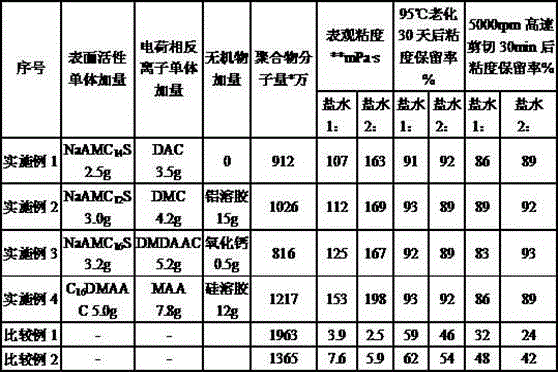
Examples
Embodiment 1
[0044] First add 2500g of deionized water to the reaction kettle, add 430g of acrylamide (AM), 150g of 2-acrylamido-2-methylpropanesulfonic acid (AMPS), 2.5g of sodium 2-acrylamidotetradecylsulfonate (NaAMC 14 S), 3.5g of acryloyloxyethyltrimethylammonium chloride (DAC), neutralized to neutral with NaOH, then added 0.04g of disodium edetate, 7g of urea, 0.07g of isopropanol, and stirred until completely dissolved. Adjust the pH value to 8.9 with NaOH, and start to feed high-purity nitrogen gas. After 30 minutes, the temperature in the kettle was lowered to 15°C, and then 10 g of 0.2% sodium bisulfite aqueous solution, 0.5% methacrylic acid N,N-di 10g of methylaminoethyl ester (DMAEMA) aqueous solution, 10g of 0.5% azobisisobutylamidine hydrochloride, 10g of 0.3% potassium persulfate aqueous solution, continue to pass nitrogen gas for 30min and then seal. After 1 hour, the reaction temperature was gradually raised to 48°C. After 3.5 hours of reaction, a gel-like polymer produ...
Embodiment 2
[0050] First add 2600g of deionized water to the reaction kettle, add 480g of acrylamide (AM), 130g of 2-acrylamido-2-methylpropanesulfonic acid (AMPS), 3.0g of 2-acrylamido sodium dodecylsulfonate (NaAMC 12 S) and 4.2g of methacryloxyethyltrimethylammonium chloride (DMC), neutralized to neutral with NaOH, then added 0.045g of disodium edetate, 7.0g of urea, 0.06 of isopropanol g. Aluminum sol 15g, stirred until completely dissolved. Adjust the pH value to 9.0 with NaOH, and start feeding high-purity nitrogen gas. After 30 minutes, the temperature in the kettle was lowered to 16°C, and then 10.2 g of 0.2% aqueous sodium bisulfite solution, 0.5% acrylic acid N,N-dimethyl Aminoethyl ester (DA) aqueous solution 11g, 0.5% azobisisobutylamidine hydrochloride 11.9g, 0.3% potassium persulfate aqueous solution 11.2g, continue to pass nitrogen gas for 30min and then seal. After 1 hour, the reaction temperature was gradually raised to 52°C. After 3 hours of reaction, a gel-like polymer ...
Embodiment 3
[0053] First add 2700g of deionized water to the reaction kettle, add 500g of acrylamide (AM), 150g of 2-acrylamido-2-methylpropanesulfonic acid (AMPS), 130g of acrylic acid, 3.2g of 2-acrylamido hexadecyl Sodium sulfonate (NaAMC 16 S) and 5.2g dimethyl diallyl ammonium chloride (DMDAAC), neutralized to neutral with NaOH, then added 0.05g disodium edetate, 8.0g urea, 0.07g isopropanol, oxidized Calcium 0.5g, stirred until completely dissolved. Use NaOH to adjust the pH value to 9.5, and start to feed high-purity nitrogen gas. After 30 minutes, lower the temperature in the kettle to 20°C, and then add 10.2 g of 0.2% aqueous sodium bisulfite solution, 0.5% acrylic acid N,N-dimethyl Aminoethyl ester (DA) aqueous solution 12.1g, 0.5% 2,2'-azo[2-(2-imidazolin-2-yl)propane] dihydrochloride 12g, 0.3% potassium persulfate aqueous solution 11g, Continue to pass nitrogen gas for 30 minutes before sealing. After 1 hour, the reaction temperature was gradually raised to 55°C. After ...
PUM
 Login to View More
 Abstract
Description
Claims
Application Information
 Login to View More