
A novel peptide with active tumor targeting and pH-sensitive cell membrane penetration
A sensitive and new technology, applied in anti-tumor drugs, peptides, hybrid peptides, etc., can solve problems such as side effects
- Summary
- Abstract
- Description
- Claims
- Application Information
AI Technical Summary
Problems solved by technology
Method used
Image

Examples
Embodiment 1
[0019] Preparation and Characterization of TR Peptide Modified Liposomes (TR-Lip)
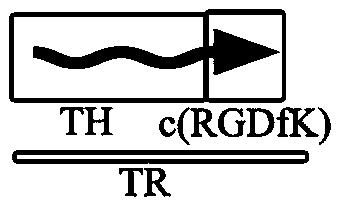
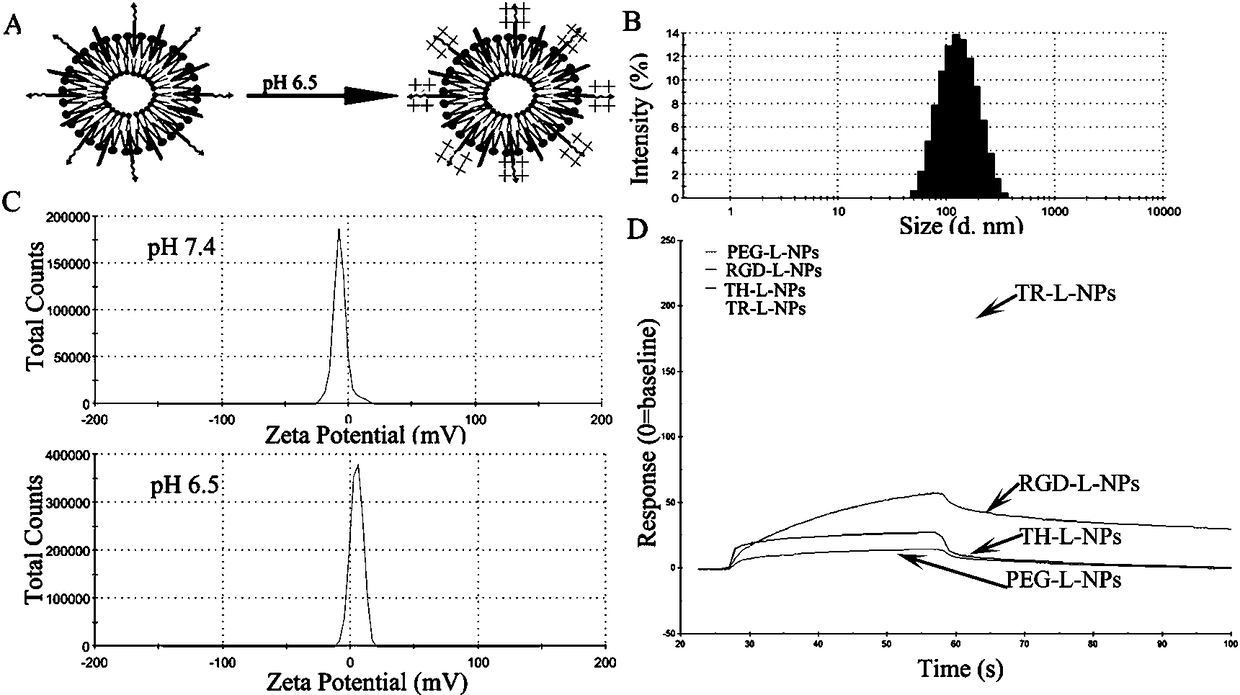
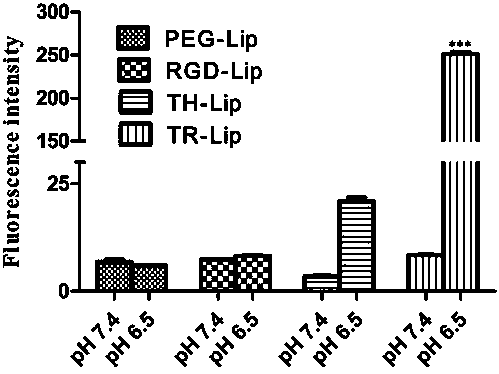
[0020] Liposomes were prepared by thin film dispersion method. Weigh 1.2 mg soybean lecithin, 0.4 mg cholesterol, 0.05 mg monomethoxy-modified polyethylene glycol and 1 mg TR peptide-modified polyethylene glycol, dissolve them all in chloroform / methanol mixture, rotate and evaporate , form a thin film layer, and place it in a vacuum desiccator overnight, so that the organic solvent is fully evaporated. Add 1ml of Hepes buffer solution (pH 7.4), shake on a shaker (180 rpm×30 min, 37°C), and ultrasonicate (5 times×5 s×15 s) to obtain TR with uniform particle size. -Lip. Take 100 μl of TR-Lip and dilute it 10 times, and measure its particle size distribution and charge distribution with a Zetanano particle size analyzer. The particle size of TR-Lip is around 150 nm. At pH 7.4, the Zeta potential of TR-Lip was around -7 mV; at pH 6.5, the Zeta potential of TR-Lip was around +5 mV. Surface plas...
Embodiment 2
[0022] Preparation and characterization of TR peptide-modified nanoparticles (TR-NPs)
[0023] TR peptide-modified nanoparticles were prepared by W / O / W emulsification-solvent evaporation method. Dissolve a certain amount of PLA-PLL-TR in dichloromethane to form an organic phase, use pure water as the water phase, mix the organic phase and the water phase in a certain proportion, and ultrasonically form colostrum. Pour the colostrum into the external water phase containing the poloxamer F-18 emulsifier, continue to sonicate to obtain the double emulsion, put it in a beaker, stir and evaporate the organic solvent to obtain a nanoparticle colloidal dispersion system. Zetanano particle size analyzer was used to measure its particle size distribution and charge distribution; SPR instrument was used to measure its binding force with integrin. The particle size of TR-NPs is about 90 nm. At pH 7.4, the Zeta potential of TR-NPs was about -7.5 mV; at pH 6.5, the Zeta potential of TR-N...
Embodiment 3
[0025] Preparation and characterization of TR peptide-modified micelles (TR-micelle)
[0026]Take 10 mg DSPE-PEG-TR and 20 mg DSPE-PEG-OMe respectively and dissolve them in anhydrous chloroform, rotary evaporate to form a film, dry under reduced pressure overnight, add 5 ml of 20 mM Hepes buffer (pH 7.4), shake in a water bath at 37 °C After 20 min, filter with a 0.22 μm microporous membrane to obtain TR peptide-modified polymer micelles (TR-micelle). Zetanano particle size analyzer was used to measure its particle size distribution and charge distribution; SPR instrument was used to measure its binding force with integrin. The particle size of TR-micelle is about 112 nm. At pH 7.4, the Zeta potential of TR-micelle was about -8 mV; at pH 6.5, the Zeta potential of TR-micelle was about +4 mV. Surface plasmon resonance (SPR) was used to measure the binding ability of micelles modified by different polypeptides to integrin, and the binding ability of TR-micelle to integrin was ...
PUM
| Property | Measurement | Unit |
|---|---|---|
| particle diameter | aaaaa | aaaaa |
| particle diameter | aaaaa | aaaaa |
| particle diameter | aaaaa | aaaaa |
Abstract
Description
Claims
Application Information
 Login to View More