
Lithium manganese nickel oxide cathode material having nickel manganese concentration gradient and preparation method thereof
A lithium-nickel-manganese oxide and cathode material technology, which is applied in battery electrodes, electrochemical generators, electrical components, etc., can solve restriction screening and optimization, comprehensive chemical performance limitations of high-voltage lithium-nickel-manganese oxide cathode materials, interface Impedance increase and other problems can be eliminated to eliminate volume change mismatch, reduce lithium ion migration resistance, and improve chemical stability.
- Summary
- Abstract
- Description
- Claims
- Application Information
AI Technical Summary
Problems solved by technology
Method used
Image

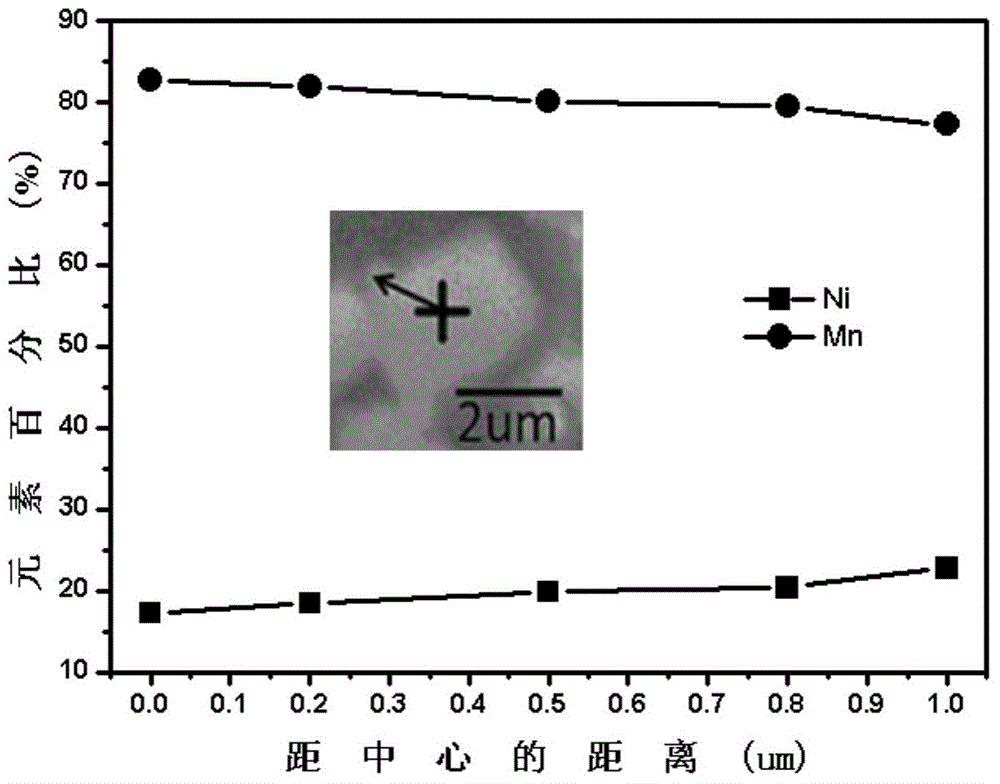
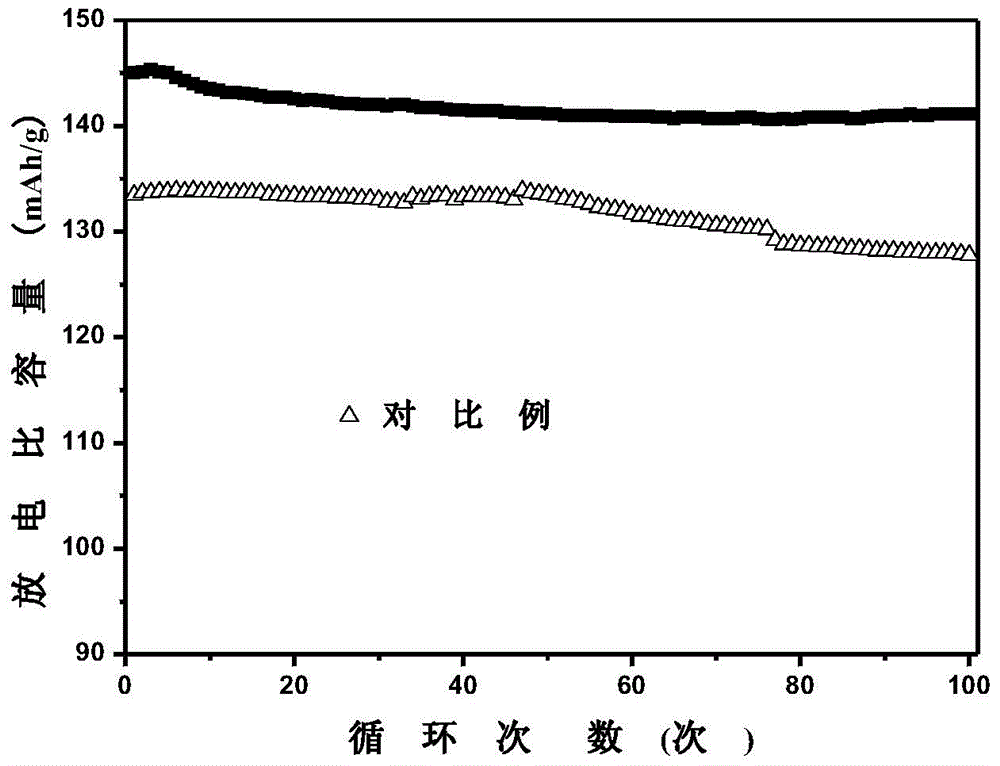
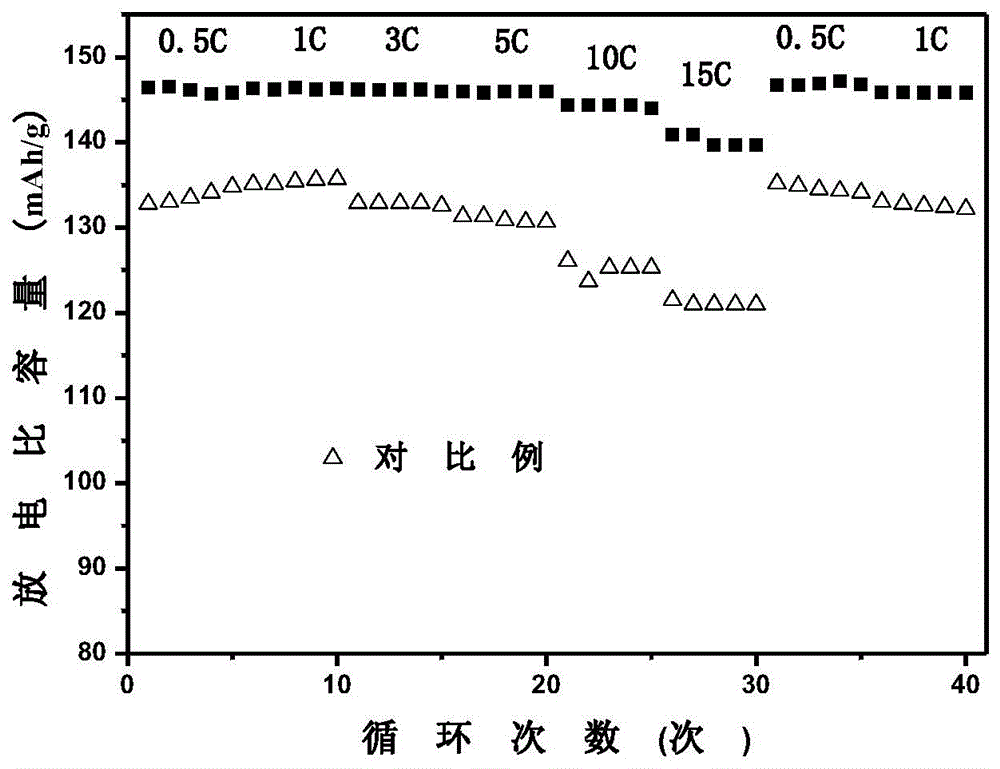
Examples
Embodiment 1
[0039] MnSO 4 ·H 2 O and NiSO 4 ·6H 2 O is dissolved in pure water according to the molar ratio of 1.65:0.35, and the total concentration is 1.33mol / L mixed solution I, the MnSO 4 ·H 2 O and NiSO 4 ·6H 2 O is dissolved in pure water at a molar ratio of 3:1 to form a mixed solution II with a total concentration of 0.67mol / L; NaOH and NH 3 ·H 2 O was dissolved in pure water respectively to form a mixed solution of sodium hydroxide-ammonia water, in which NaOH and NH 3 ·H 2 The concentration of O in the mixed solution is 2mol / L and 0.24mol / L respectively;
[0040] Take solution Ⅰ, solution Ⅱ and sodium hydroxide-ammonia water mixed solution with a volume ratio of 1:1:2, respectively. Pump the mixed solution of sodium hydroxide-ammonia water into the reactor at a constant speed of 0.7ml / min. The temperature of the reactor is 60°C and the stirring speed is 1000r / min. Pump solution I into the kettle, and control the pH value of the solution in the reaction kettle by adjus...
Embodiment 2
[0050] MnSO 4 ·H 2 O and NiSO 4 ·6H 2 O is dissolved in deionized water according to the molar ratio of 1.8:0.2, and the total concentration is 1.5mol / L mixed solution I, and the MnSO 4 ·H 2 O and NiSO 4 ·6H 2 O was dissolved in deionized water at a molar ratio of 3:1 to form a mixed solution II with a total concentration of 0.7mol / L; NaOH and NH 3 ·H 2 O was dissolved in deionized water respectively to form a mixed solution of sodium hydroxide-ammonia water, in which NaOH and NH 3 ·H 2 The concentration of O in the mixed solution is 2mol / L and 0.24mol / L respectively;
[0051] Take solution Ⅰ, solution Ⅱ and sodium hydroxide-ammonia water mixed solution with a volume ratio of 1:1:2, respectively. Pump the mixed solution of sodium hydroxide-ammonia water into the reactor at a constant speed of 9.5ml / min. The temperature of the reactor is 60°C and the stirring speed is 1000r / min. Pump solution Ⅰ into the kettle, and control the pH value of the solution in the reaction...
Embodiment 3
[0056] MnSO 4 ·H 2 O was dissolved in deionized water to prepare a solution I with a concentration of 1.4mol / L, and the MnSO 4 ·H 2 O and NiSO 4 ·6H 2 O was dissolved in deionized water at a molar ratio of 3:1 to form a mixed solution II with a total concentration of 0.6mol / L; NaOH and NH 3 ·H 2 O was dissolved in deionized water respectively to form a mixed solution of sodium hydroxide-ammonia water, in which NaOH and NH 3 ·H 2 The concentration of O in the mixed solution is 2mol / L and 0.24mol / L respectively;
[0057] Take solution Ⅰ, solution Ⅱ and sodium hydroxide-ammonia water mixed solution with a volume ratio of 1:1:2, respectively. Pump the mixed solution of sodium hydroxide-ammonia water into the reactor at a constant speed of 2ml / min. The temperature of the reactor is 60°C and the stirring speed is 1000r / min. Pump solution Ⅰ in the middle, and control the pH value of the solution in the reaction kettle by adjusting the pumping speed of solution Ⅰ to keep it a...
PUM
| Property | Measurement | Unit |
|---|---|---|
| The average particle size | aaaaa | aaaaa |
| Diameter | aaaaa | aaaaa |
| Thickness | aaaaa | aaaaa |
Abstract
Description
Claims
Application Information
 Login to View More