Preparation method of three-dimensional pd-ni nanowire array catalyst for electroreduction of hydrogen peroxide

A technology of nanowire array and hydrogen peroxide, which is applied in the direction of circuits, electrical components, battery electrodes, etc., can solve the problems of slow cathode reaction kinetics, etc., and achieve the effect of solving poor cathode activity, reducing usage and improving utilization rate

CN106549168BActive Publication Date: 2018-12-11HARBIN ENG UNIV
6 Cites 0 Cited by

Patent Information

Authority / Receiving Office
CN · China
Patent Type
Patents(China)
Current Assignee / Owner
Publication Date
2018-12-11

Smart Images

  • Figure 1
    Figure 1
  • Figure 2
    Figure 2
  • Figure 3
    Figure 3
Patent Text Reader

Abstract

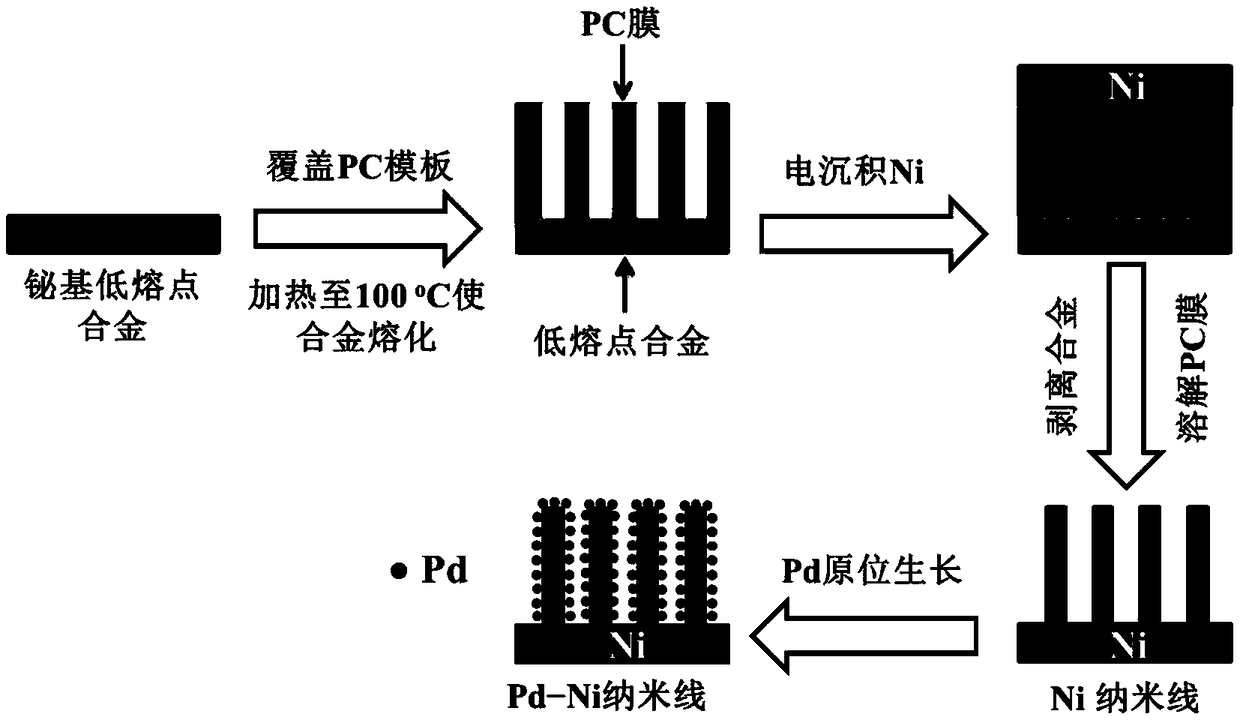
The invention provides a preparation method for a three-dimensional Pd-Ni nanowire array catalyst for catalyzing electro-reduction of hydrogen peroxide. The method comprises the following steps of brushing liquid low-melting-point bismuth-base alloy on the surface of a track-etching polycarbonate membrane template; carrying out electrochemical deposition in an electrolyte for four hours with a composite electrode as a working electrode, an electrolytic nickel sheet as an auxiliary electrode and a saturated Ag / AgCl electrode as a reference electrode; after the electrochemical deposition process ends, utilizing dichloromethane to dissolve the template and washing through ethyl alcohol to obtain a three-dimensional Ni nanowire array electrode; and utilizing a chemical in-situ growth method to replace the obtained Ni nanowire array electrode in PdCl2 solution to obtain a three-dimensional Pd-Ni nanowire array electrode. According to the preparation method, the manufacturing cost of the catalyst is greatly reduced. A binder and a conductive agent are not needed, so that the utilization rate of the catalyst is improved while the catalyst has high catalytic activity, and a problem of poor cathode activity of a hydrogen peroxide based fuel cell is solved.
Need to check novelty before this filing date? Find Prior Art

Description

technical field

[0001] The invention relates to a method for preparing a three-dimensional catalyst for electroreduction of hydrogen peroxide through a template-in-situ growth method. Background technique

[0002] A fuel cell is a device that directly converts the chemical energy of fuel (such as hydrogen) and oxidant (such as oxygen, hydrogen peroxide) into electrical energy. Because the energy conversion is not limited by the Carnot cycle and the additional products are clean, the fuel cell has the characteristics of high energy conversion efficiency and environmental friendliness. In recent years, it has received widespread attention from governments and research institutions of various countries, and has shown broad application prospects in aerospace, navigation, electronics and other fields.

[0003] Oxygen is currently the most common oxidant in commercialized fuel cells, but it cannot work properly in some special fields (such as aerospace and underwater submersibles...

Examples

Embodiment Construction

[0022] In order to better illustrate the effect of the process of the present invention, specific examples are used below to illustrate.

[0023] (1) In a constant temperature oven at 100°C, brush the liquid low-melting bismuth-based alloy (melting point: 65°C) on the surface of the track-etched polycarbonate film (PC template), and after the alloy is cooled, it is mixed with The PC template constitutes a composite electrode (PC film-alloy electrode).

[0024] (2) Take 80mL of electrolyte solution in a 100mL beaker, use the composite electrode (PC film-alloy electrode) as the working electrode, and electrolyze the nickel sheet (4.0×4.0cm 2 ) is the auxiliary electrode, and the saturated Ag / AgCl electrode is the reference electrode, forming a three-electrode system for electrochemical deposition. The electrodeposition process is carried out in a constant temperature water bath at 55 °C and a stirring speed of 150 rpm. After applying a constant cathodic current (-196mA), Nickel...